Tampilkan postingan dengan label parkinson's. Tampilkan semua postingan

Senin, 26 Januari 2015

SnapType For Occupational Therapy Has More Updates And Features Now

picture of a child writing on paper with a pencil


This post has been written by Amberlynn Gifford - creator of the ever popular app "SnapType for Occupational Therapy".

When I created SnapType last year, I knew it would help children struggling with handwriting. However, I could never have imagined the outcry of support I received from therapists and parents. Each week I read several emails from users with stories of how SnapType has changed their lives.

"Thank you for this app! You are a blessing! I can honestly tell you that I have spent many hours crying and hurting inside while watching my son struggle to write pages of sentences and spelling words and other homework assignments. He screams out with frustration. It's been so bad that I have stopped him and honestly wrote for him, left handed to make it look more like a neater version of his because I could not take it anymore! Now, with SnapType, he completes his worksheets, show off his intelligence and feels more confident than ever. Thank you from the bottom of my heart!"

That was an email I received from a mother who felt like she was losing her son. I tear up while reading emails like this from parents and it brings me so much joy to know that these children are succeeding with the help of SnapType.

I have learned along the way that SnapType helps not only children with dysgraphia but also individuals with several other learning disabilities, low vision, low muscle tone, and Parkinson's. It is so exciting to learn that a variety of individuals can benefit from SnapType.

When I first had the idea for SnapType, I wanted to test out the idea as quickly and inexpensively as possible. So I paid a developer in India $300 to build the first version of the app. It was so basic, but it was the perfect way to quickly find out if anyone would find value in my idea. With tens of thousands of downloads, and over a hundred emails from users, it was clear that people were finding value in the app.

screenshot of app snaptype occupational therapyEvery week emails came in from users who were so happy to have found SnapType. But they were also asking for more functionality. They wanted to print and email from within the app, save documents to work on later, import documents from the image gallery and much more. The initial SnapType app lacked all of these features yet people still used the app because there was nothing else like it on the market that could help their kids and students.

I wanted to give the users what they were asking for. But being a full time occupational therapy graduate student, I couldn't afford to pay thousands of dollars to get the app made. I asked the developer in India if he would be interested in partnering with me to create a new app but without the cash, he wasn't interested. So then I reached out to a community of app developers and received interest from a few. Shortly thereafter, I started working with a developer and it was going great. Then the emails stopped. He fell off the face of the earth it seemed and I was back where I started.

Feeling defeated at the end of September, I reached out to another developer who previously expressed interest and he jumped on board right away. Instantly, we were going back and forth, exchanging ideas and building the app's fundamental layout and features. The communication was prompt and continuous as we crafted the upgrade. I say upgrade, but it's really an all new app, built from the ground up.

The developer, Brendan Kircher, has been instrumental in making SnapType a success. There were
times when I felt overwhelmed because we were moving so quickly and there were so many questions he needed me to answer. I was juggling being a full time grad student, working a part time job 25 hours a week and also spending several hours a day on SnapType. Nevertheless, I appreciated Brendan's speed and pushing because it has helped create a wonderfully powerful and intuitive tool. Without his speed, knowledge, enthusiasm and commitment this would not have been possible.

By Thanksgiving we were ready to share the app and we enlisted the help of two dozen users who were equally passionate about this project. We spent the month of December working with our team of testers to debug and refine the feature set. By early January we submitted the app to Apple and crossed our fingers that they would approve it. Two weeks later we received confirmation that it was in the app store and ready for the world!

As I write this article, SnapType version 2.0 has been public for just a few days. But already the comments are pouring in. Parents, occupational therapists, teachers and students are loving the new features!

SnapType is available for free on the App Store. We wanted to keep it free in order to help as many people as possible. Interestingly, many users asked us to charge for the app. That took me off guard, but they wanted to make sure that we receive some revenue to ensure that we continue to keep the app updated. After lengthy discussions with mentors, users and each other, we decided to keep the app free, but also offer an in-app purchase to provide advanced features for the power users. SnapType Pro enables users to work on multiple documents and also access the a whiteboard feature which turns documents into simplified black and white images, to save ink when printing. SnapType Pro is $4.99, but for a limited time, we're offering it for $2.99.

Another frequent request we receive is for an Android version. I'm happy to say that we've just started working on SnapType for Android (which by the way, requires writing the app all over again in a different programming language with it's own set of challenges). To learn more about the Android version and to stay connected for other SnapType updates, follow SnapType on Facebook or Twitter.


Amberlynn Gifford is a 2nd year OT student at Springfield College in Massachusetts. When she's not studying, which is rare, you can find her coaching gymnastics and working on all sorts of creative projects. She will graduate with her masters degree in 2016 and looks forward to working in pediatrics. Connect with Amberlynn at https://www.linkedin.com/in/amberlynngifford. 


Image source: Carissa Rogers

Minggu, 10 Agustus 2014

Talkitt - App/ Software That Lets People With Speech Impairment Communicate In Any Language Using Their Voice

image showing talkitt for different devices - computer, tablet, smartphone, wearable devices like google glass and smart watch.


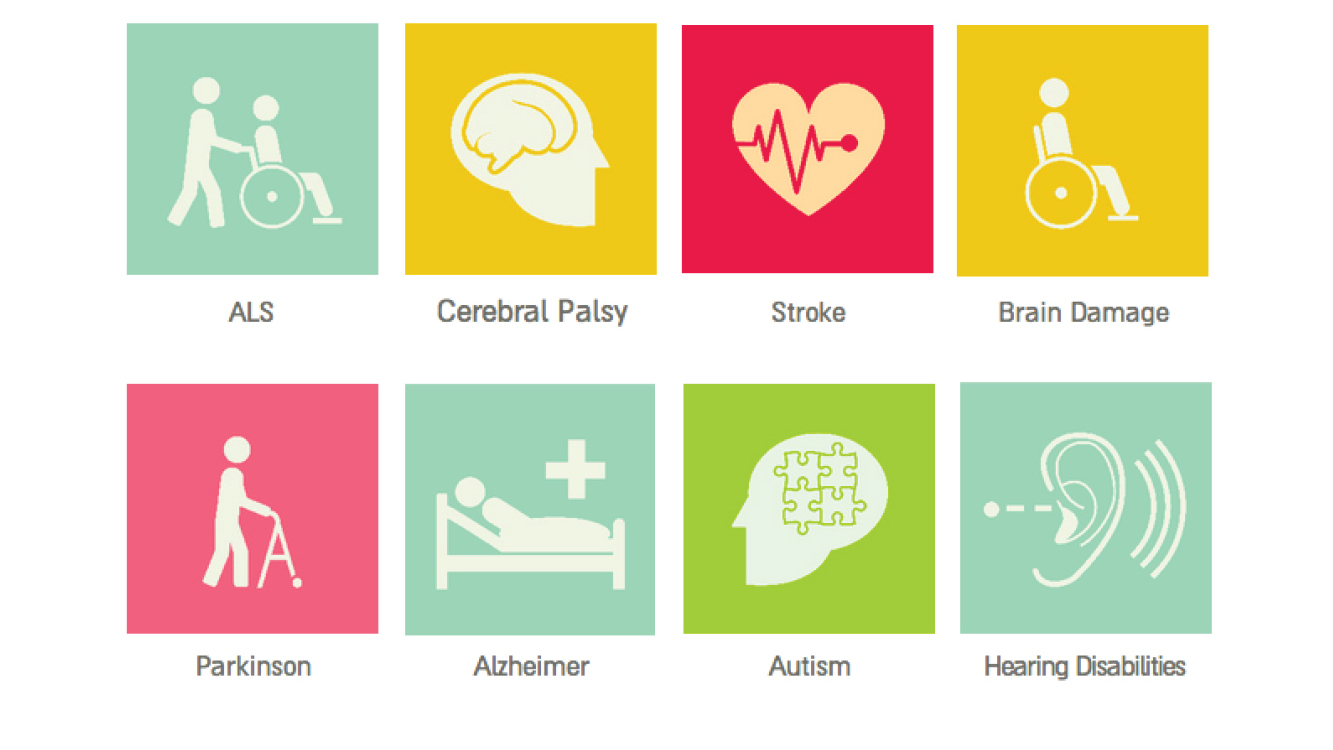
image showing various medical conditions that can cause speech impairment - ALS, cerebral palsy, stroke, brain damagem parkinson, alzheimer, autism, hearing disabilitiesIn many cases, disabled users with speech disorders find it extremely difficult to communicate, primarily because people around them have difficulty understanding their speech. Speech disabilities can be caused by a variety of conditions including Cerebral Palsy, Autism, Brain Damage, Parkinson's and many more. It is a struggle not just for those who have speech disorders but also for their caregivers and loved ones. In the recent past, various companies have come up with text to speech apps and software that let users either type or choose words that are spoken by the app, and thus help the users communicate. However, the one aspect that these apps sideline is the fact that the users are very much capable of speech and would ideally like to use their natural mode of communication.


a lady with speech impairment ordering coffee at a coffee shop using talkitt on a tablet.
Talkitt, a new "speech to speech" app in the works, plans to give disabled users more freedom and expression in the most natural way possible - it helps them communicate by just using their voice. Talkitt has the ability to recognize the user's vocal patterns and translate them into words that are more understandable. As you will see in the video below, it does a very good job of translating unintelligible pronunciation into perfect sentences with utmost accuracy. This also means that Talkitt works very well with any spectrum of speech severity - from mild to extreme.The best part about this app is that it is not just limited to English - it can translate any language the user is speaking! 

The accuracy of this app will let users gain more confidence, and encourage them more to use their speech to communicate, not to mention that it will make communicating easier and convenient for their family, friends, and caregivers as well.


Very soon, Talkitt will be available on all smartphones and tablets. The next phase will see it run on computers and wearable devices, giving much more flexibility to users wherever they are. Once Talkitt is available, there will be a monthly subscription charge of $19.99 per month.

Currently, it is being tested by various partners and hospitals in Israel and Europe, and there is also a Indiegogo funding campaign going through which the team behind Talkitt is raising money to get it out to the masses quick (as soon as Q1 of 2015). Visit the Indiegogo page if you want to contribute to this campaign.

Definitely watch the video below to see the inspiration behind this app and what the team is doing to make this app a reality.

Minggu, 27 April 2014

Google Glass: For People With Parkinson's Disease?

Woman wearing google glass

Wearable technology has gained a lot of momentum in the last year or so. The most popular, or should we say notorious, wearable tech that has come out is Google Glass, which has received both praise and backlash from different groups because of all the things that it can do. Taking pictures, making videos, sending emails, finding directions, setting reminders - everything can be done with just a few voice commands or gestures. While society debates whether or not Google Glass should be allowed to be worn everywhere, there is a group of researchers that is busy making Google Glass extremely useful for people with a certain disease - Parkinson's.

Since Parkinson's causes shaking/tremors,  sudden stiffness of limbs , posture instability, "freezing" besides mood swings and cognitive changes, scientists at Newcastle University are exploring various ways to see how Google Glass can be used to help people with Parkinson's, thus providing workarounds to live a life that's not constantly hampered by symptoms that ultimately bring down confidence levels in the person dealing with them.

One area that's being looked at is setting reminders. Since patients are required to take medication everyday and on time, Google Glass can easily send regular reminders to the patient reminding that they should take their medication. Reminders would not only tell them when to take their medication but how/ with what (water; food - different combinations at different times of day).  Similar discrete reminders can be sent to the patient to remind them to swallow their drool - a common problem with people with Parkinson's disease because of lack of motor control. 

Another common symptom is freezing, where the patient just gets stuck and is unable to walk. In such cases, the patient would want to call someone who could come get them, but calling on a phone with a touch screen can become a big hassle for someone with not so good motor skills. Google Glass can be helpful in such situations because someone can be easily called by just using voice commands. Since it is always connected to the Internet, friends and carers will be easily able to see where the patient is, and would come and get them.

Google glass also has maps and directions. If someone is out and about, chances of them getting lost are minimal because Glass displays turn by turn directions too, thus providing relief to not just the patient but also family and friends.

This video shows the researchers tell us in detail about their research:


The research is still at its very early stages, but what the volunteers with Parkinson's, who helped test Google Glass, say is remarkable. They are happy with what they experienced, and they thought that Glass really helped them control symptoms and live a normal life. Hit the source link to read their testimonial. 

Let's hope we get to hear more about this research in the future!

Source: Newcastle University via Gizmodo
Image source: Ubergizmo

Senin, 24 Maret 2014

VocaliD: Donating Your Voice To People With Speech Impairment

An image showing voice synthesis

We never give too much attention to our voice - it is one of the things we take for granted. However, there are millions of people around the world who were either born with a speech impairment or lost their voice because of a stroke, or some serious disease like Parkinson's or Cerebral Palsy. Learning new ways to communicate either using sign language or any other accessible device with limited/generic synthetic voices may not be a weapon of choice for many, especially the ones who lose their perfect voice later in their lives because of a disease.

That is where VocaliD comes into the picture. VocaliD is a company that is trying to bridge all sorts of gaps and helping people with speech impairments communicate using natural voices. 

But what does that exactly mean?

VocaliD consists of a team led by Dr. Patel who listens to the limited sounds of patients with speech impairments. These sounds help the team understand what this person's voice may sound like if it were high pitched, raspy, etc. Once they have the patient's sounds, they look for a surrogate - a person of the same age and sex who has no speech impairment. This surrogate is made to record thousands of sample sentences (from books like White Fang, The Wonderful Wizard of Oz, and The Velveteen Rabbit). The two voices of the patient and surrogate are then blended and broken down into tiny units of sound that can then be used to construct words! The hybrid of the two voices makes the final voice very natural and personalized,  and not so synthetic.

(To read more technical details on how this is done, go here.)

This is a big improvement in communication because the listener gets more information from how a person speaks than just the content of what they say. 

Currently, the process requires that the surrogate come to a studio to record their voice but VocaliD plans to release a phone or web app so that anyone could record their voice from locations most convenient to them (their home, for example). This makes more sense because recording thousands of sentences takes many hours, and surrogates who volunteer to donate their voices would ideally like to do it in 15 - 20 minute sessions over a period of days. The team is also planning on creating a game to encourage children to record their voices.

VocaliD is looking for volunteers from around the world to donate their voices, and if you are interested, head to their website to sign up.

If you are interested in receiving a personalized voice, you can sign up for that here.

Website: vocalid.org

Source: NewScientist 

Minggu, 05 Agustus 2012

Low Cost Eye Tracker To Control Computer

Researchers at Imperial College London have invented a device made from off the shelf video game equipment that tracks eye movement, thus allowing users (especially stroke victims; people with bad motor skills, Multiple Sclerosis, Parkinson's, muscular dystrophy, spinal cord injuries or amputees) to control a cursor on a screen.

a user wearing the glasses with video cameras for demonstration
Image source: The Inquisitr
The device comprises of two video game cameras that are attached to a pair of glasses. The cameras, facing the eyes, keep track of movement of pupils by constantly taking pictures, and these pictures are used in a calibration process to figure out where exactly the person is looking at the screen.

For demonstration purposes, subjects were asked to play the video game "Pong". The subjects controlled the movement of the paddle with their eyes, which was tracked by this device. It was noted that all six subjects were able to play the game comfortably only within ten minutes of using the device for the first time. In addition to playing the video game, they were also able to browse the web and write emails.

This device transmits data over wi-fi or USB to Windows or Linux computers, and is built from parts that cost no more than $30, thus appropriately being called a "frugal innovation" by its inventors.

Watch this video to see a demo of this device that tracks eye movement precisely, and yet is thousands of times less expensive than commercial devices.


Source: Phys.org
Full free article: IOPScience
Mas Kur. Diberdayakan oleh Blogger.

 
biz.