Tampilkan postingan dengan label impaired mobility. Tampilkan semua postingan

Minggu, 01 Februari 2015

Reemo: Wearable That Can Automate The Entire House

photo of playtabase's cofounder al baker
Al Baker from Playtabase
In recent years, we have seen a ton of wearables that do a lot of things - track physical activities/calories burned, display email/text/phone notifications, monitor how well one sleeps at night, steps walked, workouts done, and several other activities. Typically, these wearables are worn on the hand and they don't necessarily interact with other objects in the environment - with current wearables, you cannot open or close doors, turn on or off the lights. They just interact with you (the wearer) and your phone in most cases (phone call, text, email, social media notifications).

Playtabase, a company in Minneapolis, MN co-founded by Al Baker, is working hard to take wearables to the next level - a level that will make interaction with every object in the house or office a breeze. This will be especially incredible for people with disabilities.

Reemo - What is it?

Reemo, just like several other wearables, is worn on the wrist. However, the purpose is to not just track your physical activities. Reemo works in combination with a wireless receiver and smart plug. A device or object like a coffeemaker, stereo, lock, light, door, window blinds or almost anything around the house can be connected to the receiver and operated by Reemo by simply gesturing towards it. For example, you don't have to walk up to the switch to turn it on or off or to adjust the thermostat. No need to walk up to the door to keep opening and closing it as more and more guests come in. Lights, security systems, entertainment systems, fireplace int the house - you name it, Reemo can operate it. All one has to do is wear Reemo and use one of the six gestures that can be assigned to Reemo, and Reemo performs the desired operation for them.

Reemo & Assistive Technology

Picture this - a person is in a wheelchair. They may be an amputee, have mobility issues, have had a
stroke recently and were paralyzed. Moving around in the house and operating different devices may be a struggle or in some cases not really possible. For such a person, just being in their bed or wheelchair and to be able to adjust their thermostat, start the fireplace, turn on the security system, and turn blinds up and down by just pointing and gesturing will bring great convenience. Similarly, a blind person gesturing towards their coffee machine to get a freshly brewed cup of coffee or turning on their music system without approaching it and looking for buttons will be tremendously convenient as well.

Al sees Reemo in the assistive technology/care realm as a complimentary device. Currently, there are around 10 - 11 million homes that are "smart" as compared to a total of 135 million homes in the US. He also says that homeowners and caregivers at various facilities have started looking at smart technology but they want solutions that are better than what a phone app offers to really control everything. That's where Reemo fits in nicely.

There are currently 110 developers that are developing applications for Reemo whether as an assistive technology device or something really cool because after all, Reemo is not just a technology for people with disabilities - it's a technology for anyone, including lazy people!

Listen to Al talking about Reemo and assistive technology below:


Reemo Demo

Al was kind enough to give me a demo of how Reemo works. The scenario in this video is that of a person who is going to bed and wants to turn off the light(s) and turn on the lock on the door (both at the same time). This demonstrates that with one gesture, multiple objects/devices can be operated. Al also shows how, with a different gesture, just one of the multiple objects in the setup can be operated as well.


Note: I will add captions to the video soon!

Now that you have seen the demo, watch the following video too to get an idea of what all you can use Reemo for:


Reemo For life from John Valiton on Vimeo.

Inspiration Behind Reemo

Reemo came into existence for two reasons - one, to do cool things, and two, because Playtabase's cofounder Muhammad's father suffered two strokes that left half of his body disabled. The idea was to give him a "universal remote" that he wouldn't drop and it would just consist of a wave of a hand. They wouldn't have to pay anyone so much to look after him because not only would it make him more independent but also make him feel emotionally better.  During the same time, the emergence of smart homes and wearables also encouraged Al and Muhammad to create a solution that will work on all smart watches and wouldn't be proprietary. 

Hear Al talk more about the inspiration behind Reemo:


Reemo - The Product

In the next month and a half, Reemo will be shipped to its alpha and beta users. It will be available to consumers sometime during summer of this year. The consumer kit can also be pre-ordered on Reemo's website for $249 (and $299 for a developer kit).

To know more about all the great progress Reemo's making and to get the latest news, sign up on for their mailing list.

Playtabase

Playtabase has been around for two and half years and Reemo for around two. Playtabase has aspirations to create products that are both engaging and fun to use but are also meaningful and have a lot of depth.


Website: www.getreemo.com

Kamis, 04 Desember 2014

Ubi: A Voice Controlled Device That Converts Speech To Actions

photo of ubi on a side table by a couch


There is a device in the market that just might be the ultimate device for anyone with limited mobility and/or vision impairment - a device that just sits around and does pretty much anything you want.

Say  hello to the Ubi!

The Ubi is a hands-free, voice operated device that connects to the wifi and converts commands in natural speech to remarkable actions. It can pick up your voice from up to 8 feet, and can be used to do several things like sending text messages and emails to contacts, listening to music (free music streaming service), looking up information on the internet, controlling your home thermostat, controlling lighting in your house, locking doors, making announcements to family ("come down, kids! Dinner's ready."), setting reminders for yourself, getting important updates and alerts, controlling other internet connected devices...the options are endless! All one has to do is say "OK Ubi.." and say what they desire!

It's an amazing device for someone who may have bad motor skills, limited mobility, or vision impairment - it makes communication extremely easy for them and alleviates their dependence on others.

Be sure to check out their blog too. They post about all the amazing things Ubi can do.

The Ubi is priced at $299 and can be ordered directly from its website.

Watch the following video to see the Ubi in action!


Website: http://www.theubi.com


Rabu, 23 Juli 2014

Google Glass For Prosthetics And Blind Athletes

Google Glass, 3D printing, Prosthetics! We have heard so much about these in the recent past, and we will keep hearing about them since things are progressing so well in each of these avenues! Today, we have two different stories related to Google Glass - one, that will help people get cheaper prosthetics, and two, a blind paralympian using Google Glass to show kids his point of view and boost their confidence.

Prosthetics With Google Glass


Researcher scanning lower leg of test subject with google glass


Traditionally, getting prosthetics requires traveling to a clinic where a huge measuring machine with a robotic arm determines the specifications for the needed leg brace or prosthetics. Of course, this process is not inexpensive since the machine itself costs tense of thousands of dollars, and typically, the clinic would like to pass on costs to clients.

researchers looking at 3d printing information for leg brace on a computer
This will soon hopefully change. A research team at University of Delaware is exploring more affordable and convenient ways to do the exact same thing, but without the additional exorbitant costs of getting prosthetics from a traditional clinic.

The team is using Google Glass to capture all the information of the foot and lower leg in videos. These videos are then stitched together to get a 3D model of the cast and then instantly transformed into a template for a 3D printer. This method will first of all, cut down costs for the patients and second of all, make it convenient to go through this process at home without even going to the clinic to get the measurements taken. The patient can print the leg brace at home if they have a 3D printer or send it to a 3D printing lab or studio.

The team will soon be applying for funding to expand into prosthetic manufacturing as well.

A combination of technology like Google Glass and 3D printing helps bring manufacturing to everyday consumers who are not engineers or manufacturers.

Google Glass And A Blind Paralympian


Disability advocates are always looking for different ways to showcase abilities, and not disabilities of disabled people. Google Glass will be used for just that purpose.

Lex Gilette is a blind paralympian who began to lose his sight when he was seven years old. He has won three silver medals and holds the world record for long jump for F11 classified athletes. Being blind, he has to depend on someone to direct him down the runway and make calls for him on the fly.

"No need for sight when you have a vision."

Lex's plan is to wear Google Glass and show his perspective to high school kids so they could see what all it entails, and how a blind paralympian does it. The idea is to show kids that everything is possible, and how being not able bodied does not cause hindrance to your goals. Through Google Glass, Lex aims to make high school kids more confident.


Hit the source links to read more about both the stories.

Jumat, 11 Juli 2014

Parrot Speak To Call: Hands Free Phone Software

Parraot speak to call logo

As we saw in the last post, spinal cord injuries or paralysis can render arms unusable. Anyone with not so good motor skills also have difficulty using their fingers and hands to perform daily operations, thus making them depend on others around them to get things done. One of those things can be getting help to make and receive phone calls - a process that seems fairly simple, but without the use of arms, can be quite a bit of a challenge. It is quite possible that someone may not be around all the time, and waiting for a friend or caregiver to come check in on them may be the only option for quite many people.

To alleviate this problem, Parrot "Speak to Call" provides a very convenient solution. A software that runs on Windows PC along with Dragon Naturally Speaking and Microsoft Speech (comes with Windows), Parrot helps make and receive phone calls by just using speech. The interface is very simple and minimal with just the essential options displayed. The software comes with a few "lists" of its own (Family, Friends, Professionals & Businesses and Work), to which you can add contact information and their phone numbers. Of course, it gives you the ability to add more lists too if the four it comes with are not enough. With just one word commands, Parrot can make making and receiving phone calls a breeze. Check out the quick videos below to see Parrot "Speak to Call" in action.


Set up is very simple (make sure you know how to enable your speech recognition software). The best part is that you don't require a phone line or need to hook it up to your existing phone line. It works on its own and does not depend on any other hardware accessories (except the USB headset you will be using to make calls) which typically complicate set up and use, and make things difficult to fix if they break. When you sign up, they give you a phone number as well.

A very good solution for people who don't have good motor skills or cannot use their arms because of paralysis or other spinal cord injuries. This software can also be used by bedridden people or  those who cannot move a lot because of sickness or old age to call their caregiver to let them know if they need anything.

Signing up requires a one time fee of $99 and a monthly $39 fee for unlimited calling within USA and Canada (month to month; no contract). $10 from each sale also goes to charity!

Go to Parrot's website to learn more about this product.


Website: www.speaktocall.com

Rabu, 11 Juni 2014

WHILL: World's Most Advanced Personal Mobility Device Starts A Kickstarter Campaign

WHILL Type A being used by different people


In the recent past, WHILL has received a lot of coverage and recognition for all the right reasons. A personal mobility device that gives an amazing level of flexibility, control, maneuverability as well great comfort and design. This personal mobility device has become so popular recently that its first batch, scheduled for delivery in July, is completely sold out, and the second batch, scheduled for August, is almost 80% preordered. 


This device definitely has some features that have been really well thought out by its designers, especially its arms that can be adjusted for easy sitting, electronic seat sliding forward and backward for easy table access and comfort, and not to mention its ability to maneuver any type of terrain - snow, grass, gravel, or anything else, thanks to four wheel drive, and its ability to be controlled by a phone app!

The team behind WHILL just launched a Kickstarter campaign to promote their device and receive more funding to keep enhancing this already wonderful device. To know more about this personal mobility device, see it in action and to support the campaign, head over to their Kickstarter campaign page!

Read more about the honorable mention the team got at the Red Dot Award 2014 here.

WHILL Kickstarter.
WHILL Website.
 

Minggu, 06 April 2014

Cyabathlon: Sporting Event For People With Disabilities

There is a lot going on in the assistive technology world - newer and exciting advancements are happening all the time. However, the purpose of assistive technology is not just to provide suitable accommodations and make life easier for people with disabilities but also to take things to the next level - make them competitive; help them become true sportsmen.

To bring that philosophy to reality, Cybathlon, a championship for people with disabilities, will take place in Zurich on 8 October 2016. The event is open to everyone who wear prosthetic limbs; use exoskeletons, powered wheelchairs or brain interfaces. The people competing can either use commercially available products or prototypes made by individuals or research labs. There would be two medals for each event - one for the "pilot" (the person driving or using the device) and the other for the manufacturer of said device.


 Pilots will be participating in the following disciplines:
  • Arm Prosthetic Race: Amputees wearing prosthetic upper arm limbs will be required to complete two hand tasks as quickly as possible.
  • Brain Computer Interface Race: Pilots will wear a brain interface that will be used to control their avatar in a horse race or car race game.
  • FES Bike Race: Pilots with complete spinal cord injuries will be given Functional Electrical Simulation devices which will enable them to pedal on a circular track.
  • Leg Prosthetics Race: Pilots with lower limb prosthetics will be competing in a race with tasks and hurdles.
  • Powered Exoskeleton Race: Pilots wearing exoskeleton will be walking in a circuit with various tasks, elements and hurdles.
  • Powered Wheelchair Race: Similar to the Exoskeleton Race, pilots who are on powered wheelchair will be steering their wheelchairs along a particular course with various obstacles.


As an example, here is what the Leg Prosthetic Race circuit looks like (click to enlarge):

diagram showing leg prosthetic race circuit with its elements and hurdles


The Cybathlon is not just for promoting competitiveness among people with disabilities - there are some very noble aspirations attached to it. First and foremost, to keep encouraging companies and research labs to produce cutting edge assistive technology devices. Second, to make the common public aware of all the challenges and opportunities that assistive technology provides, and last, but not the least, to enable pilots to compete in various races!

This is a unique way to bring excitement into the assistive technology world and to everyone involved in this area. Keep an eye on this event. I will post again about Cybathlon as more information becomes available!

Website: Cybathlon

Kamis, 13 Maret 2014

Disability Hacker: A Great Blog For Hacks Around The House For Disabled People

Banner stating outta the box thinking with disability hacker

We depend so much on technology these days that more often than not, we sideline some of the most basic and trivial things and concepts that can be extremely beneficial in performing day to day activities. We are constantly looking at the next cutting edge technology that is going to revolutionize the assistive technology world, but how often do we scrutinize the very ordinary and simple things around us that can make everything easy and wonderful?

I recently stumbled across a blog that does just that - instead of focussing on top of the line technological marvels, it looks at the simplest of items around us that prove to be, well, magical of sorts. If you go to Disability Hacker, you will find all sorts of workarounds, gadgets, ideas that are either readily available or can be easily brought to life ("hacked"). From single handed soap dispensers to knives (helpful for amputees), from cracking an egg single handedly using a special (readily available on Amazon!) gadget to chopping vegetables, this blog is full of ideas and mechanisms that will help anyone with not so good motor skills to perform daily activities without trouble. Has taking care of a pet always been a challenge because of your disability? They have tips on how to take best care of your pet - what items to buy and where that doesn't involve a lot of physical work. For someone who has mobility issues, going around the house and turning off all the lights around the house can be quite a cumbersome process. Did you know you could connect your lights to remote controlled sockets and turn them off all at once while relaxing in your favorite chair? Don't thank me, thank the Disability Hacker! 

I am glad blogs like Disability Hacker exist. What I realized after reading that blog is simplicity is everywhere, and provides a great deal of convenience and comfort. All we have to do is look for it and appreciate it!

Head to the Disability Hacker to know more about hacks around the house! On Twitter , they are @hackdisability.


Minggu, 02 Maret 2014

WHILL Type-A Four Wheel Drive Stylish Wheelchair!

picture of WHILL Type-A wheelchair
Assistive technology products and concepts are always appreciated for their functionality and not necessarily their aesthetics, because traditionally, the focus has never been on how a product looks. The only criteria, really, for an accessibility related product to succeed is that it does its job well.

But why not take things a step further and make them look pleasing as well? What's wrong with making an accessibility product aesthetically pleasant and beautiful? In this age of minimalism and sleek designs, why not give "the looks" of a product some love and affection as well?


We already know that the WHILL Type-A brings technology and modern design together. The company that is combining sleekness, robustness and speed in the form of a personal mobility device has more exciting news for everyone!

The award winning team behind the WHILL Type-A comprises of talented people who've worked at Nissan, Sony, Olympus in the past, will be selling 50 units in California this summer and all over the US in the winter. Pre-order is available for an initial deposit of $500. The purchase price for this product is $9,500 which does not include shipping etc. I am hoping that insurance companies would be able to fund the purchase of this wheelchair for those who really need it.

WHILL Type-A can handle any kind of terrain without showing any signs of stress, thanks to its four wheel drive.


Did I say even snow?


Another big hurdle WHILL Type A helps the user tackle is going up steep slope. Who says four wheel drives are only for cars and big SUVs?


Talking about cars and SUVs, the WHILL Type-A is so compact that you can fit two in a car!


Want to see all the features of WHILL Type-A? Go here.

If you are a AT professional who work with clients in wheelchairs and go to exhibitions and events to check out the newest products, WHILL will be at the following events this year if you want to check them out:

- Abilities Expo LA
February 28th - March 2nd
Los Angeles Convention Center - West Hall A
1201 South Figueroa Street Los Angeles, CA 90015

- Test Drive Event at Independent Living Resource Center of San Francisco
March 5th, 11am-3pm
Independent Living Resource Center of San Francisco
649 Mission St, 3rd Floor San Francisco, CA 94105

- San Diego Annual International Technology & Persons with Disabilities Conference
March 19th - March 21st
Manchester Grand Hyatt Hotel
One Market Place San Diego, CA 92101

WHILL Website: whill.jp
WHILL on Facebook: https://www.facebook.com/teamWHILL


Senin, 24 Februari 2014

3D Printed Exoskeleton

Amanda Boxtel walking with the 3d printed exoskeleton

What is it that 3D printers cannot print? "Nothing" is probably the most accurate answer!

Artificial limbs, that are usually not very cheap and easy to get are easily becoming quite affordable. To take things a step further and make things more exciting, a 3D printed exoskeleton was given to Amanda Boxtel, who has been paralyzed from waist down since 1992, enabling her to get off her wheelchair and walk again. She was told by her doctors that she would never be able to do so!

The Ekso-Suit, designed specifically for Amanda, was made possible by designers at 3DS. To make sure that the exoskeleton fit her perfectly, they started by scanning the contours of her thighs, shins and spine and digitizing all that information to create the 3D base for the exoskeleton, which was then integrated into other mechanical components to create the full automated suit. One important factor they had to consider while designing the suit was that since Amanda did not have any sensation from waist down, they didn't want any of the components poking into her skin as that would have caused abrasions. Since Amanda has no sensation in her legs, those abrasions could have formed dangerous complications.

This 3D printed Exoskeleton is a big step towards making such accessories available to the common masses at prices substantially less than other commercially available solutions. 3D printing in the coming years is going to bring lots of exciting yet inexpensive enhancements to the assistive technology world!

Watch this video to see all the components the Ekso-Suit is made of. Also see Amanda Boxtel walk with the Ekso-Suit on!


Source: 3D Systems via Gizmodo


Senin, 30 Desember 2013

PointGrab: Control Household Appliances And Electronic Devices With Point And Gesture Control

a user pointing finger and eyes at computer screen to perform action


We have been seeing a lot of devices that are touch and gesture enabled that can be very helpful for people with various disabilities (motor skills, spinal injuries, quadriplegics). However, all the devices that we have seen so far work with computers.

That is soon going to change.

A Tel Aviv based company, PointGrab, is working on bringing to the masses a couple of concepts that use motion and gesture controls not just with computers but also with household appliances! The technology works by creating a "transparent space" in front of the user, enabling a touch interface but from a distance. The user has to be pointing their eyes and a finger at the device and perform a gesture to get the desired action. For example, pointing a finger at a lamp will turn it on, and moving it in a downward motion will dim the lamp. Similar gestures can be used to control any device in the house - air conditioners, window shades, thermostats, doors, etc. PointSwitch is the concept that works with appliances, and AirTouch works with computers, televisions, and other consumer devices.

The company suggests that we should start seeing these technologies in consumer products as soon as early 2014.

Watch the following two videos to see how PointSwitch and AirTouch work.


Source: Engadget
Image Source: Engadget

Website: PointGrab

Rabu, 24 April 2013

Samsung Demonstrates Tablet That Can Be Controlled By Brain

Samsung has taken the mobile industry by storm in the last couple of years with  its very successful Galaxy S III phone and the Galaxy Tab/ Note tablets. Competitive pricing and an easy to use UI (besides the world famous brand) are what set them apart from the rest.

It is now planning to take regular tablets into a different realm by allowing a new way of communicating with its tablet devices - brainwaves (mind control!), a feature that people with impaired mobility will definitely appreciate.

scientist demonstrating thought control wearing a cap with eeg electrdes
Image source: MIT Technology Review
Samsung, in collaboration with Roozbeh Jafari, an assistant professor at the University of Texas have started research on how to open applications, perform commands within an app, power up and down a tablet device using just a person's thought. The initial stages of this research involve a cap studded with EEG electrodes(Electroencephalogaphy - recording electrical activity with the scalp) that monitor the electrical signals from the brain. In this research, scientists found out that people could launch an app and make selections within five seconds (with an accuracy of 85 to 90 percent)if they concentrated on an icon that was blinking at a distinctive frequency. Of course, as this project moves to the next stages, they would try the same experiment without the cap with all the electrodes because that's what the masses would want.

I am hoping that a bigger brand like Samsung would be able to keep the costs low if this tablet is mass produced in the future.

Make sure to check the video of this demonstration in the source link!

Source: MIT Technology Review via Gizmodo

Senin, 15 April 2013

Scientists Restore Hand Function In Paretic Monkey Using Artificial Neural Connection

Spinal cord injuries or strokes usually result in loss of limb control. Typically, these injuries cause interruption of the pathways that conduct impulses from the brain to the spinal cord. However, it is known that the neural circuits above and below the lesion still remain functional.

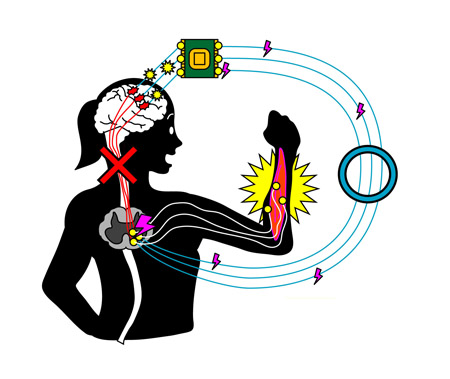
Diagram showing artificial neural connection that causes movement in limb using brainpowerRecently, a combined effort between scientists from University of Washington, Seattle, Japan Science and Technology Agency, and National Institute for Physical Science, Japan did an experiment on a monkey with a paretic hand to see if they could restore neural activity in its hand and create natural limb movement without the help of any artificial limb. The results were pretty impressive.

The team used two approaches - first, they applied an artificial neural connection to bridge the neural
circuits above and below the lesions on the partially paralyzed monkey. This partially restored strength in the limb and allowed the monkey to move its arm purely using brainpower. Second, they also created another circuit that helped stimulate the spinal cord, thus boosting ongoing activity in the muscle.

These experiments have shown tremendous promise in curing semi paralytic people and restoring natural movement in their limbs without the need of any artificial/bionic limbs. We should hopefully get more promising news in the near future! 

Check the source links for more details. There's also a direct link to a pdf of the full paper.

Source: NIPS, Frontiers via Engadget

PDF

Rabu, 13 Maret 2013

Hodu: A "Zero Failure" Physical Therapy Device

Traditional physical therapy devices require a lot of effort even when a patient is just starting with their therapy, only to get discouraged and disappointed sooner or later and giving up. Hodu, however, is a simple "zero failure" physical therapy device that rewards the patient for even the slightest of effort applied, thus encouraging them to keep going and getting better and stronger. The device has built in sensors that detects the effort/pressure being applied and lights up colored LEDs. Every color is associated with a certain level of pressure applied on the device.

diagram showing sensors and led placement on hodu

The team behind Hodu is also working on software that will record the patient's progress and email all the information to their therapist.

A very simple, yet useful device. Check out the video to see what Hodu is capable of!


Source: Engadget, Meatbotics
Image source: Engadget

Kamis, 28 Februari 2013

Surgery Helps Paralysis Patients Walk Again

paralytic patient on treadmill

Dr. Justin Brown, a neurosurgeon in San Diego, is helping patients suffering from paralysis walk again!

Most recently, he helped Rick Constantine, 58, who, following a car crash had a brain stem stroke which resulted in paralysis of the right side of the body. He was told that he would never be able to walk again. He tried physical therapy but that gave him unsubstantial benefits.

The surgery that Dr. Brown performed on Rick is called a selective peripheral neurotomy and is done under a microscope. Essentially, this surgery trims the troublesome nerve branch by up to 80 percent, thus reducing the amount of "noise" being sent back to the spinal cord. The noise is what causes the spasticity.

Rehabilitation can begin 72 hours after the procedure. Rick was walking without a walker two weeks after the procedure and even finished a 1 mile race without any assistance.

Watch the video to see what Dr. Brown's patients are saying about their experiences. Dr. Brown also explains the surgery in great technical detail.


Anyone requiring more information about this surgery should call 858-657-7000.

Source: UC San Diego Health System, Science Daily via Bill Shackleton

Minggu, 13 Januari 2013

Mobi-Chair: Wheelchair For The Beach!

A man using mobi-chair in the water
 
 
How often do people in wheelchairs get to go to the beach and play in the water?

Deschamps, a New Jersey based family owned business, has created the Mobi-Chair, a high quality beach chair that provides people bound to wheelchair an easier way to access and navigate across the beach. The arm rests and wheels are made of floating materials that enable the chair to fully float in water.
mobi chair disassembled and fitted in the trunk of a car

The Mobi-Chair can be assembled or disassembled in 5 - 10 minutes without the use of any tools, and can easily fit into the back of the trunk of a vehicle. The aluminum frame and other materials are corrosion free and the fabric used for the chair is non allergenic, UV resistant, and ventilated for quick drying.

The Mobi-Chair may not necessarily be inexpensive as it will set you back by $2139. I could not find any information on whether insurance companies would cover costs for the chair or not.

See the video to see Mobi-Chair in action, and check out the website for more information!


Source: Disabled-World via Barrier Break

Website: Mobi-chair.com


Rabu, 02 Januari 2013

i-Transport: Wheelchair That Helps People Move And Reach Heights

man using i-Transport standing in upright position

Scientists at the National Cheng Ku University in Taiwan have designed a wheelchair that not only allows users to maneuver around but also adjust its height so that they could practically stand in order to reach things and/or perform chores and other activities.

man using i-Transport performing a chorei-Transport, which is quite light and has greater mobility (thus helping perform daily chores with ease), comes with its own health monitoring system that monitors blood pressure and breathing condition. People who are in wheelchairs 12 - 18 hours a day, feel the need to recline, move their body position and shift their body pressure, and this wheelchair allows them to do just that. Of course, they also get a sense of pride when they get to stand and do things on their own.

The entire assembly consists of a robotic arm, the electric drive wheels, and a control panel. i-Transport also has a safety mechanism built in - it reads certain physiological signals, converts them to parameters and compares them against data it has in its monitoring system.

There's no news of this wheelchair going into mass production, but we sure hope it does!

Source: NCKU via Engadget

Selasa, 25 Desember 2012

Controlling A Prosthetic Arm With Thought

Jen controlling prosthetic arm with her thought
Image source: BBC
What we used to see a few years ago in movies is turning into reality. Controlling objects with just your thought? Who would have ever thought?

Jan Scheurmann, a 53 year old quadriplegic who is paralyzed from the neck down, recently managed to control a prosthetic arm with her mind to grasp and move objects with ease.

Two sensors were implanted in her brain that pick up electrical signals from around 200 individual brain cells, which later translate into commands that are used to move the arm and grab objects. The co-ordination, skill and speed she achieved only after 14 weeks of training (she was picking up objects on the second day!!) was almost similar to that of an able bodied person.

the robot arm was controlled by thought
Image source: BBC
The next plan is to attach the prosthetic arm to Jen's wheelchair so that she could use it on a daily basis. There have been attempts to give sensation to the prosthetic arm as well so that Jen could feel the sense of touch.

This development is huge for people with spinal cord injuries, amputees, and quadriplegics. We saw something similar earlier this year, and looking at the progress, we should see a lot more action in this area in the coming years!

Hit the source links to read more about this in detail.

Source: BBC, The Lancet via Gizmodo

Minggu, 21 Oktober 2012

Robot Wheelchair That Climbs Steps; Tackles Obstacles

robot wheelchair climbing up a step
Image source: Diginfo TV

A group at Chiba Institute of Technology in Japan has developed a new concept wheelchair that can climb stairs!

This robot wheelchair, equipped with four wheels, five axes, a joystick, and various sensors moves on regular surface just like any other wheelchair. However, whenever it sees a step, it lifts its legs off the ground and "climbs up" in a walking style. The user just needs to direct the wheelchair using the joystick. The robot has a bunch of sensors on its feet, and that helps it detect obstacles. These sensors are used to detect how big and far the steps are. On uneven surfaces, the robot uses these sensors to make sure the chair remains stable (the intention is to use this robot wheelchair on regular paved surfaces). This robot wheelchair also has the ability to line up its wheels, thus allowing it to make 360 degree turns even in narrow spaces.

As of now, Shuro Nakajima, the scientist leading the group behind this robot wheelchair wants more people to test this wheelchair so that he could get more data to tweak the user experience.

Check out the video to see this amazing robot wheelchair in action!


Source: DigInfo TV

Kamis, 27 September 2012

Bill Signed For Self Driving Cars On Public Roads

Self driving cars are a step closer to reality!

California governor Jerry Brown signed bill SB1298 two days ago which formalizes the legal and safety standards for automated cars so that they could be driven on state owned roads. This is good news for people with visual impairment and other disabilities (that hinder their ability to commute) because in the future, this self driving car would enable them to fearlessly commute without having to depend on others for transportation purposes.

Several important points were made during the bill signing ceremony, some of which were:

- Accidents are caused by human errors. The self driving cars have potential to avoid accidents.

- The "drivers", when stuck in traffic, can utilize their time doing something else, thus being more productive.

- Self driving cars have the ability to eliminate congestion.

- Last, but not the least, self driving cars do not jump red lights!

Of course, there is still a lot of testing that needs to be done. However, Sergey Brin thinks that the self driving car would probably be ready for public use in five years or so.

Watch the following video to see Sergey Brin and Jerry Brown talk about the self driving car and how these cars would change our lives.


Source: Google+ via Engadget

Minggu, 23 September 2012

Hands Free Wheelchair

Josh in his wheelchair
Image source: Engadget
If you are a technology aficionado, and are curious to know what sort of amazing projects can come out   of a small workshop, then you should totally subscribe to The Ben Heck Show!

In one of his latest episodes, Ben Heck shows how he created a hands free wheelchair for a soon to be father who wanted to take care of his baby while still in his wheelchair.

Watch this video to see how Ben created two additional accessories for Josh's wheelchair - an add-on motor assembly that sits beneath the wheelchair and a joystick (track ball?) like device that sits in the front on the footrest and controls the chair's speed and directionality.

If you want to skip all the technical details, go straight to the "Powering it up" segment on the video's progress bar.


Source: The Ben Heck Show via Engadget
Mas Kur. Diberdayakan oleh Blogger.

 
biz.