Tampilkan postingan dengan label paralysis. Tampilkan semua postingan

Minggu, 08 Maret 2015

Ripchair Provides Full Independence To Wheelchair Users So They Could Enjoy The Outdoors Again

a wheelchair user backing into Ripchair

When summer comes, the first thing we think of is the great outdoors! Some like to hike, swim, bike whereas others like to go fishing or hunting (which can be done in winters too!). However, it may not be very easy for those who are on a wheelchair. Navigating the rugged terrain in some locations may be very challenging for a wheelchair with all sorts of rocks of varying sizes, uneven terrain, hills, rivers, mud and so many other elements that can make maneuvering extremely difficult.

To overcome all these obstacles and to give wheelchair users the independence and confidence to  venture out and participate in their favorite outdoor activity and sport , Howe and Howe Tech, a small business run by two brothers out of Waterboro, ME have invented the Ripchair. Currently at version 3.0, Ripchair is an "extreme"  vehicle that has a ramp and an area big enough for a wheelchair (and its occupants) to fit in. The ramp helps the user back into the Ripchair where they get locked in and secured. Customized left or right electronic control, cup holders, lighting and other add-ons for recreational pleasure. With all the controls, accessories and add-ons, the user has full comfort and control of the vehicle that provides them great maneuverability and sturdiness. Whether it's the riverside they want to go to or on top of a mountain, Ripchair will get them there!

Ripchair specifications
Ripchair 3.0 specifications


Watch the following videos to see what all Ripchair can do and where all it can take you. 


To know more about Ripchair, visit their website. Unfortunately, there is no pricing information available anywhere on the website but the order form on the website suggests that 60% of the total price is due upfront.

Source: Legendary Speed [Thanks for sharing, Teresa!]
Image Source: TrackChairExtreme

Minggu, 24 Agustus 2014

Assistive Technology Gadgets That Could Change Your Life [Infographic]

Are you or someone you know an Occupational Therapist and/or take care of someone with special needs? Michael Leavy at Home Healthcare Adaptations, a family run company has created this helpful infographic that shows some really useful assistive technology devices that can make life convenient for a lot of people. 

An electric car that people in wheelchairs maneuver  without getting off and folding the wheelchair separately? A gadget that translates head movements into computer mouse movements? Alarm clocks for the deaf? Bookmark this handy infographic for quick reference to some really cool assistive technology gadgets. (click to enlarge)

infographic titled assistive technology gadgets that could change your life
Click to enlarge

Source: Michael Leavy

Jumat, 11 Juli 2014

Parrot Speak To Call: Hands Free Phone Software

Parraot speak to call logo

As we saw in the last post, spinal cord injuries or paralysis can render arms unusable. Anyone with not so good motor skills also have difficulty using their fingers and hands to perform daily operations, thus making them depend on others around them to get things done. One of those things can be getting help to make and receive phone calls - a process that seems fairly simple, but without the use of arms, can be quite a bit of a challenge. It is quite possible that someone may not be around all the time, and waiting for a friend or caregiver to come check in on them may be the only option for quite many people.

To alleviate this problem, Parrot "Speak to Call" provides a very convenient solution. A software that runs on Windows PC along with Dragon Naturally Speaking and Microsoft Speech (comes with Windows), Parrot helps make and receive phone calls by just using speech. The interface is very simple and minimal with just the essential options displayed. The software comes with a few "lists" of its own (Family, Friends, Professionals & Businesses and Work), to which you can add contact information and their phone numbers. Of course, it gives you the ability to add more lists too if the four it comes with are not enough. With just one word commands, Parrot can make making and receiving phone calls a breeze. Check out the quick videos below to see Parrot "Speak to Call" in action.


Set up is very simple (make sure you know how to enable your speech recognition software). The best part is that you don't require a phone line or need to hook it up to your existing phone line. It works on its own and does not depend on any other hardware accessories (except the USB headset you will be using to make calls) which typically complicate set up and use, and make things difficult to fix if they break. When you sign up, they give you a phone number as well.

A very good solution for people who don't have good motor skills or cannot use their arms because of paralysis or other spinal cord injuries. This software can also be used by bedridden people or  those who cannot move a lot because of sickness or old age to call their caregiver to let them know if they need anything.

Signing up requires a one time fee of $99 and a monthly $39 fee for unlimited calling within USA and Canada (month to month; no contract). $10 from each sale also goes to charity!

Go to Parrot's website to learn more about this product.


Website: www.speaktocall.com

Selasa, 08 Juli 2014

Neurobridge: Technology That Helps Paralyzed People Move Limbs With Their Thought

Ivan using Neurobridge technology to move his arm with his thought

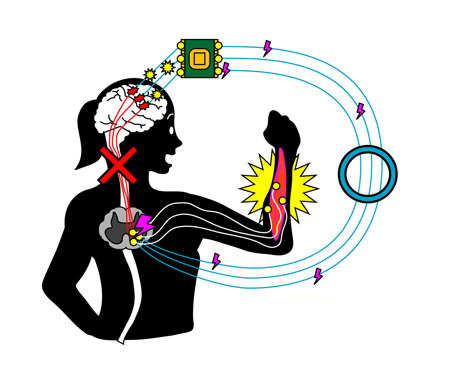
Spinal cord injuries/ paralysis are fatal because they cut off communication between the brain and limbs - damaged nerves are unable to transfer signals from the brain to limbs, thus rendering them unusable. However, just recently, a team of scientists from Ohio State University and Battelle partnered together to use a breakthrough technology called Neurobridge (created by Battelle) that helps quadriplegics move their limbs with just their thought!

Ivan seen using Neurobridge technologyAs mentioned earlier, nerves are crucial for limb movement, and fatal accidents that cause injuries to the
spine and damage nerves drastically impact limb movement. This is where Neurobridge comes to rescue. A little chip (smaller than a pea) is implanted in the part of the brain that controls arm and hand movements. This chip reads and interprets brain signals, sends them to a computer that recodes and sends them to a sleeve that the patient is wearing, and simulates the proper muscles, thus allowing them to move the desired limb. It takes a total of one tenth of a second from thought to limb movement. So essentially, it totally bypasses the (damaged) nerves responsible for transmitting signals from the brain to the limb and sends them directly to the muscles instead.

Watch this video to see Ivan Burkhart, a 23 year old quadriplegic who was paralyzed after a diving accident move his arm by using Neurobridge.


This is still a clinical study (FDA approved) that is working with five patients. Currently, the study is focussing on arms and hands, but the possibilities in the future are endless. To begin with, brushing their teeth, flossing, using their own hands to eat with a spoon or fork etc. can be a huge boost to a paralyzed person's morale and confidence.

What the scientists have achieved so far is a big step forward, and they are only going to continue to make such advancements in the future. 

Watch the video to learn more about paralysis and how this technology works. Hit the source links for more details.


Minggu, 22 Juni 2014

Students Create Reactive Suit That Shows Paraplegic Athletes When They Are Injured

an athlete in a wheelchair wearing the reactive suit demonstrating the stain this suit gets when the athlete is injured

The one thing athletes who have disabilities struggle with is assessing the severity of injuries they get while playing sports. It becomes especially troublesome for people who are paralyzed from waist down and play sports like wheelchair basketball, sit ski, motor racing and several others where they come in contact with other players or objects, resulting in physical trauma or internal injuries. Internal injuries often don't give any visible warning, and if the athlete cannot feel impact or pain because of paralysis, they may not even know that they are injured. This can be dangerous since they can bleed to death or have some other serious life threatening consequences if they don't treat their injury during or right after the game.

To combat this problem, a team of students at Imperial College in London has designed a reactive prototype suit that will enable people paralyzed from the waist down to identify physical impact/injuries immediately and assess how serious those injuries are. The trousers consists of pockets in different areas that have a removable strip of pressure reactive film. Whenever impact occurs to the area where the strip has been placed, it registers impact in the form of a magenta stain. Higher the impact, higher is the color intensity of the stain. This does two things - first of all, it notifies the athlete immediately that they have had an injury, and second, the pattern and color intensity can help experts analyze what type of injury the athlete has. (Different type of injuries have different patterns/bloom on the strip)

At the end of the day, this suit gives peace of mind to the athletes, trainers and support staff.

Photo showing reactive trouser and all the areas that have pockets to hold reactive strip
Pockets located on each bone (click to enlarge)


Photo describes how stains appear wherever contact pressure is applied
Description of how the pressure sensitive film works (click to enlarge)

Watch this video to see what it takes to create the suit, and the testing process it goes through.


Rabu, 11 Juni 2014

WHILL: World's Most Advanced Personal Mobility Device Starts A Kickstarter Campaign

WHILL Type A being used by different people


In the recent past, WHILL has received a lot of coverage and recognition for all the right reasons. A personal mobility device that gives an amazing level of flexibility, control, maneuverability as well great comfort and design. This personal mobility device has become so popular recently that its first batch, scheduled for delivery in July, is completely sold out, and the second batch, scheduled for August, is almost 80% preordered. 


This device definitely has some features that have been really well thought out by its designers, especially its arms that can be adjusted for easy sitting, electronic seat sliding forward and backward for easy table access and comfort, and not to mention its ability to maneuver any type of terrain - snow, grass, gravel, or anything else, thanks to four wheel drive, and its ability to be controlled by a phone app!

The team behind WHILL just launched a Kickstarter campaign to promote their device and receive more funding to keep enhancing this already wonderful device. To know more about this personal mobility device, see it in action and to support the campaign, head over to their Kickstarter campaign page!

Read more about the honorable mention the team got at the Red Dot Award 2014 here.

WHILL Kickstarter.
WHILL Website.
 

Senin, 24 Februari 2014

3D Printed Exoskeleton

Amanda Boxtel walking with the 3d printed exoskeleton

What is it that 3D printers cannot print? "Nothing" is probably the most accurate answer!

Artificial limbs, that are usually not very cheap and easy to get are easily becoming quite affordable. To take things a step further and make things more exciting, a 3D printed exoskeleton was given to Amanda Boxtel, who has been paralyzed from waist down since 1992, enabling her to get off her wheelchair and walk again. She was told by her doctors that she would never be able to do so!

The Ekso-Suit, designed specifically for Amanda, was made possible by designers at 3DS. To make sure that the exoskeleton fit her perfectly, they started by scanning the contours of her thighs, shins and spine and digitizing all that information to create the 3D base for the exoskeleton, which was then integrated into other mechanical components to create the full automated suit. One important factor they had to consider while designing the suit was that since Amanda did not have any sensation from waist down, they didn't want any of the components poking into her skin as that would have caused abrasions. Since Amanda has no sensation in her legs, those abrasions could have formed dangerous complications.

This 3D printed Exoskeleton is a big step towards making such accessories available to the common masses at prices substantially less than other commercially available solutions. 3D printing in the coming years is going to bring lots of exciting yet inexpensive enhancements to the assistive technology world!

Watch this video to see all the components the Ekso-Suit is made of. Also see Amanda Boxtel walk with the Ekso-Suit on!


Source: 3D Systems via Gizmodo


Senin, 30 Desember 2013

PointGrab: Control Household Appliances And Electronic Devices With Point And Gesture Control

a user pointing finger and eyes at computer screen to perform action


We have been seeing a lot of devices that are touch and gesture enabled that can be very helpful for people with various disabilities (motor skills, spinal injuries, quadriplegics). However, all the devices that we have seen so far work with computers.

That is soon going to change.

A Tel Aviv based company, PointGrab, is working on bringing to the masses a couple of concepts that use motion and gesture controls not just with computers but also with household appliances! The technology works by creating a "transparent space" in front of the user, enabling a touch interface but from a distance. The user has to be pointing their eyes and a finger at the device and perform a gesture to get the desired action. For example, pointing a finger at a lamp will turn it on, and moving it in a downward motion will dim the lamp. Similar gestures can be used to control any device in the house - air conditioners, window shades, thermostats, doors, etc. PointSwitch is the concept that works with appliances, and AirTouch works with computers, televisions, and other consumer devices.

The company suggests that we should start seeing these technologies in consumer products as soon as early 2014.

Watch the following two videos to see how PointSwitch and AirTouch work.


Source: Engadget
Image Source: Engadget

Website: PointGrab

Selasa, 24 Desember 2013

Tongue Driving System: Tongue Controlled Wheelchair For Quadriplegics


picture of headset, piercing and app for TDS


Professor Maysam Ghovanloo at Georgia Tech has been working hard since 2005 on a system that lets a user control their wheelchair with their tongue. Tongue! His research has borne fruit, and the results are pretty incredible.

This system is most beneficial for people who have high level spinal cord injuries or are quadriplegic.

This is how it works: The user has a magnet placed inside their tongue in the form of a piercing. The
the phone interface for TDS user also wears a headset which actually detects the location of the magnet as the tongue moves. The location is grabbed and wirelessly communicated to an app installed on the user's phone which in turn sends it to the wheelchair and the command is finally executed.

This method is found to be three times faster than the traditional sip and puff method.  Not only can it be used to just maneuver a wheelchair, but to play video games and use computers or phones too. 11 volunteers helped with the testing and it was found that their performance significantly improved between training session one and two, suggesting how easy it is to use.

The idea behind the study was not just to see how accurate and fast TDS (Tongue Driving System) is but also to prove to insurance companies that tongue control is indeed useful.

The next step in this research is to enhance the TDS by getting rid of the headset.

Watch this video to learn more about what professor Ghovanloo has to say about TDS.


Go here if you are interested in reading the published paper.

Source: The Verge

Kamis, 25 Juli 2013

DexType: Virtual Keyboard For Leap Motion Controller

DexType app screenshot


Leap Motion controller, that allows you to control your computer by using gestures (sometimes just a flick of a finger is enough), was made available to the public on Monday. Of the very few apps that are available in the Leap Motion, one that truly stands out, and is extremely useful for people with impaired motor skills (whose skills may not be strong enough to use a physical keyboard) is an app called DexType.

DexType is a virtual keyboard that lets you type by just using gestures in the air. To type, the user just "bounces" from one key to another. The keys are aligned in a line at the bottom of the screen, and the user can switch to one of many keyboard formats with QWERTY, of course, being one of them. The beauty of DexType is that typing can be achieved by using only two fingers one one hand. Using just one hand for typing would be beneficial for people who may have only one hand functional and/or one of their hands is paralyzed.

DexType also comes with tools that help users navigate the web without the use of a keyboard and mouse. Going to any website, composing and sending emails, following links and doing every task that you would typically do on the web is a breeze with DexType.

Here is a quick demo of DexType in action.


This app is available for Google chrome here for free till August 7. After that, the free version will be ad supported and a premium ad free version will be available for $4.99.

Read the following press release for more detailed and specific information about DexType.

PRESS RELEASE

On Monday, the LEAP Motion gesture recognition device finally became available to everyone.  The first generation of software for the LEAP includes some incredible programs, but we believe that gesture recognition can be used for so much more than just playing games.  We're proud to announce the release of DexType, which changes the LEAP from an entertaining gadget into a genuinely useful tool by providing an alternative to the most important peripheral device of all - the keyboard.

DexType is the world's first truly "virtual" keyboard, a system that allows users to type using nothing more than gestures in the air.  The keys are arranged at the bottom of the screen in a single line.  The sequence of letters is a linear arrangement of the familiar QWERTY keyboard.*  To type, the user simply bounces from key to key.

DexType gives you a lot of leeway to be imprecise with your keystrokes.  It treats keystrokes as groups instead of as discrete letters, and processes input with a disambiguation algorithm to predict the intended output.  This means that even with gibberish input, such as "nxopl", the system will still produce a word - "hello".  The most likely output is predicted based on the available possibilities, and if necessary the user can select from other options with a simple swiping gesture.

If definitive keystrokes are required (such as for acronyms, usernames, or passwords), they are easily available by simply pressing deeper.  Numbers and symbols are accesible through a separate layout, but can also be produced via handwriting recognition.  Punctuation can be produced via chords - pressing two keys at the same time in specific regions.  Editing is possible using simple gestures - a sideways swipe allows the user to erase single letters or entire words, depending on the length of the motion.

DexType includes a tool set that gives you all the options you need to navigate the web without having to use a keyboard or a mouse.  You can scroll and click within pages, and most importantly, you can type.  You can follow links, launch a search engine, or navigate directly to literally anywhere on the web.  You can compose emails and documents, or fill in forms.  You can move backward or forward in your browser history; you can open new tabs, close existing ones, or browse through them all.

With DexType, it becomes possible to use a computer without having to touch anything at all.  Pastry chefs can look up recipes while their hands are covered in flour.  Neurosurgeons can add notes to a brainscan without having to touch an unsterilized surface.  And everyone else can lounge on the couch and select a movie to watch while munching on buttered popcorn.

DexType is currently available for download via the Chrome Web Store (see link below).  The software is absolutely free until August 7, at which point the free version will become ad-supported and a premium version will be available for $4.99.

DexType will also be available for cellphones and tablets.  In late August, we intend to have a beta version available for Android users to download and try.  Users who purchase the premium version of DexType will receive automatic access to the Android version, and the beta version will be available to other users as well for a minimal cost.

For additional information, please contact:

Zack Dennis
Pointesa, LLC
E-mail: zack@dextype.com

Phone: 323-877-6918

Rabu, 24 April 2013

Samsung Demonstrates Tablet That Can Be Controlled By Brain

Samsung has taken the mobile industry by storm in the last couple of years with  its very successful Galaxy S III phone and the Galaxy Tab/ Note tablets. Competitive pricing and an easy to use UI (besides the world famous brand) are what set them apart from the rest.

It is now planning to take regular tablets into a different realm by allowing a new way of communicating with its tablet devices - brainwaves (mind control!), a feature that people with impaired mobility will definitely appreciate.

scientist demonstrating thought control wearing a cap with eeg electrdes
Image source: MIT Technology Review
Samsung, in collaboration with Roozbeh Jafari, an assistant professor at the University of Texas have started research on how to open applications, perform commands within an app, power up and down a tablet device using just a person's thought. The initial stages of this research involve a cap studded with EEG electrodes(Electroencephalogaphy - recording electrical activity with the scalp) that monitor the electrical signals from the brain. In this research, scientists found out that people could launch an app and make selections within five seconds (with an accuracy of 85 to 90 percent)if they concentrated on an icon that was blinking at a distinctive frequency. Of course, as this project moves to the next stages, they would try the same experiment without the cap with all the electrodes because that's what the masses would want.

I am hoping that a bigger brand like Samsung would be able to keep the costs low if this tablet is mass produced in the future.

Make sure to check the video of this demonstration in the source link!

Source: MIT Technology Review via Gizmodo

Senin, 15 April 2013

Scientists Restore Hand Function In Paretic Monkey Using Artificial Neural Connection

Spinal cord injuries or strokes usually result in loss of limb control. Typically, these injuries cause interruption of the pathways that conduct impulses from the brain to the spinal cord. However, it is known that the neural circuits above and below the lesion still remain functional.

Diagram showing artificial neural connection that causes movement in limb using brainpowerRecently, a combined effort between scientists from University of Washington, Seattle, Japan Science and Technology Agency, and National Institute for Physical Science, Japan did an experiment on a monkey with a paretic hand to see if they could restore neural activity in its hand and create natural limb movement without the help of any artificial limb. The results were pretty impressive.

The team used two approaches - first, they applied an artificial neural connection to bridge the neural
circuits above and below the lesions on the partially paralyzed monkey. This partially restored strength in the limb and allowed the monkey to move its arm purely using brainpower. Second, they also created another circuit that helped stimulate the spinal cord, thus boosting ongoing activity in the muscle.

These experiments have shown tremendous promise in curing semi paralytic people and restoring natural movement in their limbs without the need of any artificial/bionic limbs. We should hopefully get more promising news in the near future! 

Check the source links for more details. There's also a direct link to a pdf of the full paper.

Source: NIPSFrontiers via Engadget

PDF

Rabu, 13 Maret 2013

Hodu: A "Zero Failure" Physical Therapy Device

Traditional physical therapy devices require a lot of effort even when a patient is just starting with their therapy, only to get discouraged and disappointed sooner or later and giving up. Hodu, however, is a simple "zero failure" physical therapy device that rewards the patient for even the slightest of effort applied, thus encouraging them to keep going and getting better and stronger. The device has built in sensors that detects the effort/pressure being applied and lights up colored LEDs. Every color is associated with a certain level of pressure applied on the device.

diagram showing sensors and led placement on hodu

The team behind Hodu is also working on software that will record the patient's progress and email all the information to their therapist.

A very simple, yet useful device. Check out the video to see what Hodu is capable of!


Source: Engadget, Meatbotics
Image source: Engadget

Kamis, 28 Februari 2013

Surgery Helps Paralysis Patients Walk Again

paralytic patient on treadmill

Dr. Justin Brown, a neurosurgeon in San Diego, is helping patients suffering from paralysis walk again!

Most recently, he helped Rick Constantine, 58, who, following a car crash had a brain stem stroke which resulted in paralysis of the right side of the body. He was told that he would never be able to walk again. He tried physical therapy but that gave him unsubstantial benefits.

The surgery that Dr. Brown performed on Rick is called a selective peripheral neurotomy and is done under a microscope. Essentially, this surgery trims the troublesome nerve branch by up to 80 percent, thus reducing the amount of "noise" being sent back to the spinal cord. The noise is what causes the spasticity.

Rehabilitation can begin 72 hours after the procedure. Rick was walking without a walker two weeks after the procedure and even finished a 1 mile race without any assistance.

Watch the video to see what Dr. Brown's patients are saying about their experiences. Dr. Brown also explains the surgery in great technical detail.


Anyone requiring more information about this surgery should call 858-657-7000.

Source: UC San Diego Health System, Science Daily via Bill Shackleton

Selasa, 25 Desember 2012

Controlling A Prosthetic Arm With Thought

Jen controlling prosthetic arm with her thought
Image source: BBC
What we used to see a few years ago in movies is turning into reality. Controlling objects with just your thought? Who would have ever thought?

Jan Scheurmann, a 53 year old quadriplegic who is paralyzed from the neck down, recently managed to control a prosthetic arm with her mind to grasp and move objects with ease.

Two sensors were implanted in her brain that pick up electrical signals from around 200 individual brain cells, which later translate into commands that are used to move the arm and grab objects. The co-ordination, skill and speed she achieved only after 14 weeks of training (she was picking up objects on the second day!!) was almost similar to that of an able bodied person.

the robot arm was controlled by thought
Image source: BBC
The next plan is to attach the prosthetic arm to Jen's wheelchair so that she could use it on a daily basis. There have been attempts to give sensation to the prosthetic arm as well so that Jen could feel the sense of touch.

This development is huge for people with spinal cord injuries, amputees, and quadriplegics. We saw something similar earlier this year, and looking at the progress, we should see a lot more action in this area in the coming years!

Hit the source links to read more about this in detail.

Source: BBC, The Lancet via Gizmodo

Senin, 24 September 2012

Human Support Robot: Toyota's Personal Assistant for People With Disabilities

Human Support Robot with a mounted tablet on top to enable communication with others.

Toyota recently announced a new personal robot that has been designed to be an assistant of sorts for people with disabilities, essentially helping them live more independently.

HSR pulling a drawer out.The Human Support Robot (HSR) can be controlled using any tablet like device. The tablet can also be placed on top of HSR which would allow communication between the robot's owner and other people (caregivers) using Skype or other similar communication tools. HSR is capable of picking things up from the floor/atop tables/counters, opening & closing curtains, and fetching things for the owner, which may not be easy tasks for elderly or disabled people.

Toyota has been extensively testing HSR since 2011 and constantly getting feedback from patients. From the looks of it, HSR has a very good chance of becoming a real consumer product in a couple of years. Toyota would be demonstrating HSR from 26 - 28 September at Tokyo Big Sight as part of the "bleeding edge development of health care equipment" project.

HSR shown picking up things from the floor, atop table, and a high counter.

HSR handing something to a patient.

Source: Gizmag.com via The Verge
Images source: Gizmag.com

Selasa, 04 September 2012

Shower Bay - Portable Shower For Wheelchair Users

picture shows a woman in wheelchair in front of shower bay - a portable shower meant for wheelchair users
Image Source: Shower Bay website


One constant problem that wheelchair users face is the difficulty in maneuvering their wheelchairs in bathrooms to take a shower. This ultimately results in expensive home renovations.

To counter this problem, Russell Simpkins of Forward Day, LLC, and his sister have come up with an extremely innovative product that lets wheelchair users take a shower pretty much anywhere in the house. Shower Bay's design allows for quick assembly in any room of the home, and no tools are required. The unit snaps together, and connects to a standard household faucet. As water enters the unit through a deluxe showerhead, the user can bathe comfortably with or without the assistance of a caregiver. The water is then pumped out of the unit to any nearby household drain. The following image shows Shower Bay assembled in a household bedroom: 


image of shower bay installed in a bedroom
Image source: Shower Bay website

Shower Bay provides a small ramp that allows users to just roll in and out of the shower very easily, thus making the entire process very smooth and safe.


Given the unique safety advantages and the uncompromised showering experience, Shower Bay is the perfect bathing solution for many wheelchair users, including the following:


� Home owners who want to avoid a costly and time-consuming bathroom remodel.

� Renters, who generally cannot modify or remodel their apartment or home.

� Families seeking to avoid the high cost of assisted living facilities and keep their loved ones at home.

� Users whose mobility restricts them to the first floor of a residence (where the home has only a half bath on the first level).

� Families that have a loved one with mobility limitations temporarily stay at their home.

� Individuals who are rehabbing an injury and only need a temporary bathing solution.

� Users planning to change residences, who can move Shower Bay with them to their next home and not worry about remodeling ever again.

Watch the following two videos to see what the Shower Bay experience is like, and how easily it can be installed.


Shower Bay is available for $4200 from its website. There may be financing options available as well.

Website: ShowerBay
Facebook: Shower Bay
Mas Kur. Diberdayakan oleh Blogger.

 
biz.