Tampilkan postingan dengan label deaf. Tampilkan semua postingan

Rabu, 17 Desember 2014

UNI: Device That Converts Sign Language To Text $1,278 Shy Of Meeting Crowdfunding Target

UNI detecting sign language


Motion Savvy, the company that introduced perhaps the most innovative product of 2014 in the assistive technology realm, UNI, has managed to raise almost all of the funds required to mass produce it and deliver it to 370 million deaf people around the world. The crowdfunding campaign ends in 3 days on the 20th, and the company is still $1,300 short of the set target.

If you think this product will be a great asset for deaf people, and want to show your support in any form, head over to their indiegogo page or share this information with someone who might be interested in this device.

Watch the following video to see how a deaf woman plans to use UNI in the future. Read below for more information on UNI as well.


From Motion Savvy:

The pre-sale campaign for UNI, the world�s most innovative communication device for the Deaf and Hard of Hearing, will be ending in three days on December 20th, 2014 and is currently just $2,300 $1,738 shy of hitting the crowdfunding goal.

Time has named MotionSavvy�s first product, UNI, as one of 2014�s best inventions due to the device�s first of its kind technology that utilizes motion gesture recognition to translate sign language to audio and spoken word to text in real time.

Since the launch of UNI�s crowdfunding campaign in October, the product has gained global recognition due to its mission to shed light on the degrading and uncomfortable situations the Deaf community faces when it comes to communicating with the rest of the world. With UNI, the 370 million Deaf people and 3.7 billion others that engage with them every day no longer have to type messages on smartphones, scribble on pieces of paper, or make over-dramatic gestures.

Although the immense positive reaction has proven that there is a high demand for this next level of communication technology, it is apparent from the feedback of the Deaf community that even at the low campaign price of $189, people are unable to afford the product alone. In it�s mission to empower the Deaf community, the MotionSavvy team is inviting the rest of the world to help its cause. With contribution options ranging from $399 to $10,000, people will be able to donate UNIs to individuals, families, schools, or organizations while limited supplies last.

UNI is comprised of three parts: a tablet, a smart case, and a mobile app. The device works without an Internet connection to help the Deaf and Hard of Hearing communicate anywhere at anytime. Here�s what UNI does:
  • Translates sign language into audible speech for hearing individuals using motion gesture recognition technology.
  • Converts spoken word to written text for Deaf and Hard of Hearing individuals using voice recognition technology.
  • Recognizes different ways of signing so that users can train their device to recognize their styles.
  • Gets smarter with every use through SignBuilder to allow people to crowdsource signs so that UNI can provide the most accurate translations.
�An overwhelming amount of people from the Deaf community have reached out to us about how they need UNI, but we�re finding that the same people are having trouble affording one.� said Ryan Hait-Campbell, CEO and co-founder of MotionSavvy. �We�re so thankful for the support we�ve received so far, but it�s clear that this communication barrier is real and we need help from the rest of the world to give UNI to those in need�

MotionSavvy�s crowdfunding campaign on Indiegogo will be ending in three days and is on its way to reach its crowdfunding goal of $40,000 to understand market fit and begin manufacturing. UNI is expected to ship in the Fall of 2015. To learn more or for those who want to help MotionSavvy�s mission, visit: www.motionsavvy.com

Senin, 08 Desember 2014

OtoSense Mobile App: Re-Imagining Alerting Devices For Deaf, Hard Of Hearing


For Joyce Edmiston, 55, who admits she can�t hear her oven timer beeping when she removes her hearing aids, even if she�s in the kitchen, says lack of awareness of these audio alerts and other sounds can be a real problem. 

OtoSense, a sound recognition software company, has developed the first mobile app that identifies and distinguishes the source of incoming audio alerts, including alarms, sirens, timers, bells and other sounds, turning smartphones and tablets into assistive alerting devices for the deaf and hard of hearing. 

Joyce, who runs http://xpressivehandz. blogspot.com is seen here with an award.
Joyce, who runs http://xpressivehandz.
blogspot.com is seen here
with an award.
For people like Joyce and Travis Dougherty, 33, who is deaf, OtoSense offers an adaptable, affordable and useful means of being notified of important sounds in their environment.

Wherever you go, it seems, people, young and old, are using smartphones and tablets. The real value of these devices, however, comes from the mobile applications. 

Smartphones have quite literally become the new form of an assistive device - the all-in-one system that is made all that more powerful with the mobile applications available to download. Today, there are apps that let you watch (even in closed captions), text, video chat, bank, shop, read, listen, take photos and movies, check the weather, traffic and even get updated arrival and departure times during busy holiday travel season. 

Travis, who admittedly is an early adopter when it comes to new technology, says that the time has come for alerting devices to evolve and �putting this kind of technology into a smartphone and tablet just makes sense.� 

Since the birth of his daughter, Travis now wears a Pebble smartwatch, which connects to OtoSense, and he will soon connect the app to his Philips Hue Lights when the next update comes out later this month. 

Most people today have their smartphone and/or tablet within arm's reach at all times, it's the portable computer in their pocket and charging it and keeping it running is important. Certainly that�s the case for Noelle Bell, 32, who has a cochlear implant. 

OtoSense works immediately upon download, coming with a built-in library of standard fire and smoke alarm sounds found in the U.S. and Europe. Additionally, OtoSense can be personalized by users, recording and storing the most significant sounds of their environment, notifying users via flash, vibration and third-party notification including SMS text and push notification.
Noelle Bell, founder/CEO of
Buzz Worthy Social Media.
For Noelle, who pairs OtoSense with her Pebble Smartwatch, says she�s taught the app the sounds of her alarm clock, the doorbell, oven timer and dog barking. 

�It lets me know the audio cues to participate in my environment, and has helped me not feel as isolated in trying to figure out all of the different sounds of modern life,� says Noelle. �For me, the sound of the oven beeping is very similar to the sound of my doorbell, and I�ve recorded both sounds and stored them in my personal library on OtoSense. Now I can distinguish the difference between the two, and that is a real benefit.�

OtoSense is available now on the Google Play store. When the iPhone and iPad versions come out later this month, the cost of the app, on either Google Play or the App Store, will be $4.99 with some additional in-app purchases. OtoSense connects to any smartwatch, alerting user via text and vibration of a particular sound they have recorded and want to be aware of. And with the launch of the app on the App Store, users will be able to connect the app to Philips Hue Personal Wireless Lighting, customizing notifications.


According to the World Health Organization, there are 390 million people who suffer from a disabling hearing loss. In the United States, there are 48 million people who report a hearing loss according to the Hearing Loss Association of America. 

Please follow OtoSense on Twitter at www.twitter.com/otosense, like us on Facebook at www.facebook.com/otosense, and Instagram at www.instagram/otosense. If you have questions or want to sign up for our email list, please go to www.otosense.com or email us atexplorers@otosense.com.

This guest blog post was writting by Kathryn M. Quirk. Kathryn leads marketing activities for OtoSense, bringing more than 15 years of experience developing and managing multi-channel communications programs across an array of business sectors. Kathryn has insatiable thirst for news and information, reading, listening and watching everything with eye for how she can develop and share good stories, with a preference for sharing stories about how technology helps people to live more independent and autonomous lives. Always in the back in her mind, are the words of Maya Angelou, who wrote, "People will forget what you said. People will forget what you did. But people will never forget how you made them feel."

Kamis, 09 Oktober 2014

VEST: A Vest That Helps Deaf People Hear

image showing front and back of vest
 
 
We know very well that a large majority of deaf people use hearing aids or cochlear implants to amplify and hear the sounds around them. A scientist is working on another form of aid that will help deaf people convert sound to electrical signals which are sent to the brain directly - no need for an aid or implant!
 
This new aid, called VEST (Versatile Extra-Sensory Transducer) is an actual vest that a deaf person will wear under their shirt. Their (Android) smart phone will capture the sounds around them and send them to vibration motors on the vest real time, which will be converted to touch in the form of vibrations. These vibrations, or electric signals, are then sent to the brain directly where they are interpreted into information. With this vest, deaf people will be able to do several things that are typically either not possible for them or very difficult, like listening to traffic sounds in their surroundings, music, etc.
 
image showing description of how VEST works.
 
This device would cost approximately $2,000 - an eighth of what a cochlear implant surgery costs, and since this is something one just wears (and is hidden under their clothing), there is no need for a medical surgery.
 
The inventor of VEST, David Eagleman, also plans to send weather, stock market information, and tweets directly to this vest in the future. As an example, if the wearer of VEST were in a room where people were tweeting with a certain hashtag, they would get all those tweets directly into their brain!

Data around them will get directly streamed to their brain!
 
This vest weighs around 10 lbs but future enhancements include shedding that extra weight off.
 
Eagleman will be posting regular VEST updates on his website here.
 
Watch this Kickstarter video (that was successfully funded just yesterday to learn more about VEST and what all it can do.


Watch this three minute video to understand the bigger theoretical concepts behind VEST.


And here's a very amazing presentation by David Eagleman at Being Human last year. It's 22 minutes long but totally worth watching!


Source: Medical Daily, Kickstarter, Eagleman Laboratory

Minggu, 31 Agustus 2014

Assistive Technology Blog Minisode: Signs Restaurant in Toronto, Canada


I am starting a new series called "minisodes" which will showcase some fun, interesting, exciting facts and tidbits about assistive technology, accessibility, and accommodations in the form of short youtube videos. Feedback will be greatly appreciated!


Did you know that a new restaurant has opened in Toronto Canada where you order using the American Sign Language?  And why is it that, you may ask?

It's because almost all of the waiters at this restaurant are deaf.

The inspiration behind this restaurant is the owner's struggle to communicate with a deaf customer at his previous job.

The restaurant gives you a crash course in sign language right from the get go - As soon as you enter, you see a wall that has big pictures that show handshapes to help you fingerspell. There's also a cheat sheet on the table that serves the same purpose. Of course, the restaurant is encouraging you to use sign language as much as possible, primarily to make things easy for the wait staff and also to adopt sign language as another language for day to day conversation, but if you are not comfortable with it, you can still point to items on the menu and order.

This unique restaurant is a great example of how someone�s disability does not and will not stop them from performing a regular job - all they need is an employer who is willing to provide them the right accommodations and also create an environment where their disability is overshadowed by their skill set and zeal to be outstanding at their job.

Do check out this restaurant though - signrestaurant.ca. It is a fairly new restaurant but already has amazing ratings on Yelp, Urban Spoon and the likes.

Click the subscribe button to watch forthcoming minisodes on Youtube.

Minggu, 24 Agustus 2014

Assistive Technology Gadgets That Could Change Your Life [Infographic]

Are you or someone you know an Occupational Therapist and/or take care of someone with special needs? Michael Leavy at Home Healthcare Adaptations, a family run company has created this helpful infographic that shows some really useful assistive technology devices that can make life convenient for a lot of people. 

An electric car that people in wheelchairs maneuver  without getting off and folding the wheelchair separately? A gadget that translates head movements into computer mouse movements? Alarm clocks for the deaf? Bookmark this handy infographic for quick reference to some really cool assistive technology gadgets. (click to enlarge)

infographic titled assistive technology gadgets that could change your life
Click to enlarge

Source: Michael Leavy

Rabu, 30 Juli 2014

The Blind Photographer: What Does He See?

There is no stopping a passionate person irrespective of whether they have a disability or not.

Brenden Borrellini was born with complete deafness and a sight impairment that gradually got worse, and developed into complete blindness by the age of 7. Growing up for him was frustrating, and he depended a lot on his family and teachers which slowly helped him understand the world around him. Thanks to his zeal to learn and inquisitiveness, he learned finger spelling and other skills to improve his communication.

One day he picked up a camera and started clicking pictures. Initially it was all a joke about a blind person taking photos, but soon enough, with assistance from others, his curiosity towards the camera and photography became a full fledged hobby. To make things easier for him, he is explained objectives in detail as to what photos he should be taking. He is explained the surroundings in great detail, and then given technical feedback as well after the photos are taken. He can feel the controls on the back of the camera, and he can sense the lens moving when he is focussing, but he still needs some help from the subject to get a good picture.

Clicking photographs is fine, but what does Brenden really see?

This is where creativity plays a great role. Brenden's two dimensional photos are converted to three dimensional prints so he is able to interpret the various textures and recognize various elements of the image.

Watch this short movie about Brenden to understand the process he goes through to take and "see" photos, and the wonderful support system he has. Creativity and willingness to pursue a hobby knows no bounds, and Brendan's story is an exemplary example of that.


Source: The blind photographer from ABC Open Tropical North on Vimeo.


Selasa, 24 Juni 2014

Soundhawk Smart Listening System: Hearing Aid With Smartness Built In

Soundhawk scoop (earpiece) and other accessories including wireless microphone and charging case

Hearing aids have been traditionally known  for amplifying sound around the person wearing them. OF course, this works very well in all cases, however, one thing the traditional hearing aid lacks is aesthetics - when it comes to design and looks, the hearing aid has not been given much love by manufacturers. This is not really a big deal except that just the size and aesthetically unappealing aspect of it have discouraged a few people from using them. 


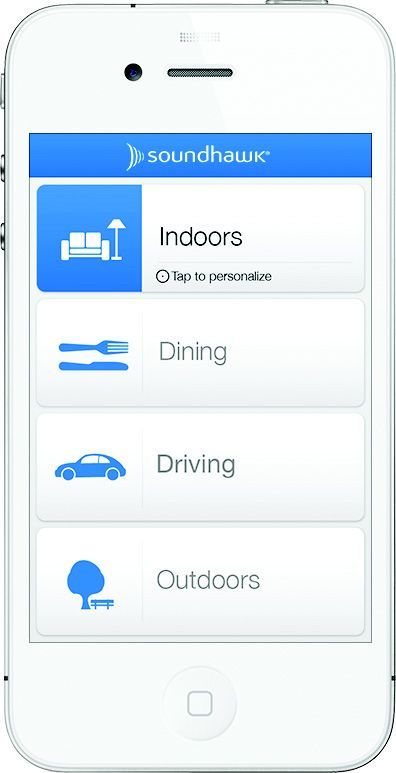
soundhawk app showing different environments it can be set toSoundhawk, a company on a mission to transform the listening experience, has introduced a new "hearing aid" that not only looks visually pleasing but comes with a lot of features that the regular hearing aid does not typically deliver. Soundhawk comes with a "Scoop" - the earpiece part that sits snugly in the ear (and doubles as a Bluetooth headset that syncs with your phone and lets you talk and listen to audio). It has a little microphone that amplifies sound around the wearer. If they are in a louder setting (think restaurant), they can use the mic (separate accessory) and place it in the direction the sound is coming from, and it picks it up and beams straight to the ear. Soundhawk is also accompanied by an app that lets you adjust the scoop to the environment you are in - outdoor indoor, dining or driving. Once selected, the wearer moves their finger on a touch interface to adjust the volume for the Scoop. 

The scoop has an eight hour battery life and the charging case extends its life to 24 hours. 


Pre-order for this device starts today at $280 and the price will go up to $300 after launch. On average, a decent hearing aid costs approximately $1,500. Head to the website to learn more and to pre-order! 

Source:  Techcrunch, Gizmodo
Video source: http://soundhawk.com/ 

Sabtu, 24 Mei 2014

Tablet That Uses Gesture Control And Translates Sign Language To Voice

MotionSavvy tablet
If you are deaf and use sign language on a regular basis, you know that communicating with a person who doesn't understand sign language can be bit of a challenge. Communication in such situations usually involves using a notepad or phone for writing sentences and passing it back and forth. Although not the least effective of ways to communicate, it can still be cumbersome and time consuming. To alleviate this, a company called MotionSavvy is busy building a tablet that "reads" sign language and "translates" it for the other person.

The tablet has Leap Motion built in, a gesture recognition device introduced last year. The leap motion part of it recognizes the deaf person's signs and speaks them out loud for the hearing person. The deaf person then turns the tablet towards the hearing person so they could speak into it. Once they finish speaking, Leap Motion translates speech into sign language for the deaf person. 

Deaf person communicating with a store clerk using MotionSavvy tabletWith this tablet, communication can be made much easier and smoother between a deaf and hearing person. No need for third party interpreters anymore - It can be easily carried in a purse or backpack and can be used anytime and anywhere - with friends or strangers!

Of course, this tablet is still in the works, and currently, it recognizes only a 100 words, but the team is diligently working on expanding the number of words it can recognize/sign.


They are constantly video blogging on YouTube providing updates. Subscribe to their channel if you want to follow the progress they are making.

Source: MotionSavvy via Engadget

Minggu, 13 Oktober 2013

TacitLanguage: Glove For The Hearing Impaired

person wearing TacitLanguage - the glove with lights to make signing easier in dar environments

To make signing simple in dim or not so well lit areas, a design student from New Zealand has developed a very simple glove called TacitLanguage that can be used by people with hearing impairment or sign language interpreters in darker environments.

The simple design consists of a glove with two lights on two fingers and four on the wrist that light up whenever the user makes movement. The movement is picked up by the attached accelerometer, and activates the lights. Although worn on just one hand, the lights are bright enough to illuminate the face and the other hand

See the video for a quick demonstration of TacitLanguage.


Source: Faesen Design via

Minggu, 14 Juli 2013

Glove That Helps Deaf-Blind People Communicate

Image Source: The Atlantic

Tom Beiling, a 32 year old doctoral candidate in Berlin, has come up with a glove that just might revolutionize the way deaf-blind people communicate, at least in the form of texting. 

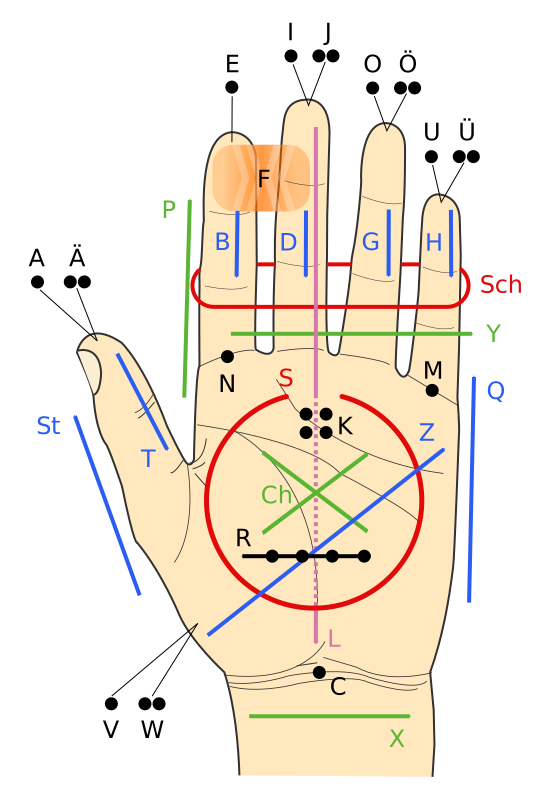
Image showing Lorm alphabetWith the intention of making communication easier between people who cannot see and hear, Tom has developed a glove that translates texts into pulses (haptic feedback). The glove consists of a set of pressure sensors, and with the help of a bluetooth device, connects to an iPhone app. The glove uses the Lorm alphabet (which places letters at different parts of  the hand (see image)), and a pressure sensor is placed at the locations that are meant for letters (for example, fingertips are meant for vowels). 

When someone needs to send text, the user just pushes the sensors meant for the alphabets that comprise of the words that they are wanting to send, and the haptic information from the tapping is converted to digital text and sent to the iphone app that sends out the message to the intended recipient. When the recipient receives the text, the motors on their glove vibrate and translate the words into vibrations, and they feel the vibrations on the pressure sensors. The vibrations essentially spell the words out. 

One advantage of using this glove to communicate is that you don't have to know Lorm alphabet to communicate  with  someone who is deaf-blind - the app converts digital text to Lorm alphabet for them. Till now, one had to know Lorm alphabet in order to communicate with people with deafblindness. 


The glove is still a prototype. Beiling's next prototype would probably be made out of material that is thinner than the one used for the current prototype.

Source: The Atlantic

Selasa, 02 April 2013

Free Captioning Service From Amara

Are you an individual or organization that has a plethora of videos that you think should be subtitled for  your viewers with hearing impairment? But because of time and financial constraints, it is not possible for you to get the videos captions with clear and understandable text (not the robotic mumbo jumbo that youtube's automatic captioning churns out)? Are you extremely appreciative of volunteers and thank them sincerely when they perform tasks for you pro bono?

Say hello to the free version of amara, the crowdsourced captioning platform.

Getting videos captioned via amara is very simple - you upload your videos to your youtube channel (as you normally do) and then visit amara.org and connect your youtube channel from their homepage. All videos from your channel are added to amara, and a link is added to every video inviting viewers to subtitle your work. Once the subtitles are added to your video, they are automatically sent to youtube, thus adding captions and updating language options on all websites where your videos are embedded!


Hit the source link to read more details.

Source: TNW via Karen Mardahl

Minggu, 28 Oktober 2012

Netflix To Caption All Its Content By 2014

Netflix logo


In a recent agreement with the National Association for the Deaf (NAD), Netflix has agreed to add captions to all its contents by the year 2014, thus making its entire catalog accessible to 48 million deaf users. Currently, 82% of Netflix's content is already captioned.

The company would also add captions on new content within 30 days by 2014; within 14 days by 2015, and within 7 days by 2016. This agreement brings to an end a class action lawsuit that NAD had filed in 2010 claiming that by not providing captions, Netflix was out of compliance with the Americans with Disabilities Act.

There are over a thousand devices that stream Netflix content. Most of these are capable of showing captions too. Netflix will do its best to make all the devices show captions, however, it is not obligated to do so.

As part of the agreement, Netflix would be paying $755,000 in legal fees to the plaintiff's lawyers, and $40,000 for implementing the decree.

Source: Ars Technica

Rabu, 22 Agustus 2012

Online Videos To Have Captions

fcc closed captioning logo
Image source: it.wikipedia.org

Deaf viewers and disability advocates have a reason to rejoice - Starting September 30, the FCC has ordered online video sites to start providing captions to their viewers. In the recent past, the lack of captions in online streaming videos has been a hot topic for debate, with deaf viewers complaining that the industry has not done much to accommodate their needs. However, with this new ruling, deaf and hard of hearing viewers will have a right to get access to captions in online videos.

Industry leaders like Youtube, Amazon, and Apple argued that they need more time, however, their plea literally fell on deaf ears. However, as of now, content providers are only required to provide just the captions and not the raw data, which means that viewers would not be able to change the font color and size as per their needs - they would have to wait 16 months to get that flexibility (early 2014). Also, this ruling covers only those contents that are created for both TV and web. Clips created by providers just for the web (news clips, webisodes, etc.) are not required to have captions starting September 30.

To read the ruling, visit this link.

Source: GigaOm

Senin, 02 Januari 2012

Subway Navigation In NYC To Become Easier For Hard Of Hearing

In a busy area like NYC where subway stations are always crowded , navigation for a person with hearing impairment can become quite uneasy. Canceling all the unnecessary noise while asking for directions or seeking more information about oncoming trains can be a daunting task.

Not anymore. 

Thanks to a device called "hearing loop" being introduced all over the city, hearing only what is important without unnecessary noise is becoming quite possible. The loop is placed close to a room or a window and sends out signals which are caught by a "t-coil" which is already inside many hearing aids and cochrain implants. The t-coil eliminates all the background noise and picks up only what is coming out of a microphone or speaker.

That's it!

To watch a detailed video and read more about this process, please go here.

Source: ny1.com via design:related


Rabu, 14 September 2011

DeafYouVideo: A Great Website For People With Hearing Impairment

I recently stumbled upon a website called DeafYouVideo  (http://deafyouvideo.blogspot.com), and was amazed by the kind of resources it has for people with hearing impairment. This website is "video heavy", and contains a lot of Youtube videos that specifically have been made for deaf people. This website has ten main sections.

Home - This is where the most recent blog post (with a video) can be found. These blog posts are about deaf people, interpreters, parents of deaf children, and bullying, to list a few. Other blog posts can be found in the "Recent Posts" section on the right bar, along with the "Most watched videos" right under the blog post. All the videos can be found in the "Video Archive" section which shows up at the bottom of every page if you keep scrolling down.

ASL: This section lists some really useful ASL resources. It primarily contains Youtube videos that teach sign language (American, British, Russian; songs etc.), and has links to businesses that provide these services.

Deaf Comedy: This section has some really entertaining and funny videos! Most of the videos have either captions or people interacting in sign language, or both. Some videos that do not have either are still funny to watch because there are no dialogues in them.

Here's one which I thought was funny!


Deaf Events: A short yet important list. I was particularly impressed by the very fist listing - H3 TV which broadcasts in sign language. Their website is www.h3.tv. Do check it out! The other listings are for a company that specializes in cruises for deaf groups, a travel guide for deaf people, and Deaflympics.

Deaf TV: Another list of websites that has videos for the deaf. This one's a longer list, and has H3TV on it too. Honestly, I did not know that there are so many websites that host videos for deaf people. One website that caught my attention on this list was http://deafbook.tv/. I did not sign up for it to explore its features, but it is a social video networking website for deaf people. I am curious about it now.

Deaf Way:  Another list of resources for the deaf - It has links to Gallaudet University ( undergraduate school for deaf and hard of hearing students), and various other associations, activists, workshops for the deaf etc.

Deaf Youtube: Another set of Youtube videos (I told you this is a "video heavy" website!) that has a lot of people communicating using sign language.

VRS: This is a list of many Video Relay Service providers.

Video Games: Not necessarily for the deaf, but very fun to play!

Last, but certainly not the least, there are quite many deaf comic strips on every page for our amusement!

So, if you, or someone you know, is deaf,  check this website out. It brings a lot of fun, entertainment, and education!

Senin, 29 Agustus 2011

"Subtitle Glasses" For Deaf Cinema Goers


People with hearing impairment love to watch movies, but there is a certain limitation that stops them from going out to the theaters...the screens do not display captions.
To combat this problem Sony UK is developing a pair of "Subtitle Glasses" which would put subtitles/closed captions on to the screen of the glasses. To the person wearing them it would seem like the subtitles are actually superimposed on the cinema screen.

They don't mention anything about how the glasses would work. I am speculating that they would have some kind of downloadable content available for specific movies that the user would download on to their glasses and take them to the movies, or they may have a built in speech to text converter.
These glasses were tested by Charlie Swinbourne (who is deaf), and he felt that the words on the subtitle glasses and the cinema screen were together, overall giving him a great experience. He thought that these glasses have massive opportunity in the future, and would really encourage people with hearing impairment to go out to the movies.

These glasses are expected to be out in the movie theaters next year.

Watch the video at the source link for more details.

Source: BBC

Sabtu, 26 Februari 2011

Captioning On Youtube

There are some very friendly and extremely simple features on Youtube that let you add captions to your videos for your audience that may have speech impairment.

If you are the owner of a video, Youtube lets you do two things with respect to captioning.

Automatic Captioning: Basically, you don't have to do anything to add captions to your videos. Under "CC" (at the bottom of the player), you will find an option called "Transcribe Audio". If clicked, Youtube  automatically uses its speech to text algorithm and starts showing captions at the bottom of the screen. This is the same algorithm that is used by Google Voice. The captioning is pretty decent, but not accurate. Still, it does a fantastic job of creating automatic captions from just the audio speech available in the video. 

Note: As of now, only "participating channels" have access to this feature, but hopefully it will be released to all uploaders soon. To check if this feature is available to you, go to your uploaded videos, and under one of your videos click "Insights", and choose "Captions and Subtitles". If you see "English: Machine Transcription" under "Available Caption Tracks" then Automatic Captioning would work on your video.

Another note: It seems like Automatic Captioning works really well on videos with clear audio.

Check out this video. The audio in this video is very crisp and clear, and the people in this video are speaking at what seems to be the average rate of speech.


Here's another video that I made around an year ago with a friend. My friend's rate of speech is average too, but the audio does not seem to be very crisp and clear (the audio was captured using just the phone mic). Needless to say, Automatic Captioning on this video is pretty much terrible.


Automatic Timing: If you want to use your own transcripts, Youtube allows you to add transcripts in a very simple text format, and automatically detects when the words are spoken. There is absolutely no need to add time codes (unlike the SubViewer transcript files that require time codes in front of every sentence in the file, making the entire process very cumbersome). The transcript file would be a simple text file that has all the dialogs from the video.

This feature is available to all video uploaders.

Please watch this video to learn more about Automatic Captioning and Automatic Timing:


Hit the source link to read more about Automatic Captioning and Timing on Youtube.

Source: The Official Google Blog

Senin, 21 Februari 2011

Accessibility Video Tutorials For Websites

Think Vitamin Membership recently made all its accessibility tutorial videos free. Think Vitamin is a website for web developers, and has many video tutorials on the latest technology that web designers and developers need to know in order to design websites. The videos are available in different resolutions (including HD), and their tutorials are very easy to understand.

There is actually a membership cost to access their videos, but recently they made their accessibility tutorial videos available to everyone for free. The tutorial consists of  21 very easy to understand lessons. It starts with the fundamentals - some basic things to keep in mind while designing pages for people with not just low/no vision and hearing impairment, but also for those who have impaired mobility (e.g., make pages keyboard accessible). The videos are around 5 - 7 minutes long.


Here is the video that discusses designing web pages for people with impaired mobility (video 5/21):


Video #6 is about screen readers. This lesson is a quick primer on screen readers and how they tend to navigate and read content on a web page. They show a quick demo of a free and open source screen reader called NVDA (Windows only), and put emphasis on a very important point - screen readers read content based on markup, not visual presentation.

The rest of the videos show how to include accessibility features in forms, tables, dynamic elements, and graphs and charts.

Here are all the accessibility videos.

Rabu, 16 Februari 2011

ASL videos from IRS With Captioning

The IRS has a number of videos on Youtube that are very informative and beneficial for people who have low/ no vision, or hearing impairment. The videos feature IRS employees who are using ASL to provide information on tax filing, software for filing taxes, and other useful tips for tax payers, business owners, and leaders of non exempt organizations. All these videos have captions in English as well.

One very important piece of information they provide through one of these videos is that taxpayers can do their federal tax returns for free using tax software provided by companies in the Free File Alliance. Taxpayers in AL, AZ, AR, GA, ID, IA, KY, MI, MN, MO, MS, NY, ND, NC, OK, OR, RI, SC, VT, VA, WV can file their state tax returns for free as well. (Source).

If taxpayers do not have access to a computer, they can call 1- 800-829-1040 through relay service to get assistance with tax filing. For face to face assistance, taxpayers can contact their local IRS office (more info here).

Here is a video with some tips on what taxpayers should do if they do not receive their W2.


Here's another video that has information on IRS's iPhone and Android app (IRS2Go) to check refund status, and get other useful tax information.


To see all the IRS ASL videos with captions, please go to their Youtube channel here.

Source (@mpaciello)

Mas Kur. Diberdayakan oleh Blogger.

 
biz.