Tampilkan postingan dengan label deafblind. Tampilkan semua postingan

Jumat, 13 Februari 2015

A Wearable That Can Help Blind People Understand Their Surrounding

�This system could allow someone like me to focus on social interactions versus environmental aspects. It would lessen the tradeoffs I have to make whenever I�m multitasking.� - Darryl Adams, Intel employee

We saw in our last post how wearables like Reemo are taking gesturing to a totally new level. Intel, in a not so secret lab is also working on designing a wearable that will help the blind and visually impaired get a better sense of their surrounding so they could take the right actions.

This wearable, called environmental sensing system, consists of a camera and six sensors attached to
Darryl adams wearing the environmental sensing system jacket
various points of a jacket. As objects or people approach the wearer, the sensors on the shirt detect the distance and direction of said object and vibrate, thus giving the wearer a sense of their immediate environment and letting them take necessary action. Here's a simple example - a blind person with this wearable is being approached by someone from the left to greet them. With the left sensors detecting the direction and distance of the person approaching and vibrating, the wearer can immediately turn to their left and extend their hand out to greet. Similarly, in social situations, the wearer can stay engaged and focused on a conversation with someone and not worry about what's approaching them because they know that their jacket will inform them. This is especially important for people who are always in a state of mild anxiety because they are trying to figure out what's around them so they don't bump into them or fail to react to social cues.

The video below shows Intel CEO Brian Krzanich talk a bit about this wearable. In the middle of the video he also brings in Darryl Adams, an Intel employee who was diagnosed with Retinitis Pigmentosa 30 years ago and has lost almost all of his vision (he can see less than 20% of what sighted people see). Darryl explains how this wearable has helped him in day to day life and changed his life by making him more aware of his environment.


This technology will be made open source later this year and anyone can build upon it to improve the technology, the products it will be used with, and bring more comfort and convenience to visually impaired people.

Hit the source link to learn more about the prototype and what went behind the scenes to make it happen.

Source: Intel

Rabu, 17 Desember 2014

UNI: Device That Converts Sign Language To Text $1,278 Shy Of Meeting Crowdfunding Target

UNI detecting sign language


Motion Savvy, the company that introduced perhaps the most innovative product of 2014 in the assistive technology realm, UNI, has managed to raise almost all of the funds required to mass produce it and deliver it to 370 million deaf people around the world. The crowdfunding campaign ends in 3 days on the 20th, and the company is still $1,300 short of the set target.

If you think this product will be a great asset for deaf people, and want to show your support in any form, head over to their indiegogo page or share this information with someone who might be interested in this device.

Watch the following video to see how a deaf woman plans to use UNI in the future. Read below for more information on UNI as well.


From Motion Savvy:

The pre-sale campaign for UNI, the world�s most innovative communication device for the Deaf and Hard of Hearing, will be ending in three days on December 20th, 2014 and is currently just $2,300 $1,738 shy of hitting the crowdfunding goal.

Time has named MotionSavvy�s first product, UNI, as one of 2014�s best inventions due to the device�s first of its kind technology that utilizes motion gesture recognition to translate sign language to audio and spoken word to text in real time.

Since the launch of UNI�s crowdfunding campaign in October, the product has gained global recognition due to its mission to shed light on the degrading and uncomfortable situations the Deaf community faces when it comes to communicating with the rest of the world. With UNI, the 370 million Deaf people and 3.7 billion others that engage with them every day no longer have to type messages on smartphones, scribble on pieces of paper, or make over-dramatic gestures.

Although the immense positive reaction has proven that there is a high demand for this next level of communication technology, it is apparent from the feedback of the Deaf community that even at the low campaign price of $189, people are unable to afford the product alone. In it�s mission to empower the Deaf community, the MotionSavvy team is inviting the rest of the world to help its cause. With contribution options ranging from $399 to $10,000, people will be able to donate UNIs to individuals, families, schools, or organizations while limited supplies last.

UNI is comprised of three parts: a tablet, a smart case, and a mobile app. The device works without an Internet connection to help the Deaf and Hard of Hearing communicate anywhere at anytime. Here�s what UNI does:
  • Translates sign language into audible speech for hearing individuals using motion gesture recognition technology.
  • Converts spoken word to written text for Deaf and Hard of Hearing individuals using voice recognition technology.
  • Recognizes different ways of signing so that users can train their device to recognize their styles.
  • Gets smarter with every use through SignBuilder to allow people to crowdsource signs so that UNI can provide the most accurate translations.
�An overwhelming amount of people from the Deaf community have reached out to us about how they need UNI, but we�re finding that the same people are having trouble affording one.� said Ryan Hait-Campbell, CEO and co-founder of MotionSavvy. �We�re so thankful for the support we�ve received so far, but it�s clear that this communication barrier is real and we need help from the rest of the world to give UNI to those in need�

MotionSavvy�s crowdfunding campaign on Indiegogo will be ending in three days and is on its way to reach its crowdfunding goal of $40,000 to understand market fit and begin manufacturing. UNI is expected to ship in the Fall of 2015. To learn more or for those who want to help MotionSavvy�s mission, visit: www.motionsavvy.com

Senin, 08 Desember 2014

OtoSense Mobile App: Re-Imagining Alerting Devices For Deaf, Hard Of Hearing


For Joyce Edmiston, 55, who admits she can�t hear her oven timer beeping when she removes her hearing aids, even if she�s in the kitchen, says lack of awareness of these audio alerts and other sounds can be a real problem. 

OtoSense, a sound recognition software company, has developed the first mobile app that identifies and distinguishes the source of incoming audio alerts, including alarms, sirens, timers, bells and other sounds, turning smartphones and tablets into assistive alerting devices for the deaf and hard of hearing. 

Joyce, who runs http://xpressivehandz. blogspot.com is seen here with an award.
Joyce, who runs http://xpressivehandz.
blogspot.com is seen here
with an award.
For people like Joyce and Travis Dougherty, 33, who is deaf, OtoSense offers an adaptable, affordable and useful means of being notified of important sounds in their environment.

Wherever you go, it seems, people, young and old, are using smartphones and tablets. The real value of these devices, however, comes from the mobile applications. 

Smartphones have quite literally become the new form of an assistive device - the all-in-one system that is made all that more powerful with the mobile applications available to download. Today, there are apps that let you watch (even in closed captions), text, video chat, bank, shop, read, listen, take photos and movies, check the weather, traffic and even get updated arrival and departure times during busy holiday travel season. 

Travis, who admittedly is an early adopter when it comes to new technology, says that the time has come for alerting devices to evolve and �putting this kind of technology into a smartphone and tablet just makes sense.� 

Since the birth of his daughter, Travis now wears a Pebble smartwatch, which connects to OtoSense, and he will soon connect the app to his Philips Hue Lights when the next update comes out later this month. 

Most people today have their smartphone and/or tablet within arm's reach at all times, it's the portable computer in their pocket and charging it and keeping it running is important. Certainly that�s the case for Noelle Bell, 32, who has a cochlear implant. 

OtoSense works immediately upon download, coming with a built-in library of standard fire and smoke alarm sounds found in the U.S. and Europe. Additionally, OtoSense can be personalized by users, recording and storing the most significant sounds of their environment, notifying users via flash, vibration and third-party notification including SMS text and push notification.
Noelle Bell, founder/CEO of
Buzz Worthy Social Media.
For Noelle, who pairs OtoSense with her Pebble Smartwatch, says she�s taught the app the sounds of her alarm clock, the doorbell, oven timer and dog barking. 

�It lets me know the audio cues to participate in my environment, and has helped me not feel as isolated in trying to figure out all of the different sounds of modern life,� says Noelle. �For me, the sound of the oven beeping is very similar to the sound of my doorbell, and I�ve recorded both sounds and stored them in my personal library on OtoSense. Now I can distinguish the difference between the two, and that is a real benefit.�

OtoSense is available now on the Google Play store. When the iPhone and iPad versions come out later this month, the cost of the app, on either Google Play or the App Store, will be $4.99 with some additional in-app purchases. OtoSense connects to any smartwatch, alerting user via text and vibration of a particular sound they have recorded and want to be aware of. And with the launch of the app on the App Store, users will be able to connect the app to Philips Hue Personal Wireless Lighting, customizing notifications.


According to the World Health Organization, there are 390 million people who suffer from a disabling hearing loss. In the United States, there are 48 million people who report a hearing loss according to the Hearing Loss Association of America. 

Please follow OtoSense on Twitter at www.twitter.com/otosense, like us on Facebook at www.facebook.com/otosense, and Instagram at www.instagram/otosense. If you have questions or want to sign up for our email list, please go to www.otosense.com or email us atexplorers@otosense.com.

This guest blog post was writting by Kathryn M. Quirk. Kathryn leads marketing activities for OtoSense, bringing more than 15 years of experience developing and managing multi-channel communications programs across an array of business sectors. Kathryn has insatiable thirst for news and information, reading, listening and watching everything with eye for how she can develop and share good stories, with a preference for sharing stories about how technology helps people to live more independent and autonomous lives. Always in the back in her mind, are the words of Maya Angelou, who wrote, "People will forget what you said. People will forget what you did. But people will never forget how you made them feel."

Kamis, 09 Oktober 2014

VEST: A Vest That Helps Deaf People Hear

image showing front and back of vest
 
 
We know very well that a large majority of deaf people use hearing aids or cochlear implants to amplify and hear the sounds around them. A scientist is working on another form of aid that will help deaf people convert sound to electrical signals which are sent to the brain directly - no need for an aid or implant!
 
This new aid, called VEST (Versatile Extra-Sensory Transducer) is an actual vest that a deaf person will wear under their shirt. Their (Android) smart phone will capture the sounds around them and send them to vibration motors on the vest real time, which will be converted to touch in the form of vibrations. These vibrations, or electric signals, are then sent to the brain directly where they are interpreted into information. With this vest, deaf people will be able to do several things that are typically either not possible for them or very difficult, like listening to traffic sounds in their surroundings, music, etc.
 
image showing description of how VEST works.
 
This device would cost approximately $2,000 - an eighth of what a cochlear implant surgery costs, and since this is something one just wears (and is hidden under their clothing), there is no need for a medical surgery.
 
The inventor of VEST, David Eagleman, also plans to send weather, stock market information, and tweets directly to this vest in the future. As an example, if the wearer of VEST were in a room where people were tweeting with a certain hashtag, they would get all those tweets directly into their brain!

Data around them will get directly streamed to their brain!
 
This vest weighs around 10 lbs but future enhancements include shedding that extra weight off.
 
Eagleman will be posting regular VEST updates on his website here.
 
Watch this Kickstarter video (that was successfully funded just yesterday to learn more about VEST and what all it can do.


Watch this three minute video to understand the bigger theoretical concepts behind VEST.


And here's a very amazing presentation by David Eagleman at Being Human last year. It's 22 minutes long but totally worth watching!


Source: Medical Daily, Kickstarter, Eagleman Laboratory

Senin, 22 September 2014

Four Senses: Cooking Show For Blind People

photo of Christine Ha, host of Four Senses, holding a dish she cooked on the show.

How would a blind foodie learn to cook new and exciting recipes? By watching a cooking show on tv, of course!

Hosted by blind chef Christine Ha, who won the MasterChef USA in 2012, the show, called Four Senses airs on AMI - Accessible Media Inc., a Toronto based channel for hearing and visually impaired people. She is accompanied by award winning chef Carl Heinrich, who is sighted. The show is not just about cooking exciting recipes, but also about how to get familiar with your own kitchen and maneuver around once you are in there. What's going on between the two hosts is constantly narrated for the viewers so they get an idea of how and what is being done - the show is full of descriptive video that explains everything - from a chef reaching into the fridge to remove an item to arranging food on a plate.

"What we see is what say (is happening in the kitchen)."

Along with cooking, the show also brings attention to eye health and gives tips on how to get independence in the kitchen. This show is a great resource for anyone with visual impairment wanting to please their friends and family, and be a rockstar in the kitchen! The show airs on Fridays at 7PM ET.


Check out Four Season on AMI's website for more details and to download recipes.

Source: Four Season on AMI via Toronto Sun

Image Source: G3ict (another great read about this show)


Minggu, 24 Agustus 2014

Assistive Technology Gadgets That Could Change Your Life [Infographic]

Are you or someone you know an Occupational Therapist and/or take care of someone with special needs? Michael Leavy at Home Healthcare Adaptations, a family run company has created this helpful infographic that shows some really useful assistive technology devices that can make life convenient for a lot of people. 

An electric car that people in wheelchairs maneuver  without getting off and folding the wheelchair separately? A gadget that translates head movements into computer mouse movements? Alarm clocks for the deaf? Bookmark this handy infographic for quick reference to some really cool assistive technology gadgets. (click to enlarge)

infographic titled assistive technology gadgets that could change your life
Click to enlarge

Source: Michael Leavy

Rabu, 30 Juli 2014

The Blind Photographer: What Does He See?

There is no stopping a passionate person irrespective of whether they have a disability or not.

Brenden Borrellini was born with complete deafness and a sight impairment that gradually got worse, and developed into complete blindness by the age of 7. Growing up for him was frustrating, and he depended a lot on his family and teachers which slowly helped him understand the world around him. Thanks to his zeal to learn and inquisitiveness, he learned finger spelling and other skills to improve his communication.

One day he picked up a camera and started clicking pictures. Initially it was all a joke about a blind person taking photos, but soon enough, with assistance from others, his curiosity towards the camera and photography became a full fledged hobby. To make things easier for him, he is explained objectives in detail as to what photos he should be taking. He is explained the surroundings in great detail, and then given technical feedback as well after the photos are taken. He can feel the controls on the back of the camera, and he can sense the lens moving when he is focussing, but he still needs some help from the subject to get a good picture.

Clicking photographs is fine, but what does Brenden really see?

This is where creativity plays a great role. Brenden's two dimensional photos are converted to three dimensional prints so he is able to interpret the various textures and recognize various elements of the image.

Watch this short movie about Brenden to understand the process he goes through to take and "see" photos, and the wonderful support system he has. Creativity and willingness to pursue a hobby knows no bounds, and Brendan's story is an exemplary example of that.


Source: The blind photographer from ABC Open Tropical North on Vimeo.


Selasa, 24 Juni 2014

Soundhawk Smart Listening System: Hearing Aid With Smartness Built In

Soundhawk scoop (earpiece) and other accessories including wireless microphone and charging case

Hearing aids have been traditionally known  for amplifying sound around the person wearing them. OF course, this works very well in all cases, however, one thing the traditional hearing aid lacks is aesthetics - when it comes to design and looks, the hearing aid has not been given much love by manufacturers. This is not really a big deal except that just the size and aesthetically unappealing aspect of it have discouraged a few people from using them. 


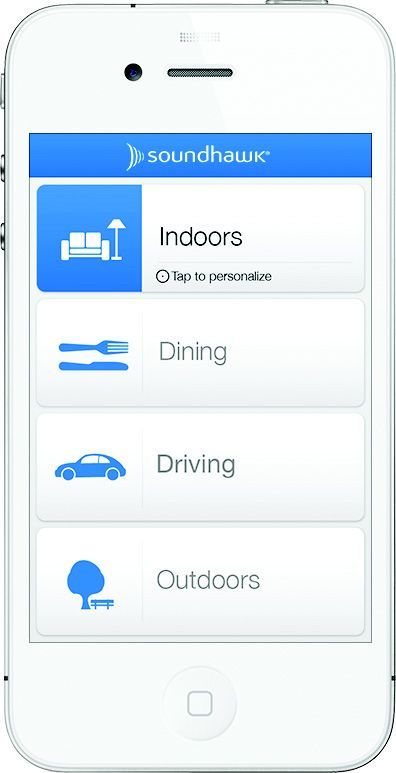
soundhawk app showing different environments it can be set toSoundhawk, a company on a mission to transform the listening experience, has introduced a new "hearing aid" that not only looks visually pleasing but comes with a lot of features that the regular hearing aid does not typically deliver. Soundhawk comes with a "Scoop" - the earpiece part that sits snugly in the ear (and doubles as a Bluetooth headset that syncs with your phone and lets you talk and listen to audio). It has a little microphone that amplifies sound around the wearer. If they are in a louder setting (think restaurant), they can use the mic (separate accessory) and place it in the direction the sound is coming from, and it picks it up and beams straight to the ear. Soundhawk is also accompanied by an app that lets you adjust the scoop to the environment you are in - outdoor indoor, dining or driving. Once selected, the wearer moves their finger on a touch interface to adjust the volume for the Scoop. 

The scoop has an eight hour battery life and the charging case extends its life to 24 hours. 


Pre-order for this device starts today at $280 and the price will go up to $300 after launch. On average, a decent hearing aid costs approximately $1,500. Head to the website to learn more and to pre-order! 

Source:  Techcrunch, Gizmodo
Video source: http://soundhawk.com/ 

Selasa, 06 Mei 2014

CDesk EDGE: Tablet For People With Visual Impairment

picture of CDesk EDGE tablets


We already know that CDesk is a wonderful suite of applications for people with visual and/or cognitive disabilities. The suite consists of, among other things, special filters for browsers that strip all images and links from the page to make reading easy, as well as simple to use word processor, and its own media and book section.

To make things easier for its users, AdaptiveVoice has recently launched two tablets with "EDGE" capabilities that will allow users to use CDesk on the go. The tablets come in two sizes - 11 and 8 inches, and run full Windows 8.1, and come with 2 GB of RAM and a powerful processor. Besides CDesk, these tablets run all Windows programs as well.

The tablets come with a folio keyboard and a stand that provide three additional USB ports. The CDesk interface is designed to handle touch input very well - in fact, most of the CDesk applications can be accessed using just thumbs. As demonstrated in the video, the interface has different spots assigned to different functions which enables navigation and use much easier. Of course, EDGE has Peggy too, CDesk's speech recognition software which works really well on the tablet. Imagine sitting under a tree on a warm, sunny day (summer's almost here!) and dictating your thoughts to peggy while sipping on a nice, cold beverage! Wouldn't that be nice?

Especially beneficial for people with low or no vision, the EDGE tablets are priced at $2,295 (11 inch) and $995 (8 inch) respectively. Both the products are shipped nationwide in the US without any extra cost, and come with excellent technical support.

Watch the video to see the EDGE tablet in action.


Click here to read more about CDesk.

CDesk/ EDGE website: AdaptiveVoice


Sabtu, 30 November 2013

VoiceMyMail: One Seamless Web Email Interface For Blind Users

image showing voicemymail interface

In the heart of Europe, there is a team of very talented and dedicated people that is working on making email easily accessible to blind users by creating one single robust web interface that integrates seamlessly into their lives, and thus narrowing the digital divide between seeing users and visually disabled users.

But what does that mean? And Isn't email already accessible?

For visually impaired users, a lot has been offered in the last so many years that provide ease of use and communication. However, in the grand scheme of things, the features offered don't seem seamless and easy - there is usually a software that needs to be installed and then configured for use. This also means that if a user is at a different location or on a different computer, they may find it very difficult or nearly impossible to use their web based email.

The folks behind VoiceMyMail have a very solid philosophy - they don't want blind users to struggle with installations and configurations; they want users' web mail interface to be accessible the moment they sign in. Unfortunately, most of the popular email providers do not offer adequate solutions to visually impaired users, as a result of which, they have to resort to obsolete desktop clients that offer features that are clunky and not the greatest.

The team doesn't want blind users to give up the ease and comfort of web based email interfaces just because they don't provide accessible features. They don't want blind users to go through a stressful training of those numerous keyboard combinations just to perform simple operations like sending emails or downloading attachments. It goes without saying that the ideal way to access web mail would be from anywhere, not just from that one computer that has the user's desktop client installed. Keeping all this in mind, the folks behind VoiceMyMail have created a new web surfing logic called "MyMail Philosophy" which lets the user perform essential operations in not more than three steps! All in all, the idea is to not let visually impaired users think that they are disabled.

This image shows how VoiceMyMail compares to other popular email providers like Windows Live Mail and Gmail.
This image shows how VoiceMyMail compares to other popular email providers like Windows Live Mail and Gmail. Click image to enlarge.
The team has been working hard on making this project global - meaning they want the VoiceMyMail interface to work with any and every email provider from across the globe. So essentially, whoever your email provider may be, the VoiceMyMail interface will work with all of them seamlessly and flawlessly. They are currently seeking funding from the happy citizens of the web to make this dream a reality.

"We would like to make the Internet, if not a better place, at least a comfortable place for everybody", says Salvatore Satta, Campaign Director of VoiceMyMail.

If you are interested in making a web email interface come to life that will work with all the email providers and make essential features easily accessible (without the need of a mouse!), head over to VoiceMyMail's Indiegogo funding page to donate, or to read more about this campaign and spread the word.

Here's the VoiceMyMail team and a couple of blind users telling you more about VoiceMyMail.


Head to their funding page to learn more, donate or spread the word.

Minggu, 14 Juli 2013

Glove That Helps Deaf-Blind People Communicate

Image Source: The Atlantic

Tom Beiling, a 32 year old doctoral candidate in Berlin, has come up with a glove that just might revolutionize the way deaf-blind people communicate, at least in the form of texting. 

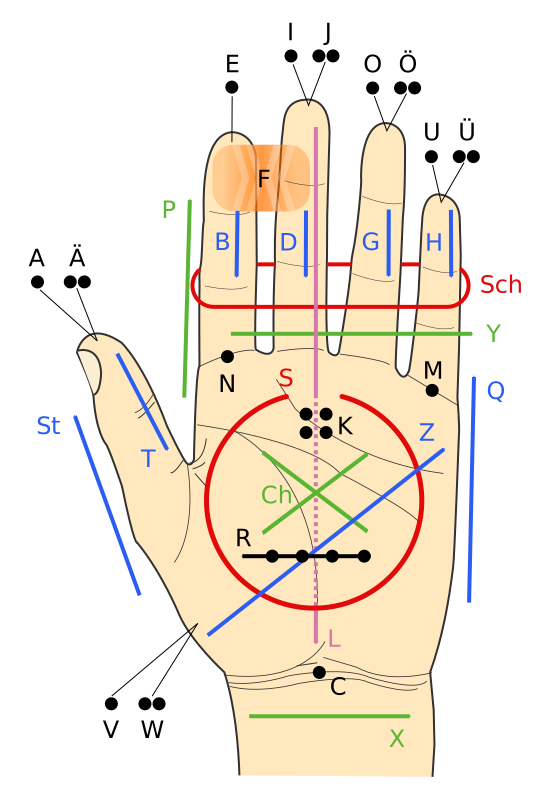
Image showing Lorm alphabetWith the intention of making communication easier between people who cannot see and hear, Tom has developed a glove that translates texts into pulses (haptic feedback). The glove consists of a set of pressure sensors, and with the help of a bluetooth device, connects to an iPhone app. The glove uses the Lorm alphabet (which places letters at different parts of  the hand (see image)), and a pressure sensor is placed at the locations that are meant for letters (for example, fingertips are meant for vowels). 

When someone needs to send text, the user just pushes the sensors meant for the alphabets that comprise of the words that they are wanting to send, and the haptic information from the tapping is converted to digital text and sent to the iphone app that sends out the message to the intended recipient. When the recipient receives the text, the motors on their glove vibrate and translate the words into vibrations, and they feel the vibrations on the pressure sensors. The vibrations essentially spell the words out. 

One advantage of using this glove to communicate is that you don't have to know Lorm alphabet to communicate  with  someone who is deaf-blind - the app converts digital text to Lorm alphabet for them. Till now, one had to know Lorm alphabet in order to communicate with people with deafblindness. 


The glove is still a prototype. Beiling's next prototype would probably be made out of material that is thinner than the one used for the current prototype.

Source: The Atlantic
Mas Kur. Diberdayakan oleh Blogger.

 
biz.