Tampilkan postingan dengan label multiple sclerosis. Tampilkan semua postingan

Selasa, 08 Juli 2014

Neurobridge: Technology That Helps Paralyzed People Move Limbs With Their Thought

Ivan using Neurobridge technology to move his arm with his thought

Spinal cord injuries/ paralysis are fatal because they cut off communication between the brain and limbs - damaged nerves are unable to transfer signals from the brain to limbs, thus rendering them unusable. However, just recently, a team of scientists from Ohio State University and Battelle partnered together to use a breakthrough technology called Neurobridge (created by Battelle) that helps quadriplegics move their limbs with just their thought!

Ivan seen using Neurobridge technologyAs mentioned earlier, nerves are crucial for limb movement, and fatal accidents that cause injuries to the
spine and damage nerves drastically impact limb movement. This is where Neurobridge comes to rescue. A little chip (smaller than a pea) is implanted in the part of the brain that controls arm and hand movements. This chip reads and interprets brain signals, sends them to a computer that recodes and sends them to a sleeve that the patient is wearing, and simulates the proper muscles, thus allowing them to move the desired limb. It takes a total of one tenth of a second from thought to limb movement. So essentially, it totally bypasses the (damaged) nerves responsible for transmitting signals from the brain to the limb and sends them directly to the muscles instead.

Watch this video to see Ivan Burkhart, a 23 year old quadriplegic who was paralyzed after a diving accident move his arm by using Neurobridge.


This is still a clinical study (FDA approved) that is working with five patients. Currently, the study is focussing on arms and hands, but the possibilities in the future are endless. To begin with, brushing their teeth, flossing, using their own hands to eat with a spoon or fork etc. can be a huge boost to a paralyzed person's morale and confidence.

What the scientists have achieved so far is a big step forward, and they are only going to continue to make such advancements in the future. 

Watch the video to learn more about paralysis and how this technology works. Hit the source links for more details.

Senin, 27 Januari 2014

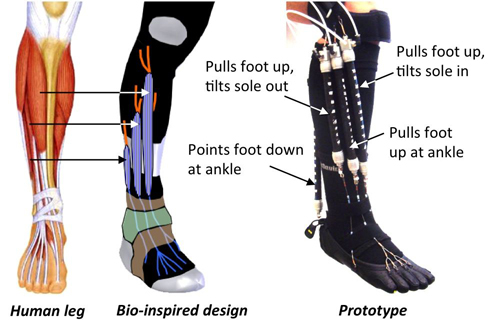
Robotic Device That Mimics Human Leg Could Help With Rehabilitation

diagram explaining how this device mimics the biological leg


Yong-Lae Park, an assistant professor at Carnegie Mellon University, has developed a device made of soft, wearable material that could help in the rehabilitation of patients with neuromuscular disorders associated with cerebral palsy, amyotrophic lateral sclerosis (als), multiple sclerosis or stroke, and ankle-foot disorders like drop foot.

This device, composed of soft plastics and composite materials, mimics the muscles and ligaments of the human leg, and is not rigid like an exoskeleton because of which it has the ability to incorporate lightweight sensors and ultimately achieve natural motion by mimicking the biological structure of the lower leg. This device's composition allows the wearer to achieve a normal walking gait (moving the foot side to side at 27 degrees).

Park says that this device can be modified to create rehabilitation devices for other parts of the body too. The next steps with this device are to determine its performance as a rehabilitation tool and also to use much lighter material to form the "muscles" of the leg.

Here is a quick demo of this device.


Source: Carnegie Mellon via Gizmodo

Kamis, 28 Februari 2013

Surgery Helps Paralysis Patients Walk Again

paralytic patient on treadmill

Dr. Justin Brown, a neurosurgeon in San Diego, is helping patients suffering from paralysis walk again!

Most recently, he helped Rick Constantine, 58, who, following a car crash had a brain stem stroke which resulted in paralysis of the right side of the body. He was told that he would never be able to walk again. He tried physical therapy but that gave him unsubstantial benefits.

The surgery that Dr. Brown performed on Rick is called a selective peripheral neurotomy and is done under a microscope. Essentially, this surgery trims the troublesome nerve branch by up to 80 percent, thus reducing the amount of "noise" being sent back to the spinal cord. The noise is what causes the spasticity.

Rehabilitation can begin 72 hours after the procedure. Rick was walking without a walker two weeks after the procedure and even finished a 1 mile race without any assistance.

Watch the video to see what Dr. Brown's patients are saying about their experiences. Dr. Brown also explains the surgery in great technical detail.


Anyone requiring more information about this surgery should call 858-657-7000.

Source: UC San Diego Health System, Science Daily via Bill Shackleton

Minggu, 05 Agustus 2012

Low Cost Eye Tracker To Control Computer

Researchers at Imperial College London have invented a device made from off the shelf video game equipment that tracks eye movement, thus allowing users (especially stroke victims; people with bad motor skills, Multiple Sclerosis, Parkinson's, muscular dystrophy, spinal cord injuries or amputees) to control a cursor on a screen.

a user wearing the glasses with video cameras for demonstration
Image source: The Inquisitr
The device comprises of two video game cameras that are attached to a pair of glasses. The cameras, facing the eyes, keep track of movement of pupils by constantly taking pictures, and these pictures are used in a calibration process to figure out where exactly the person is looking at the screen.

For demonstration purposes, subjects were asked to play the video game "Pong". The subjects controlled the movement of the paddle with their eyes, which was tracked by this device. It was noted that all six subjects were able to play the game comfortably only within ten minutes of using the device for the first time. In addition to playing the video game, they were also able to browse the web and write emails.

This device transmits data over wi-fi or USB to Windows or Linux computers, and is built from parts that cost no more than $30, thus appropriately being called a "frugal innovation" by its inventors.

Watch this video to see a demo of this device that tracks eye movement precisely, and yet is thousands of times less expensive than commercial devices.


Source: Phys.org
Full free article: IOPScience
Mas Kur. Diberdayakan oleh Blogger.

 
biz.