Tampilkan postingan dengan label cerebral palsy. Tampilkan semua postingan

Minggu, 10 Agustus 2014

Talkitt - App/ Software That Lets People With Speech Impairment Communicate In Any Language Using Their Voice

image showing talkitt for different devices - computer, tablet, smartphone, wearable devices like google glass and smart watch.


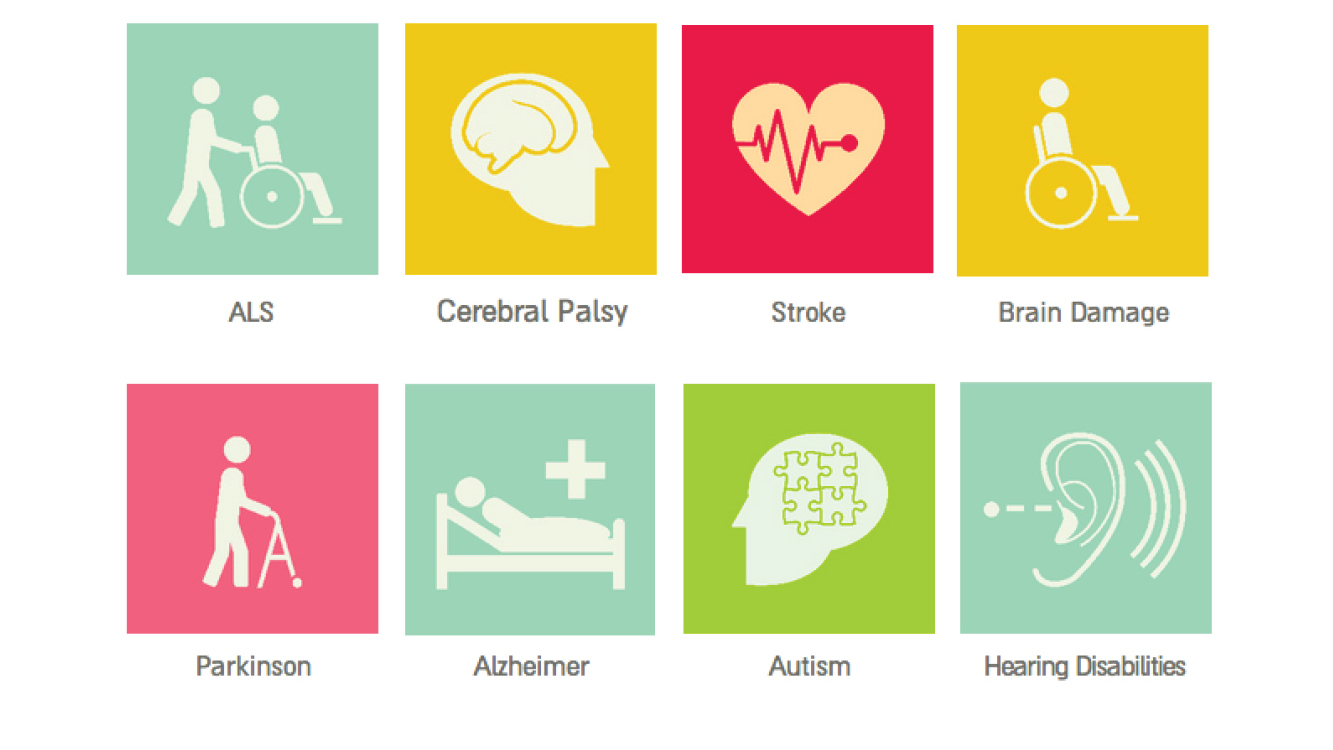
image showing various medical conditions that can cause speech impairment - ALS, cerebral palsy, stroke, brain damagem parkinson, alzheimer, autism, hearing disabilitiesIn many cases, disabled users with speech disorders find it extremely difficult to communicate, primarily because people around them have difficulty understanding their speech. Speech disabilities can be caused by a variety of conditions including Cerebral Palsy, Autism, Brain Damage, Parkinson's and many more. It is a struggle not just for those who have speech disorders but also for their caregivers and loved ones. In the recent past, various companies have come up with text to speech apps and software that let users either type or choose words that are spoken by the app, and thus help the users communicate. However, the one aspect that these apps sideline is the fact that the users are very much capable of speech and would ideally like to use their natural mode of communication.


a lady with speech impairment ordering coffee at a coffee shop using talkitt on a tablet.
Talkitt, a new "speech to speech" app in the works, plans to give disabled users more freedom and expression in the most natural way possible - it helps them communicate by just using their voice. Talkitt has the ability to recognize the user's vocal patterns and translate them into words that are more understandable. As you will see in the video below, it does a very good job of translating unintelligible pronunciation into perfect sentences with utmost accuracy. This also means that Talkitt works very well with any spectrum of speech severity - from mild to extreme.The best part about this app is that it is not just limited to English - it can translate any language the user is speaking! 

The accuracy of this app will let users gain more confidence, and encourage them more to use their speech to communicate, not to mention that it will make communicating easier and convenient for their family, friends, and caregivers as well.


Very soon, Talkitt will be available on all smartphones and tablets. The next phase will see it run on computers and wearable devices, giving much more flexibility to users wherever they are. Once Talkitt is available, there will be a monthly subscription charge of $19.99 per month.

Currently, it is being tested by various partners and hospitals in Israel and Europe, and there is also a Indiegogo funding campaign going through which the team behind Talkitt is raising money to get it out to the masses quick (as soon as Q1 of 2015). Visit the Indiegogo page if you want to contribute to this campaign.

Definitely watch the video below to see the inspiration behind this app and what the team is doing to make this app a reality.

Minggu, 27 April 2014

Google Glass: For People With Parkinson's Disease?

Woman wearing google glass

Wearable technology has gained a lot of momentum in the last year or so. The most popular, or should we say notorious, wearable tech that has come out is Google Glass, which has received both praise and backlash from different groups because of all the things that it can do. Taking pictures, making videos, sending emails, finding directions, setting reminders - everything can be done with just a few voice commands or gestures. While society debates whether or not Google Glass should be allowed to be worn everywhere, there is a group of researchers that is busy making Google Glass extremely useful for people with a certain disease - Parkinson's.

Since Parkinson's causes shaking/tremors,  sudden stiffness of limbs , posture instability, "freezing" besides mood swings and cognitive changes, scientists at Newcastle University are exploring various ways to see how Google Glass can be used to help people with Parkinson's, thus providing workarounds to live a life that's not constantly hampered by symptoms that ultimately bring down confidence levels in the person dealing with them.

One area that's being looked at is setting reminders. Since patients are required to take medication everyday and on time, Google Glass can easily send regular reminders to the patient reminding that they should take their medication. Reminders would not only tell them when to take their medication but how/ with what (water; food - different combinations at different times of day).  Similar discrete reminders can be sent to the patient to remind them to swallow their drool - a common problem with people with Parkinson's disease because of lack of motor control. 

Another common symptom is freezing, where the patient just gets stuck and is unable to walk. In such cases, the patient would want to call someone who could come get them, but calling on a phone with a touch screen can become a big hassle for someone with not so good motor skills. Google Glass can be helpful in such situations because someone can be easily called by just using voice commands. Since it is always connected to the Internet, friends and carers will be easily able to see where the patient is, and would come and get them.

Google glass also has maps and directions. If someone is out and about, chances of them getting lost are minimal because Glass displays turn by turn directions too, thus providing relief to not just the patient but also family and friends.

This video shows the researchers tell us in detail about their research:


The research is still at its very early stages, but what the volunteers with Parkinson's, who helped test Google Glass, say is remarkable. They are happy with what they experienced, and they thought that Glass really helped them control symptoms and live a normal life. Hit the source link to read their testimonial. 

Let's hope we get to hear more about this research in the future!

Source: Newcastle University via Gizmodo
Image source: Ubergizmo

Senin, 24 Maret 2014

VocaliD: Donating Your Voice To People With Speech Impairment

An image showing voice synthesis

We never give too much attention to our voice - it is one of the things we take for granted. However, there are millions of people around the world who were either born with a speech impairment or lost their voice because of a stroke, or some serious disease like Parkinson's or Cerebral Palsy. Learning new ways to communicate either using sign language or any other accessible device with limited/generic synthetic voices may not be a weapon of choice for many, especially the ones who lose their perfect voice later in their lives because of a disease.

That is where VocaliD comes into the picture. VocaliD is a company that is trying to bridge all sorts of gaps and helping people with speech impairments communicate using natural voices. 

But what does that exactly mean?

VocaliD consists of a team led by Dr. Patel who listens to the limited sounds of patients with speech impairments. These sounds help the team understand what this person's voice may sound like if it were high pitched, raspy, etc. Once they have the patient's sounds, they look for a surrogate - a person of the same age and sex who has no speech impairment. This surrogate is made to record thousands of sample sentences (from books like White Fang, The Wonderful Wizard of Oz, and The Velveteen Rabbit). The two voices of the patient and surrogate are then blended and broken down into tiny units of sound that can then be used to construct words! The hybrid of the two voices makes the final voice very natural and personalized,  and not so synthetic.

(To read more technical details on how this is done, go here.)

This is a big improvement in communication because the listener gets more information from how a person speaks than just the content of what they say. 

Currently, the process requires that the surrogate come to a studio to record their voice but VocaliD plans to release a phone or web app so that anyone could record their voice from locations most convenient to them (their home, for example). This makes more sense because recording thousands of sentences takes many hours, and surrogates who volunteer to donate their voices would ideally like to do it in 15 - 20 minute sessions over a period of days. The team is also planning on creating a game to encourage children to record their voices.

VocaliD is looking for volunteers from around the world to donate their voices, and if you are interested, head to their website to sign up.

If you are interested in receiving a personalized voice, you can sign up for that here.

Website: vocalid.org

Source: NewScientist 

Senin, 27 Januari 2014

Robotic Device That Mimics Human Leg Could Help With Rehabilitation

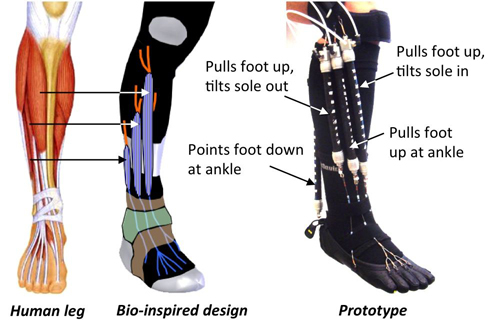
diagram explaining how this device mimics the biological leg


Yong-Lae Park, an assistant professor at Carnegie Mellon University, has developed a device made of soft, wearable material that could help in the rehabilitation of patients with neuromuscular disorders associated with cerebral palsy, amyotrophic lateral sclerosis (als), multiple sclerosis or stroke, and ankle-foot disorders like drop foot.

This device, composed of soft plastics and composite materials, mimics the muscles and ligaments of the human leg, and is not rigid like an exoskeleton because of which it has the ability to incorporate lightweight sensors and ultimately achieve natural motion by mimicking the biological structure of the lower leg. This device's composition allows the wearer to achieve a normal walking gait (moving the foot side to side at 27 degrees).

Park says that this device can be modified to create rehabilitation devices for other parts of the body too. The next steps with this device are to determine its performance as a rehabilitation tool and also to use much lighter material to form the "muscles" of the leg.

Here is a quick demo of this device.


Source: Carnegie Mellon via Gizmodo

Minggu, 15 Desember 2013

Unus Tactus Lite And Enhancements To Full Version

Unus tactus interface shows geofencing - a radius of 1 mile set for a user.Unus Tactus interface shows pictures of contacts with help button


A while ago I wrote about this wonderful yet simple app called Unus Tactus that provides an easy interface for people with motor/ cognitive deficits to make phone calls and notifies their emergency contacts if they get disoriented or lost and exit the "fence" (a radius in miles that has been set for them that's considered safe) . Recently, Unus Tactus released the lite version of the app that lets you try and test it before you buy the full version for $9.99. The lite version lets you add just one contact and does not have "geofencing" capabilities.

In the full version of the app, some features have been added and refined, like:
  •     Easy set up and editing of an unlimited number of photo/phone contacts.
  •     Alphabetizing of contacts with picture and name display of every contact.
  •     Customizable emergency contact e-mail and phone number.
  •     Emergency button for fast help with a Google maps link to ID phone caller location.
  •     E-mails with a map link location sent to the emergency contact after every outgoing call
  •     �Geo-fence� feature with 5 different distance settings up to 15 miles.
  •     Automatic e-mail with Google Map and, iCloud link if phone exits geo-fence area with out call being made. (All E-mail notifications are On/Off switch able).
Check out this video to see how easily the app can be set up. 


The lite version can be downloaded here, and the full version here.

To read the full press release that has more details on the app and new enhanced features, go here.

Unus Tactus website: www.unustactus.com 


Senin, 17 Desember 2012

Project SuperPop: Use Of Kinect For Improving Motor Skills

Is there anything Kinect cannot do?
 
Scientists at Georgia Tech's Human-Automation Systems Lab are working on a project (Project SuperPop) that would help therapists better kids' motor skills and gather a ton of data that would allow them analyze progression/ regression during rehabilitation.
 
The set up is very simple - all it has is a Kinect and a display. What the children see on the display is a game that requires them to pop balloons. Typically, kids would get excited and start popping those balloons right away, but what they wouldn't know is that the good ol' Kinect is tracking their arm movements and sending all the data to a computer!
 
This data can be used by therapists in evaluating the progress kids are making and for giving them the necessary direction required for bettering their motor skills. This setup has been designed for kids (especially the ones with Cerebral Palsy) that need to enhance their motor skills.
 
An extremely simple arrangement that can  be extremely beneficial! What are your thoughts on this? Would something like this be widely accepted by therapists?
 
Watch the video for a demo of Project SuperPop.
 

Source: Engadget
 

Minggu, 25 Maret 2012

Christopher Hills - Video Editor With Cerebral Palsy

Meet Christopher Hills - a young boy who uses Apple products to edit videos. Christopher has Cerebral Palsy, which essentially makes it impossible for him to use a traditional computer setup. To operate his computer, he presses a switch on the back of his chair with his head, which in turn is connected to a Discover Switch, a device that gives full keyboard & mouse functionalities to people with severe motor impairment.

Watch the following videos to see Christopher's amazing work. He explains his setup in the first video.


After this video became a huge success on youtube, Christopher decided to produce more videos that would show him interacting with technology to produce videos, do web design, and interact with other people online.


Keep an eye on this remarkable lad's youtube channel (icdhills) to see his work!

Source: The Verge

Selasa, 30 Agustus 2011

Frankenkindle - Brother Hacks Kindle For Sister With Cerebral Palsy


What a sweet brother he is! Glenn, an electrical engineer, worked for months on modifying the Kindle (eReader) to make it more suitable for his sister's needs who has Cerebral Palsy. During a visit to Best Buy he noticed that his sister really liked the buttons on the V.Reader. The problem was..it had books only for children.

Glenn bought the V.Reader and worked on it for months modifying it for his sister (and posting regular updates on his blog). He finally managed to connect the V.Reader controller buttons to the Kindle,   finished the prototype around ten days ago, and posted a video of the Frankenkindle in action. He thinks it is a little slow right now, although he is not too much worried about it. He is glad that it is able to provide the functionality he was looking for.


This project is open source, and the code for the demo in the video can be found here.

Source: Makezine via Engadget

Glen's blog: Breadboard Confessions
Mas Kur. Diberdayakan oleh Blogger.

 
biz.