Tampilkan postingan dengan label autism. Tampilkan semua postingan

Kamis, 26 Februari 2015

Calming Chair For Children On The Autism Spectrum

Joshua Jackson trying the calming chair

Quite often, children on the Autism spectrum find it extrremely hard to deal with stress and anxiety, resulting in tantrums, meltdowns and hyperactivity. It is also well known that hugging or snuggling with them (applying deep touch pressure) can calm them down, thus resulting in reduced tantrums and meltdowns.

To provide comfort to children in the form of non human touch pressure, there are solutions available in the market. However, these solutions are clunky, noisy, impractical and of course, expensive. Such "squeeze machines" or "hug machines" are 5 feet by 5 feet, weigh 300 lbs, have big industrial sized compressors, and cost several thousand dollars.

To come up with a practical and more affordable solution, Stuart Jackson, father of Joshua who is opn the Autism spectrum, challenged some engineering students to design a chair that was quiet, light and pleasing to the eye.

After a lot of brainstorming and ideas, the students came up with a design that involved a papasan chair and several other items. Inflatable air bags were put on top of the chair, topped by vinyl covers and a swimming noodle around the edges for cushion. The pressure in the air bags is regulated by a hand held remote that controls an air mattress pump. This entire arrangement is covered by a removable stretch fabric.

This chair, which has been checked for safety, weighs 30 to 40 lbs and costs less than a thousand dollars. There is a "lounger" as well that weighs 70 lbs for around the same price.

The students took it to an elementary school to test it and noticed that children, although a little uneasy in the beginning, started embracing and enjoying it as the chair inflated around them.

Now that they have the concept and substantial testing has been done, the students will interview parents of children on the Autism spectrum to gauge if there is indeed a bigger market for this chair. Once that's established, mass production of this chair will begin.

Let's wish these students the best and hope we get to see these chairs in the market soon!


[Thanks for sharing, Bridget!]

Selasa, 30 Desember 2014

Look At Me: Android App For Kids With Autism To Help Improve Eye Contact


There are over 60 million people around the world that have autism. Usually, children with autism struggle with making eye contact with others and displaying social skills. However, recent studies have found that autistic children love technology, especially smart devices. Keeping that in mind, Samsung, with the help of various psychologists, psychiatrists and designers has developed a free Android app that helps children improve their ability to make and sustain eye contact and interpret facial expressions.

The free app "Look At Me" uses the camera app of the phone and consists of seven interactive and engaging missions that make kids remember faces, understand a person's mood, and also lets them take photos of themselves exhibiting various expressions. Through this app, children are expected to learn diverse ranges of emotions like happiness, fear, and surprise. The addition of sound effects, point system and rewards along the way keep kids motivated.

Over a period of 8 weeks, 20 children, used the app daily for 15 minutes, and it was noticed that 60% of the children showed improvement in making eye contact.

If you know a child with Autism that may benefit from this app, head to Google Play to download and use this free app.


The "Look At Me" project is also donating 200 tablets with this app preloaded to families in Canada so they could share results and help the community. To know more or to join this project, follow this link.

Source: Samsung via Engadget

Minggu, 10 Agustus 2014

Talkitt - App/ Software That Lets People With Speech Impairment Communicate In Any Language Using Their Voice

image showing talkitt for different devices - computer, tablet, smartphone, wearable devices like google glass and smart watch.


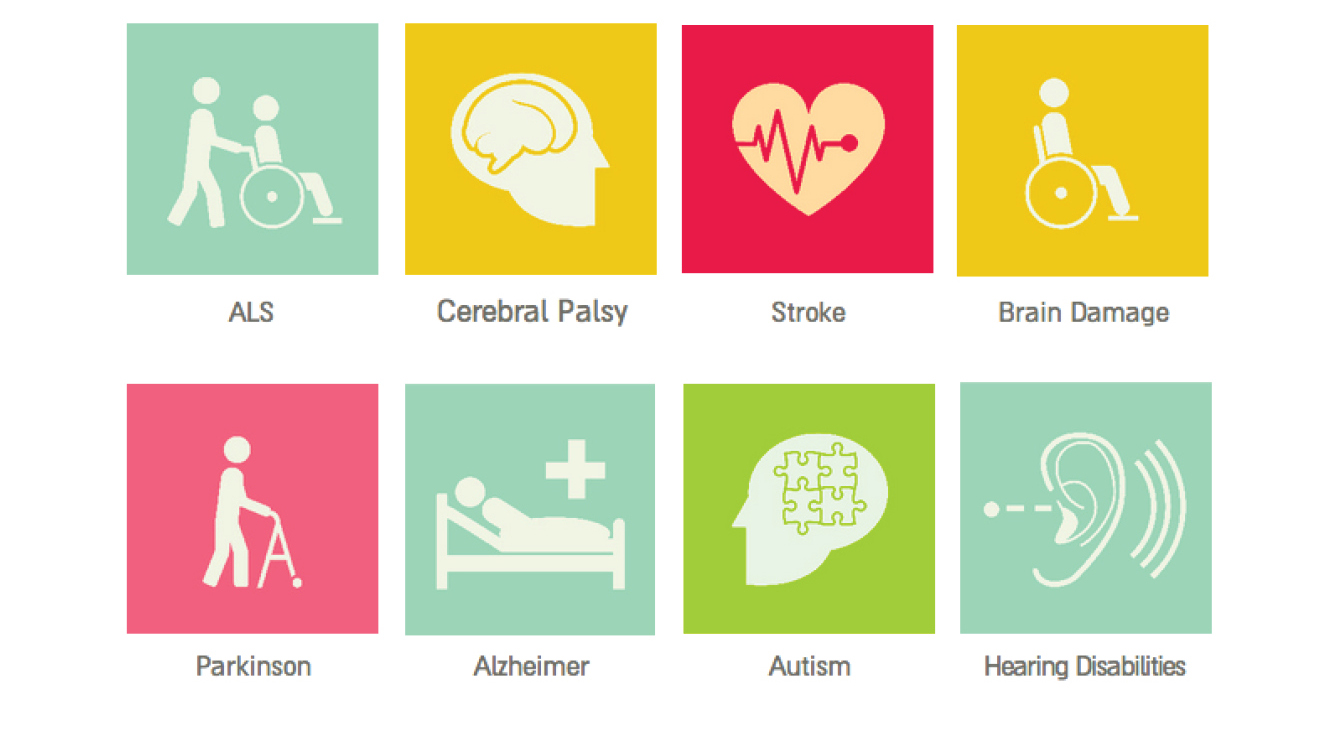
image showing various medical conditions that can cause speech impairment - ALS, cerebral palsy, stroke, brain damagem parkinson, alzheimer, autism, hearing disabilitiesIn many cases, disabled users with speech disorders find it extremely difficult to communicate, primarily because people around them have difficulty understanding their speech. Speech disabilities can be caused by a variety of conditions including Cerebral Palsy, Autism, Brain Damage, Parkinson's and many more. It is a struggle not just for those who have speech disorders but also for their caregivers and loved ones. In the recent past, various companies have come up with text to speech apps and software that let users either type or choose words that are spoken by the app, and thus help the users communicate. However, the one aspect that these apps sideline is the fact that the users are very much capable of speech and would ideally like to use their natural mode of communication.


a lady with speech impairment ordering coffee at a coffee shop using talkitt on a tablet.
Talkitt, a new "speech to speech" app in the works, plans to give disabled users more freedom and expression in the most natural way possible - it helps them communicate by just using their voice. Talkitt has the ability to recognize the user's vocal patterns and translate them into words that are more understandable. As you will see in the video below, it does a very good job of translating unintelligible pronunciation into perfect sentences with utmost accuracy. This also means that Talkitt works very well with any spectrum of speech severity - from mild to extreme.The best part about this app is that it is not just limited to English - it can translate any language the user is speaking! 

The accuracy of this app will let users gain more confidence, and encourage them more to use their speech to communicate, not to mention that it will make communicating easier and convenient for their family, friends, and caregivers as well.


Very soon, Talkitt will be available on all smartphones and tablets. The next phase will see it run on computers and wearable devices, giving much more flexibility to users wherever they are. Once Talkitt is available, there will be a monthly subscription charge of $19.99 per month.

Currently, it is being tested by various partners and hospitals in Israel and Europe, and there is also a Indiegogo funding campaign going through which the team behind Talkitt is raising money to get it out to the masses quick (as soon as Q1 of 2015). Visit the Indiegogo page if you want to contribute to this campaign.

Definitely watch the video below to see the inspiration behind this app and what the team is doing to make this app a reality.
Mas Kur. Diberdayakan oleh Blogger.

 
biz.