Tampilkan postingan dengan label ALS. Tampilkan semua postingan

Kamis, 04 Desember 2014

Ubi: A Voice Controlled Device That Converts Speech To Actions

photo of ubi on a side table by a couch


There is a device in the market that just might be the ultimate device for anyone with limited mobility and/or vision impairment - a device that just sits around and does pretty much anything you want.

Say  hello to the Ubi!

The Ubi is a hands-free, voice operated device that connects to the wifi and converts commands in natural speech to remarkable actions. It can pick up your voice from up to 8 feet, and can be used to do several things like sending text messages and emails to contacts, listening to music (free music streaming service), looking up information on the internet, controlling your home thermostat, controlling lighting in your house, locking doors, making announcements to family ("come down, kids! Dinner's ready."), setting reminders for yourself, getting important updates and alerts, controlling other internet connected devices...the options are endless! All one has to do is say "OK Ubi.." and say what they desire!

It's an amazing device for someone who may have bad motor skills, limited mobility, or vision impairment - it makes communication extremely easy for them and alleviates their dependence on others.

Be sure to check out their blog too. They post about all the amazing things Ubi can do.

The Ubi is priced at $299 and can be ordered directly from its website.

Watch the following video to see the Ubi in action!


Website: http://www.theubi.com


Senin, 15 September 2014

TALK: AAC Device That Converts Breathing to Voice

Sixteen year olds are always busy making great inventions, right? 

photo of Arsh DilbagiArsh Dilbagi from India is a finalist in the Google Science Fair 2014 with a device that is possibly going to change the lives of many people with developmental disabilities.

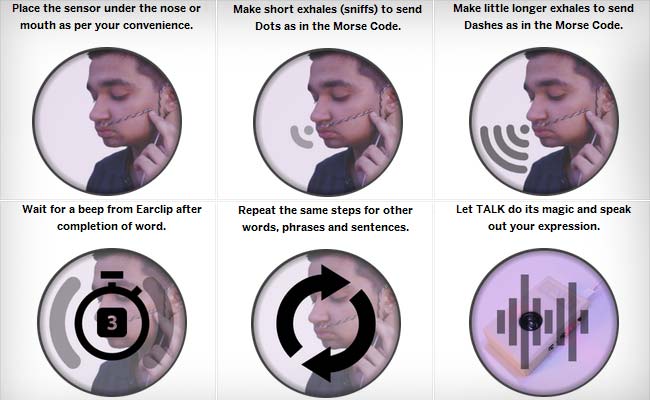
Arsh's invention, called TALK, is a new AAC device that let's a person with speech impairment and/or developmental disability to talk by using just their breath. The device has a sensor that is placed right below the nose or mouth, depending on the user. The user then breathes on the sensor in two types of bursts - a short burst for a dot and a longer burst for a dash. Yes, you guessed it right - this device is based on the Morse Code. These dots and dashes are then processed and converted into phrases and sentences by the internal processor and then sent to another processor that outputs the sentences into voice. 

TALK has two modes - one for communicating which is in English, and the other to gives specific commands which can be outputted in nine different languages and accents according to gender and age group. Arsh suggests that the price of TALK is only approximately $80 whereas other AAC devices that are generally used by people with motor-neuro disabilities can cost upward of $7,000. One significant advantage of this device is that since it is so small (the size of a cell phone), it can be carried by people with them all the time. They will also not be bound to a wheelchair to be able to use it. Another advantage is that people will not be twitching their muscles all the time thus causing muscle strains etc.

image showing how to use TALK
Click to enlarge
On a single charge, TALK can run for more than two days and is quite comfortable to wear.

Visit Arsh's Google Science Fair 2014 page to learn more about him and his project in greater detail. Don't forget to watch the videos below to get an understanding of what TALK does.


Source: Times of India
Image Sources: Google Science Fair 2014, NDTV

[Thank you for sharing, Savitha and Abhinav!]

Minggu, 10 Agustus 2014

Talkitt - App/ Software That Lets People With Speech Impairment Communicate In Any Language Using Their Voice

image showing talkitt for different devices - computer, tablet, smartphone, wearable devices like google glass and smart watch.


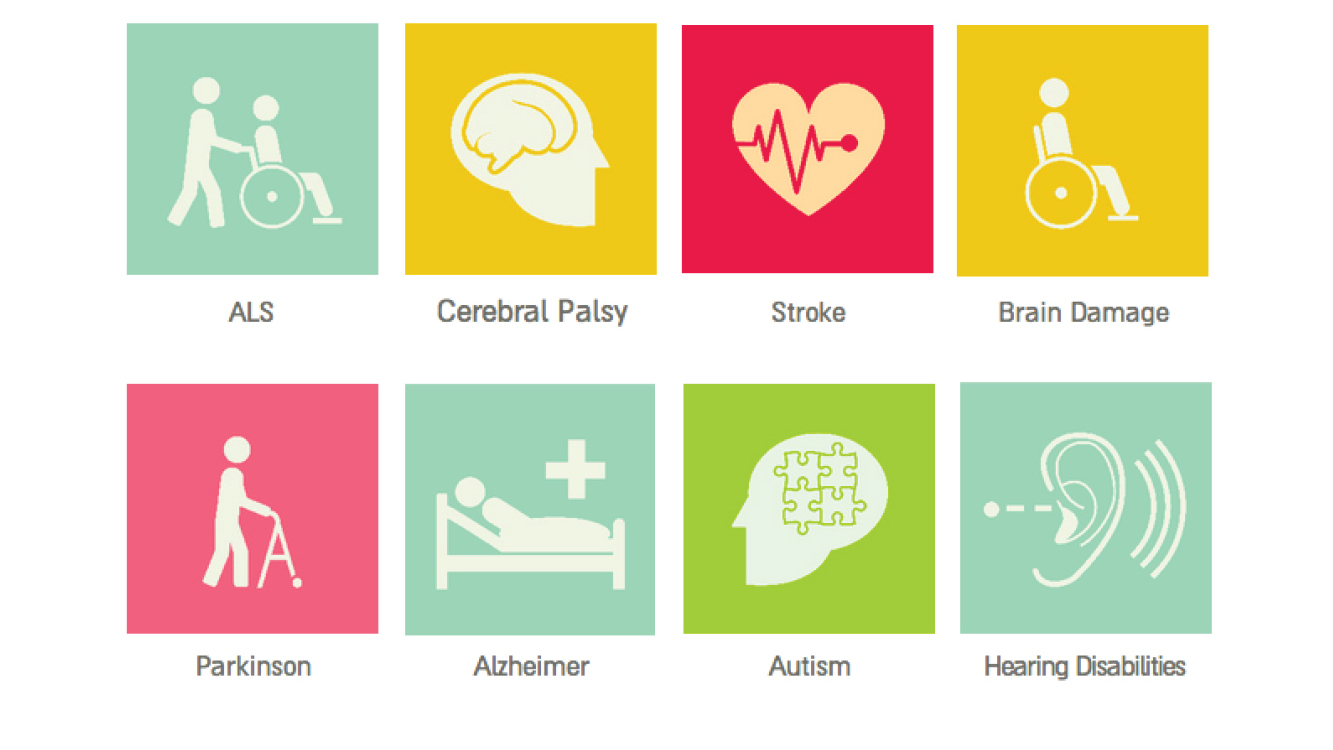
image showing various medical conditions that can cause speech impairment - ALS, cerebral palsy, stroke, brain damagem parkinson, alzheimer, autism, hearing disabilitiesIn many cases, disabled users with speech disorders find it extremely difficult to communicate, primarily because people around them have difficulty understanding their speech. Speech disabilities can be caused by a variety of conditions including Cerebral Palsy, Autism, Brain Damage, Parkinson's and many more. It is a struggle not just for those who have speech disorders but also for their caregivers and loved ones. In the recent past, various companies have come up with text to speech apps and software that let users either type or choose words that are spoken by the app, and thus help the users communicate. However, the one aspect that these apps sideline is the fact that the users are very much capable of speech and would ideally like to use their natural mode of communication.


a lady with speech impairment ordering coffee at a coffee shop using talkitt on a tablet.
Talkitt, a new "speech to speech" app in the works, plans to give disabled users more freedom and expression in the most natural way possible - it helps them communicate by just using their voice. Talkitt has the ability to recognize the user's vocal patterns and translate them into words that are more understandable. As you will see in the video below, it does a very good job of translating unintelligible pronunciation into perfect sentences with utmost accuracy. This also means that Talkitt works very well with any spectrum of speech severity - from mild to extreme.The best part about this app is that it is not just limited to English - it can translate any language the user is speaking! 

The accuracy of this app will let users gain more confidence, and encourage them more to use their speech to communicate, not to mention that it will make communicating easier and convenient for their family, friends, and caregivers as well.


Very soon, Talkitt will be available on all smartphones and tablets. The next phase will see it run on computers and wearable devices, giving much more flexibility to users wherever they are. Once Talkitt is available, there will be a monthly subscription charge of $19.99 per month.

Currently, it is being tested by various partners and hospitals in Israel and Europe, and there is also a Indiegogo funding campaign going through which the team behind Talkitt is raising money to get it out to the masses quick (as soon as Q1 of 2015). Visit the Indiegogo page if you want to contribute to this campaign.

Definitely watch the video below to see the inspiration behind this app and what the team is doing to make this app a reality.

Minggu, 13 November 2011

Wheelchair That Can Be Controlled Using Facial Expressions

Researchers at Japan's Miyazaki University have come up with a prototype wheelchair that has the ability to recognize facial expressions. This wheelchair is especially beneficial for people who have paralysis from the neck down or are losing power in their muscles due to Muscular Dystrophy/ALS. The wheelchair is very easy to use, and requires these facial expressions for movement:

Blink left eye: Turns wheelchair to the left.
Blink right eye: Turns wheelchair to the right.
Clench teeth: Wheelchair moves forward.
Clench teeth again: Wheelchair stops.

This wheelchair uses proximity sensors to determine if there are any objects in the path. If there is no obstruction, then the wheelchair speeds up, and if it detects something, it slows down. It stops when it is a meter away from an object.

The researchers soon plan to use wireless goggles instead of the facial electrodes to communicate with the wheelchair. This year they are testing it with muscular dystrophy patients and getting feedback. They plan to release a commercial version next year.

Watch this video for a demo:


Source: Gizmodo, Diginfo.tv, TechCrunch
Mas Kur. Diberdayakan oleh Blogger.

 
biz.