Tampilkan postingan dengan label stroke. Tampilkan semua postingan

Selasa, 04 November 2014

MusicGlove: World�s First FDA Approved Music-Based Hand Rehabilitation Device

When it comes to therapy for stroke patients, we picture mundane, boring exercises that they have to perform for months, and sometimes years. How great would it be to add excitement and fun  to the entire regime so that patients are actually motivated (and even look forward) to continue to exercise and feel better?

MusicGlove does just that. A glove that lets you play a Guitar Hero like game on a tablet or a bigger screen, it is meant for people who have survived strokes or have other neurological and muscular injuries that limit the movement of their hands. A study has shown that patients who use MusicGlove for therapy show significant improvement in their hand movements only after two weeks as compared to people who go through traditional therapy. It requires minimal interaction with the  therapist and the patient can "play" it whenever they want to.

Plus, there's music!

MusicGlove is priced at $1,149 (or $99 for 12 months) for the Home Version (comes with a 10 inch tablet) and $4,199 for the Clinic Version (comes with a 21 inch monitor.

Watch the video to see it in action and read the following press release to know more about MusicGlove - what it does, how it does it, and where to order it from.


Press Release

(Irvine, CA) - October 23, 2014 � Flint Rehabilitation Devices today introduced MusicGlove� (#musicglove), the world�s first FDA approved, clinically validated hand rehabilitation (#rehabilitation) device that uses music and gaming to make therapy (#therapy) fun and effective for the over six million people with stroke or other neurological or muscular injuries. The device, which helps increase users� attention span, neuropsychological scores, cognitive functioning, well-being and recovery, empowers them to regain their independence by delivering a motivating therapy regimen that significantly restores hand function in just two weeks (Friedman et al., 2014). MusicGlove is now available for purchase at www.musicglove.com/shop/ in both a Home Version from $1,149.00USD (or $99.00USD/month for twelve months) and a Clinic Version from $4,199.00USD.

The device features a sensorized glove that tracks a user�s hand movements. This allows them to play the included therapy-based game by completing specific movements along with scrolling notes displayed on a touch screen console that are timed to the rhythm of upbeat songs (similar to Guitar Hero). These movements, such as �pincer grasp� and �key pinch grip,� are vital to regaining the ability to use the hand after neural damage. MusicGlove motivates a high number of intensive and functional movements that have been proven[1] to lead to clinically significant improvements in hand function.

Picture of home version of MusicGlove that comes with the glove and a 10 inch tablet
MusicGlove is portable, easy-to-setup and easy-to-use so users can practice effective rehabilitation from the comfort of their home or on the go. Initial setup takes less than two minutes and requires no prior knowledge of how to use a computer. MusicGlove comes with everything needed to get started, right out of the box, including a dedicated 10-inch tablet (Home Version) or a 21-inch monitor (Clinic Version), the Glove, custom headphones, all connection cables and a user manual. MusicGlove is FDA approved for purchase without a prescription so users do not have to wait to start playing their way to a better life!

�Engaging with music offers a form of therapy that will keep users motivated to continue their rehabilitation regimen, and facilitates a user�s hand�s ability to recover after a stroke,� said Nizan Friedman, Ph.D., president and co-founder of Flint Rehabilitation Devices, LLC. �As music is naturally highly repetitive, people using MusicGlove typically make over 2,000 movements in a 45 minute session. In rehab, the number of repetitions is one of the most important factors for regaining hand function. Users involved in clinical studies with the device love MusicGlove and are laughing, singing along, and enjoying the experience while seeing measurable results in a short period of time.�

In addition to being fun and effective, MusicGlove changes the way clinics provide hand therapy. The device requires minimum intervention from a therapist while users play the game, so clinics can provide more intensive group therapy without increasing staff. MusicGlove also records accurate quantitative data that allows therapists to set goals for their patients and track functional improvements over time. The low price and ease of use of MusicGlove is a breath of fresh air for clinics that typically do not have access to other smart rehabilitation technology and equipment that can cost over $50,000USD and require advanced training to use.

Results of a randomized controlled trial of MusicGlove with individuals with stroke published in the
A man playing on teh clinical version of MusicGlove
Journal of Neuroengineering and Rehabilitation showed that people using MusicGlove had significantly greater improvements in hand function than people doing conventional hand exercises after only two weeks. Users reported regaining the ability to open doorknobs, type on a keyboard, wash dishes, use silverware, bathe and wash themselves, and use the restroom independently after exercising with the device.

�Options for hand therapy are typically limited to using things like play-dough, rubber bands or simply following a handout of exercises,� said Dr. David Reinkensmeyer, professor of Biomedical Engineering at the University of California in Irvine. �People lose motivation to do these exercises and do not recover to their full potential. With MusicGlove, they can have fun with their therapy while receiving quantitative feedback on their performance. This makes it easy for them to stick to their regimen, and when users get better in the game, they are actually improving their hand function.�

Another key unique benefit of MusicGlove is the continuity it provides between users� home and clinic regimens. People with hand impairment typically only have access to therapy in outpatient clinics for one to two days per week. The rest of the time, they are left without any motivating tools to help them recover. With MusicGlove, users can continue their therapy on their own with ease. When users return to the clinic, therapists can see exactly how much exercise they did at home and how much they improved over the course of the week.

About Flint Rehabilitation Devices, LLC

Founded in 2011, Flint Rehabilitation Devices, LLC is located in Irvine, CA. Its mission is to develop effective, engaging rehabilitation devices based on the latest clinical research and engineering innovations in order to provide the spark people need to break through plateaus in their recovery and reach their maximum potential. Its flagship product, MusicGlove, which is backed by the National Institute of Health and the National Institute of Disability and Research Rehabilitation, was developed by a team of world renowned researchers and physicians that specialize in rehabilitation at the University of California in Irvine (UCI), and is now used in top rehabilitation programs in the country including the Rehabilitation Institute of Chicago (#1 in the country), Rancho Los Amigos National Rehabilitation Center (#1 in California), University of California in Los Angeles, and UCI. For more information, please visit www.musicglove.com.
###
[1] Friedman, N., Chan, V., Reinkensmeyer, A. N., Beroukhim, A., Zambrano, G. J., Bachman, M., & Reinkensmeyer, D. J. (2014). Retraining and assessing hand movement after stroke using the MusicGlove: comparison with conventional hand therapy and isometric grip training. Journal of neuroengineering and rehabilitation, 11(1), 76.

Minggu, 10 Agustus 2014

Talkitt - App/ Software That Lets People With Speech Impairment Communicate In Any Language Using Their Voice

image showing talkitt for different devices - computer, tablet, smartphone, wearable devices like google glass and smart watch.


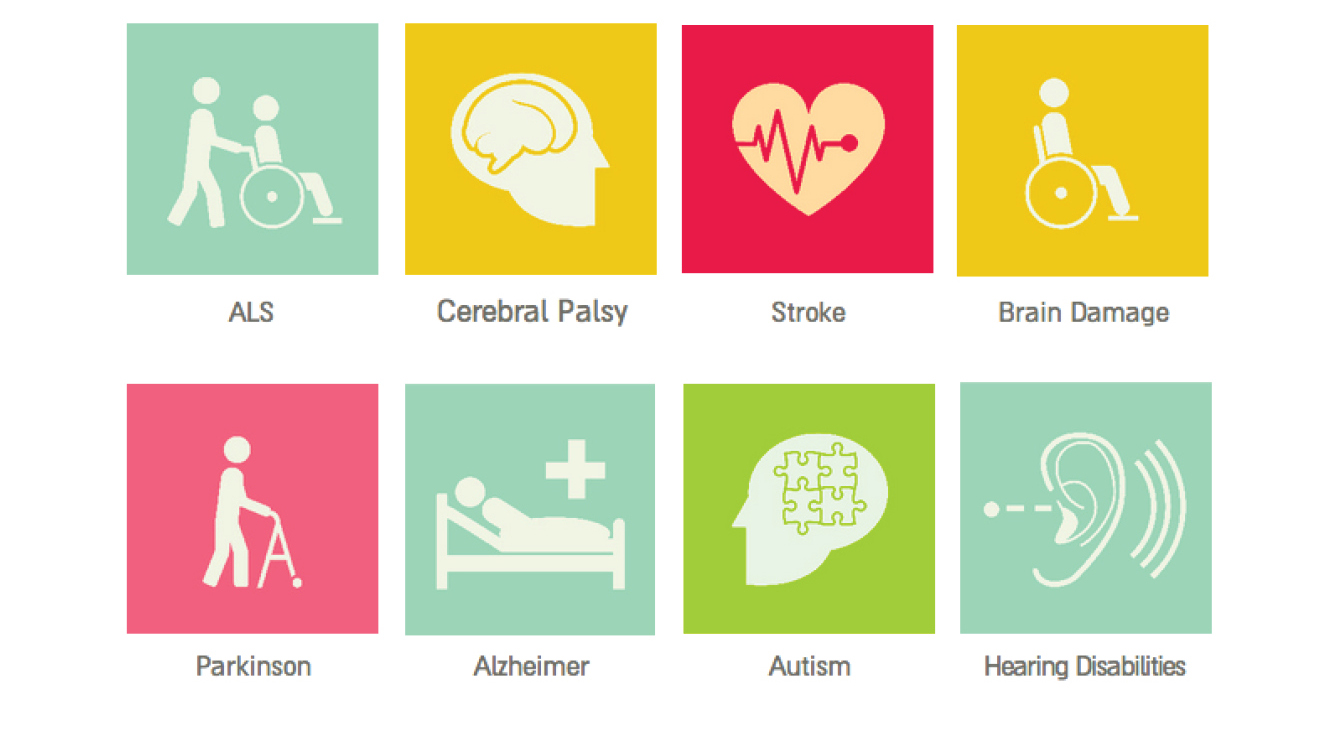
image showing various medical conditions that can cause speech impairment - ALS, cerebral palsy, stroke, brain damagem parkinson, alzheimer, autism, hearing disabilitiesIn many cases, disabled users with speech disorders find it extremely difficult to communicate, primarily because people around them have difficulty understanding their speech. Speech disabilities can be caused by a variety of conditions including Cerebral Palsy, Autism, Brain Damage, Parkinson's and many more. It is a struggle not just for those who have speech disorders but also for their caregivers and loved ones. In the recent past, various companies have come up with text to speech apps and software that let users either type or choose words that are spoken by the app, and thus help the users communicate. However, the one aspect that these apps sideline is the fact that the users are very much capable of speech and would ideally like to use their natural mode of communication.


a lady with speech impairment ordering coffee at a coffee shop using talkitt on a tablet.
Talkitt, a new "speech to speech" app in the works, plans to give disabled users more freedom and expression in the most natural way possible - it helps them communicate by just using their voice. Talkitt has the ability to recognize the user's vocal patterns and translate them into words that are more understandable. As you will see in the video below, it does a very good job of translating unintelligible pronunciation into perfect sentences with utmost accuracy. This also means that Talkitt works very well with any spectrum of speech severity - from mild to extreme.The best part about this app is that it is not just limited to English - it can translate any language the user is speaking! 

The accuracy of this app will let users gain more confidence, and encourage them more to use their speech to communicate, not to mention that it will make communicating easier and convenient for their family, friends, and caregivers as well.


Very soon, Talkitt will be available on all smartphones and tablets. The next phase will see it run on computers and wearable devices, giving much more flexibility to users wherever they are. Once Talkitt is available, there will be a monthly subscription charge of $19.99 per month.

Currently, it is being tested by various partners and hospitals in Israel and Europe, and there is also a Indiegogo funding campaign going through which the team behind Talkitt is raising money to get it out to the masses quick (as soon as Q1 of 2015). Visit the Indiegogo page if you want to contribute to this campaign.

Definitely watch the video below to see the inspiration behind this app and what the team is doing to make this app a reality.

Minggu, 22 Juni 2014

Students Create Reactive Suit That Shows Paraplegic Athletes When They Are Injured

an athlete in a wheelchair wearing the reactive suit demonstrating the stain this suit gets when the athlete is injured

The one thing athletes who have disabilities struggle with is assessing the severity of injuries they get while playing sports. It becomes especially troublesome for people who are paralyzed from waist down and play sports like wheelchair basketball, sit ski, motor racing and several others where they come in contact with other players or objects, resulting in physical trauma or internal injuries. Internal injuries often don't give any visible warning, and if the athlete cannot feel impact or pain because of paralysis, they may not even know that they are injured. This can be dangerous since they can bleed to death or have some other serious life threatening consequences if they don't treat their injury during or right after the game.

To combat this problem, a team of students at Imperial College in London has designed a reactive prototype suit that will enable people paralyzed from the waist down to identify physical impact/injuries immediately and assess how serious those injuries are. The trousers consists of pockets in different areas that have a removable strip of pressure reactive film. Whenever impact occurs to the area where the strip has been placed, it registers impact in the form of a magenta stain. Higher the impact, higher is the color intensity of the stain. This does two things - first of all, it notifies the athlete immediately that they have had an injury, and second, the pattern and color intensity can help experts analyze what type of injury the athlete has. (Different type of injuries have different patterns/bloom on the strip)

At the end of the day, this suit gives peace of mind to the athletes, trainers and support staff.

Photo showing reactive trouser and all the areas that have pockets to hold reactive strip
Pockets located on each bone (click to enlarge)


Photo describes how stains appear wherever contact pressure is applied
Description of how the pressure sensitive film works (click to enlarge)

Watch this video to see what it takes to create the suit, and the testing process it goes through.


Senin, 24 Maret 2014

VocaliD: Donating Your Voice To People With Speech Impairment

An image showing voice synthesis

We never give too much attention to our voice - it is one of the things we take for granted. However, there are millions of people around the world who were either born with a speech impairment or lost their voice because of a stroke, or some serious disease like Parkinson's or Cerebral Palsy. Learning new ways to communicate either using sign language or any other accessible device with limited/generic synthetic voices may not be a weapon of choice for many, especially the ones who lose their perfect voice later in their lives because of a disease.

That is where VocaliD comes into the picture. VocaliD is a company that is trying to bridge all sorts of gaps and helping people with speech impairments communicate using natural voices. 

But what does that exactly mean?

VocaliD consists of a team led by Dr. Patel who listens to the limited sounds of patients with speech impairments. These sounds help the team understand what this person's voice may sound like if it were high pitched, raspy, etc. Once they have the patient's sounds, they look for a surrogate - a person of the same age and sex who has no speech impairment. This surrogate is made to record thousands of sample sentences (from books like White Fang, The Wonderful Wizard of Oz, and The Velveteen Rabbit). The two voices of the patient and surrogate are then blended and broken down into tiny units of sound that can then be used to construct words! The hybrid of the two voices makes the final voice very natural and personalized,  and not so synthetic.

(To read more technical details on how this is done, go here.)

This is a big improvement in communication because the listener gets more information from how a person speaks than just the content of what they say. 

Currently, the process requires that the surrogate come to a studio to record their voice but VocaliD plans to release a phone or web app so that anyone could record their voice from locations most convenient to them (their home, for example). This makes more sense because recording thousands of sentences takes many hours, and surrogates who volunteer to donate their voices would ideally like to do it in 15 - 20 minute sessions over a period of days. The team is also planning on creating a game to encourage children to record their voices.

VocaliD is looking for volunteers from around the world to donate their voices, and if you are interested, head to their website to sign up.

If you are interested in receiving a personalized voice, you can sign up for that here.

Website: vocalid.org

Source: NewScientist 

Minggu, 02 Maret 2014

WHILL Type-A Four Wheel Drive Stylish Wheelchair!

picture of WHILL Type-A wheelchair
Assistive technology products and concepts are always appreciated for their functionality and not necessarily their aesthetics, because traditionally, the focus has never been on how a product looks. The only criteria, really, for an accessibility related product to succeed is that it does its job well.

But why not take things a step further and make them look pleasing as well? What's wrong with making an accessibility product aesthetically pleasant and beautiful? In this age of minimalism and sleek designs, why not give "the looks" of a product some love and affection as well?


We already know that the WHILL Type-A brings technology and modern design together. The company that is combining sleekness, robustness and speed in the form of a personal mobility device has more exciting news for everyone!

The award winning team behind the WHILL Type-A comprises of talented people who've worked at Nissan, Sony, Olympus in the past, will be selling 50 units in California this summer and all over the US in the winter. Pre-order is available for an initial deposit of $500. The purchase price for this product is $9,500 which does not include shipping etc. I am hoping that insurance companies would be able to fund the purchase of this wheelchair for those who really need it.

WHILL Type-A can handle any kind of terrain without showing any signs of stress, thanks to its four wheel drive.


Did I say even snow?


Another big hurdle WHILL Type A helps the user tackle is going up steep slope. Who says four wheel drives are only for cars and big SUVs?


Talking about cars and SUVs, the WHILL Type-A is so compact that you can fit two in a car!


Want to see all the features of WHILL Type-A? Go here.

If you are a AT professional who work with clients in wheelchairs and go to exhibitions and events to check out the newest products, WHILL will be at the following events this year if you want to check them out:

- Abilities Expo LA
February 28th - March 2nd
Los Angeles Convention Center - West Hall A
1201 South Figueroa Street Los Angeles, CA 90015

- Test Drive Event at Independent Living Resource Center of San Francisco
March 5th, 11am-3pm
Independent Living Resource Center of San Francisco
649 Mission St, 3rd Floor San Francisco, CA 94105

- San Diego Annual International Technology & Persons with Disabilities Conference
March 19th - March 21st
Manchester Grand Hyatt Hotel
One Market Place San Diego, CA 92101

WHILL Website: whill.jp
WHILL on Facebook: https://www.facebook.com/teamWHILL


Senin, 28 Oktober 2013

WHILL Type-A: State Of The Art Wheelchair That Offers Style And Comfort

WHILL Type-A wheelchair


The most modern wheelchair to date, the WHILL Type-A is available for pre order in the US.

Is it modern just because it is so stylish? Well, yes, but there's a lot more than style this wheelchair offers. 

To start off, this wheelchair does not force the user to sit in an upright inactive posture unlike traditional wheelchairs - it allows them to lean forward a bit, just like riding a bicycle. The small and compact wheelchair (measures only 23.6 inches wide x 32.5 inches long) has all-around wheels which allows it to rotate on the spot. The wheels are robust and large enough to avoid getting stuck in cracks or bumps on roads/ sidewalks. The four wheel drive ensures that it can achieve high power and can handle any kind of terrain (think concrete, grass, dirt, gravel roads).

The WHILL Type-A wheelchair is available for pre order on its website and the delivery is scheduled for early next year. There is no mention of pricing anywhere on the website.

WHILL will be exhibiting at the  Ability Expo San Jose from November 22 - 24 this year (Booth 514). 

Hit the source link to read more!

Source: WHILL via Gizmodo


Rabu, 24 April 2013

Samsung Demonstrates Tablet That Can Be Controlled By Brain

Samsung has taken the mobile industry by storm in the last couple of years with  its very successful Galaxy S III phone and the Galaxy Tab/ Note tablets. Competitive pricing and an easy to use UI (besides the world famous brand) are what set them apart from the rest.

It is now planning to take regular tablets into a different realm by allowing a new way of communicating with its tablet devices - brainwaves (mind control!), a feature that people with impaired mobility will definitely appreciate.

scientist demonstrating thought control wearing a cap with eeg electrdes
Image source: MIT Technology Review
Samsung, in collaboration with Roozbeh Jafari, an assistant professor at the University of Texas have started research on how to open applications, perform commands within an app, power up and down a tablet device using just a person's thought. The initial stages of this research involve a cap studded with EEG electrodes(Electroencephalogaphy - recording electrical activity with the scalp) that monitor the electrical signals from the brain. In this research, scientists found out that people could launch an app and make selections within five seconds (with an accuracy of 85 to 90 percent)if they concentrated on an icon that was blinking at a distinctive frequency. Of course, as this project moves to the next stages, they would try the same experiment without the cap with all the electrodes because that's what the masses would want.

I am hoping that a bigger brand like Samsung would be able to keep the costs low if this tablet is mass produced in the future.

Make sure to check the video of this demonstration in the source link!

Source: MIT Technology Review via Gizmodo

Senin, 15 April 2013

Scientists Restore Hand Function In Paretic Monkey Using Artificial Neural Connection

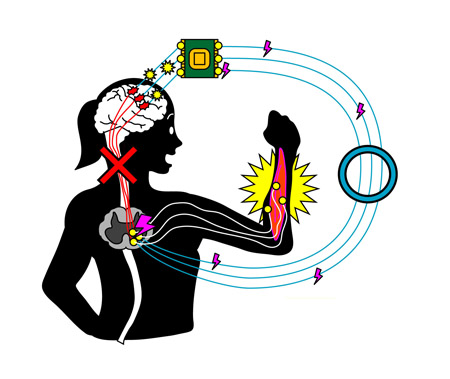
Spinal cord injuries or strokes usually result in loss of limb control. Typically, these injuries cause interruption of the pathways that conduct impulses from the brain to the spinal cord. However, it is known that the neural circuits above and below the lesion still remain functional.

Diagram showing artificial neural connection that causes movement in limb using brainpowerRecently, a combined effort between scientists from University of Washington, Seattle, Japan Science and Technology Agency, and National Institute for Physical Science, Japan did an experiment on a monkey with a paretic hand to see if they could restore neural activity in its hand and create natural limb movement without the help of any artificial limb. The results were pretty impressive.

The team used two approaches - first, they applied an artificial neural connection to bridge the neural
circuits above and below the lesions on the partially paralyzed monkey. This partially restored strength in the limb and allowed the monkey to move its arm purely using brainpower. Second, they also created another circuit that helped stimulate the spinal cord, thus boosting ongoing activity in the muscle.

These experiments have shown tremendous promise in curing semi paralytic people and restoring natural movement in their limbs without the need of any artificial/bionic limbs. We should hopefully get more promising news in the near future! 

Check the source links for more details. There's also a direct link to a pdf of the full paper.

Source: NIPS, Frontiers via Engadget

PDF

Minggu, 05 Agustus 2012

Low Cost Eye Tracker To Control Computer

Researchers at Imperial College London have invented a device made from off the shelf video game equipment that tracks eye movement, thus allowing users (especially stroke victims; people with bad motor skills, Multiple Sclerosis, Parkinson's, muscular dystrophy, spinal cord injuries or amputees) to control a cursor on a screen.

a user wearing the glasses with video cameras for demonstration
Image source: The Inquisitr
The device comprises of two video game cameras that are attached to a pair of glasses. The cameras, facing the eyes, keep track of movement of pupils by constantly taking pictures, and these pictures are used in a calibration process to figure out where exactly the person is looking at the screen.

For demonstration purposes, subjects were asked to play the video game "Pong". The subjects controlled the movement of the paddle with their eyes, which was tracked by this device. It was noted that all six subjects were able to play the game comfortably only within ten minutes of using the device for the first time. In addition to playing the video game, they were also able to browse the web and write emails.

This device transmits data over wi-fi or USB to Windows or Linux computers, and is built from parts that cost no more than $30, thus appropriately being called a "frugal innovation" by its inventors.

Watch this video to see a demo of this device that tracks eye movement precisely, and yet is thousands of times less expensive than commercial devices.


Source: Phys.org
Full free article: IOPScience

Senin, 28 Mei 2012

Paralyzed Woman Steers Robotic Arms With Mind And Sips Coffee


cathy getting a sip of coffee from a bottle held by a robotic arm.

Once there was a time when being paralyzed was a death sentence, however this may no longer be the truth. Recent breakthroughs in robotic and neural interface technology have opened a doorway for those once paralyzed. A paralyzed women name Cathy is a prime example of how modern technology is making what was once though Impossible, possible.

It starts with a simple computer chip that is inserted and planted into the brain of a paralyzed person. The chip is stocked full of software and computer recognized algorithms that have been programmed to interpret neural waves and respond accordingly. The instructions are then sent to a robotic arm that interprets the commands and acts it out. In recent trials the brain-controlled robotic arm lifted and moved a glass of water into a paralyzed women's reach so that she could sip from it, something she has been unable to do on her own for the past fifteen years.

Many tests of similar nature have been done on lab animals and have proven successful, however, this is the first time a lab trial with a human has resulted in success in real time space. Previously lab trials have been successful in computing thoughts into moving a computer cursor, however with this breakthrough all past achievements pale in comparison. However the company behind this amazing breakthrough, BrainGate, has advised it will be some time before this technology makes it outside the lab.

In the current design the computer sensor is attached to a mini-sized computer that is connected with a mess of wires. Making the system wireless is the team�s first long term goal. The research team hopes that within a decade the BrainGate device will be available for everyone with a disability at a price that will be affordable. They are also in the works of bringing this functionality to prosthetic limbs in the same time frame.
Here is a video of Cathy moving steering a robotic arm: 


The movements of the device are still clunky and not efficient enough to be used outside of the lab. However, the main goal of the test was to use the software and brain-chip in partnership so that they would work in real time. With the breakthrough of this success it has catapulted the time-frame and feasibility of technology of the same nature being commonplace forward by decades.
It is more than likely that within the next few decades we will see technology of the same nature it every part of life. Prosthetic limbs will have the capability and functionality of their real counterparts. Patients with full body disability will have control of robotic parts that they can then use as if it was an extension of their body. As technology of this nature keeps jumping forward the boundary between man and machine continues to grow smaller.
This guest post has been written by blogger Kathleen Hubert. Kathleen is a blogger who writes on a variety of different sites. Check out more of her work at modularhomes.org.


Source: Arstechnica, Gizmodo

Selasa, 22 Mei 2012

Circus Challenge: Video Games For Stroke Victims

man holding motion sensing controllers in both hands
Image source: Engadget
 It is often a challenge to retrain the brain to control a weakened limb after a stroke. It is not an impossible task, but it usually takes months to get success. In order to help speed up this process, and to make it more fun and interesting, Limbs Alive and scientists at Newcastle University have come up with a set of video games called Circus Challenge , thus providing extra in-home therapy.

This set of games has been specifically designed for people with Hemiplegia, however the target audience is anyone who needs to better their
screenshot of the game
Image source: Limbs Alive
 motor skills. These games consist primarily of circus games that require the use of both hands to perform tasks that would let them advance and reach higher levels. The patients use motion sensing controllers  (think wii remote) to perform circus activities like throwing pies, teetering, lion taming, juggling, high diving, and trapeze work to name a few. The more they advance in the games, the more challenging the tasks become and require greater coordination and strength.

The game would be available later this year and can be played on PCs, laptops, and tablets using motion sensing controllers (hopefully someone would come up with a Kinect hack too?). To find out when these games would be launched, go to Limbs Alive's Contact Us page and sign up to get latest updates from them.

Watch the video to see what Circus Challenge can do!


Source:Limbs Alive via Engadget, Gizmodo

Minggu, 22 April 2012

Tongue Interface Using Kinect

Researchers at The University of Electro Communications are busy developing an interface that detects tongue movements and allows users to access items using their tongues. This interface is being designed for people who have difficulty speaking and swallowing (stroke victims, for example).

The interface uses the Kinect and works by first detecting the location of the two eyes. Once it has located the eyes, it estimates the location of the tip of the nose. Once that is done, it estimates the location of the mouth area, and based on that, the actual movement of the tongue is obtained.

This interface could be efficiently used if the user could train their tongue. One way to do so is to move the tongue left and right. The researchers have actually created a game that uses the left to right tongue movement.

The interface is still a work in progress  - quite raw and not very robust. The researchers are working on improving the interface's ability to detect tongue movements more precisely. Also, they plan to include detection of lip movements in the future along with tongue movements. However, this is another fine example of what technology and innovation can do to make lives better for everyone.

Watch the video to see this interface (and the game) in action.


Source: DigInfo via Engadget
Mas Kur. Diberdayakan oleh Blogger.

 
biz.