Tampilkan postingan dengan label prosthetic hand. Tampilkan semua postingan

Sabtu, 03 Januari 2015

Man Controls Both Prosthetic Limbs With Mind

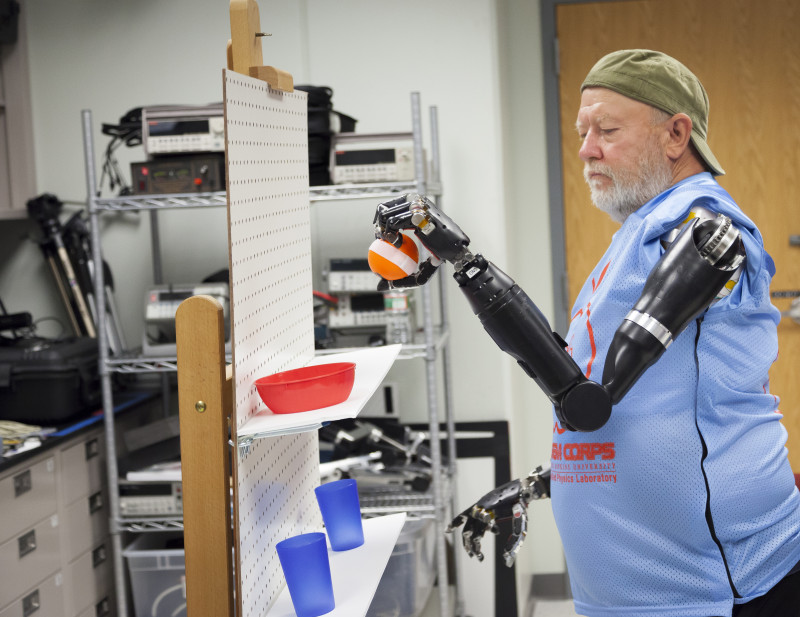
Leslie picking up a ball with his mind controlled left limb.

Recently, Lesie Baugh, who lost both his arms to a freak electrical accident forty years ago, was able to move both his prosthetic limbs to perform daily tasks with just his mind! We have seen in the past one limb being moved, but moving both has never happened before.

Moving both of Leslie's limbs with just thought was a two step process:

1. A surgical procedure known as targeted muscle reinnervation is done first. This surgery reassigns nerves that once controlled the limb. This reassignment is vital for the mind to interact directly with the prosthetic limbs.

2. After the surgery, researchers worked with Leslie to identify which muscles of his contracted, and how well they interacted with each other. This is necessary to find patterns and to calibrate the limbs so they respond to the right signals.

Once the pattern recognition was done, Leslie was fitted with a custom socket that connected his limbs directly to his reinnervated nerves. Using his mind, he could do basic tasks like lifting a glass from one shelf and putting it on another, and grip a ball and move it to a different location. 

The next step is to have Leslie use his limbs in the "outside world" and see how it works for him. He desires to use it for simple things like putting change in a pop machine and getting soda out of it.

The researchers who have been helping Leslie think that this is just the beginning, and that the next 5 - 10 years will bring wonders to the world of prosthetics.

Watch the video below to see Leslie control his limb with his mind, and hit the source link for more details.


Senin, 27 Oktober 2014

3D Printing And Prosthetics


This is the first of (hopefully) many to come in the future. This is a very basic primer on 3D printing and how it can be used effectively to print efficient and very cheap prosthetic limbs. I have created a "Sway" too that I will be updating on a regular basis to keep the content up to date and meaningful. It is also easier to share the "Sway" with family and friends. It can be accessed here:


If you prefer the regular blog format then read below.

What is 3D Printing?


In simplest of words, 3D printing involves printing actual objects. It is not manufacturing or creating, simply printing! And why is it called 3D printing? Because it involves a printer that connects to a computer.

The basic idea is that if you have designed a product in a CAD software, it can be printed out layer by layer using a 3D printer. There are several types of 3D printers available that use different technologies to print.

Some printers use powdered material (Selective Laser Sintering or SLS) while others use plastic or metal wire (Fused Deposition Modeling or FDM) or resin (Stereolithography).


Additional Reading: What is 3d Printing

Why is it such a big deal?


The basic principle of a 3D printer dictates that you can print objects with it. That's cool and all, but what is it about 3D printing that is causing such a huge commotion? See, what's amazing about 3D printing is that it cannot just print objects, it can print useful objects. VERY useful objects. So useful that those objects can save or extend people's lives.

Let's start with the basics.

We are not using ink - we are using glass, plastic, powder among other things to 3D print, which essentially means that we can print just about anything with a 3D printer. It's not easy to fathom the extent to which 3D printing can go. It is both mind blowing and baffling to know that 3D printing can print anything from a cute little toy to a life saving organ. Just recently, a major breakthrough in the 3D printing space allowed 3D printed tissue to survive on its own. Such breakthroughs have led to important organs like kidneys to be developed for transplants.

3D printing is fascinating.


3D Printing For Prosthetics


It's a no brainer that since we can print anything with a 3D printer, we can print prosthetics as well. There are more than 10 million amputees around the world [1]. Arranging a (traditional) prosthetic limb for them is always a challenge because of the cost involved which can range anywhere from $20,000 - $50,000. These exorbitant costs can deter anyone from pursuing an important accessory that will enhance their lives, more so because insurance companies do not cover the costs of prosthetic limbs especially for little children because they outgrow their prosthetic limb very quickly.


However, not surprisingly, 3D printers have come to the rescue of people who need artificial limbs. It is unbelievable how easily a limb can be printed by a 3D printer - layer by layer, that functions just like a traditional prosthetic limb. Believe it or not, a 3D printed prosthetic hand can cost anywhere from $5 to $100. That's it! And because of that, people are more willing to experiment with the design to come up with more efficient limbs. Outgrowing a prosthetic limb is not a worry anymore either.


Projects


There are several voluntary organizations out there that are making 3D printed prosthetic hands available for amputees at a very affordable price.

One of these organizations is Open Hand Project that makes prosthetic hands available for less than $1,000. It is an open source project which means that all the information required to create a
prosthetic hand using a 3D printer is readily available to the entire community on their website. Anyone who adds improvements to the project are shared with the entire community.

Another volunteer driven group is called E-nabling The Future which consists of engineers, students, teachers, occupational therapists, designers amongst others. This group helps print 3D prosthetics for those who need them, and the cost to print a hand may run anywhere between
$20 and $50.

Endless Opportunities


What you have read here is just the beginning. There are tons of innovations being made in the world of assistive technology using 3D printers on a regular basis! 3D printers are getting cheaper by the day, which means that more and more hobbyists and designers are getting their hands on them, fueling creativity and collaboration and taking 3D printing to a whole new level!

Last, But Not The Least


3D printers. If you or someone you know is interested in knowing more or using 3D printers, this link should be a good resource to get you started.

3d printers comparison


Sources: 

Images:
Cover Image [1]: Parade's Community Table
3D Printers Comparison Chart: Tom's Guide

Additional Sources:
[1]: Forbes


Minggu, 12 Oktober 2014

Prosthetic Hand Lets Amputees Feel Texture Of Objects

an amputee wearing a prosthetic hand and gripping a cherry tomato
Over the years, prosthetic hands are becoming more and more viable for people who lose their hands in accidents or were perhaps not born with one. Prosthetic limbs are great in that they help the users get back to daily routine operations. The one thing that most prosthetic limbs don't do however, is allow the wearer to feel the texture of objects that they grip. Scientists at Case Western Reserve University in Cleveland, OH have taken the prosthetic hand one step ahead by adding sensation and "feel" to the hand they have created. 

"Touch perception on the fingers and hand is essential for fine motor control, contributes to our sense of self, allows for effective communication, and aids in our fundamental perception of the world." [1]

Turns out, sensation is not felt or generated by a hand but by a certain part of the brain. When a person lose their hand, they inherently lose the input that switches on those parts of the brain responsible for sensation. By sending electric signals by a computer into nerves in the user's arm and eventually to a specific part of the brain, sensation or touch can be reactivated.

Igor Spetic, a man who lost his right hand in an industrial accident in 2005, says that he can see his arm hair raise when a cotton is brushed against his prosthetic hand.

another amputee wearing the prosthetic hand squeezing toothpaste on a toothbrushSince the amputees can now feel the texture of the object they are handling, they also know exactly how much pressure to apply to form their grip without damaging the object. With other prosthetic hands, gripping tomatoes and grapes meant creating juice instantly!

Currently, this arm can be tested and improved only in a lab setting, however, the team plans to create an implantable hand in the next five years so it could be tested at home. Detailed description of how this hand works was published in this article.

Watch the video to learn about all the research that has been going on to make this hand a success.


Source: CWRU via Gizmodo, Science Translational Medicine [1] 

Rabu, 23 Juli 2014

Google Glass For Prosthetics And Blind Athletes

Google Glass, 3D printing, Prosthetics! We have heard so much about these in the recent past, and we will keep hearing about them since things are progressing so well in each of these avenues! Today, we have two different stories related to Google Glass - one, that will help people get cheaper prosthetics, and two, a blind paralympian using Google Glass to show kids his point of view and boost their confidence.

Prosthetics With Google Glass


Researcher scanning lower leg of test subject with google glass


Traditionally, getting prosthetics requires traveling to a clinic where a huge measuring machine with a robotic arm determines the specifications for the needed leg brace or prosthetics. Of course, this process is not inexpensive since the machine itself costs tense of thousands of dollars, and typically, the clinic would like to pass on costs to clients.

researchers looking at 3d printing information for leg brace on a computer
This will soon hopefully change. A research team at University of Delaware is exploring more affordable and convenient ways to do the exact same thing, but without the additional exorbitant costs of getting prosthetics from a traditional clinic.

The team is using Google Glass to capture all the information of the foot and lower leg in videos. These videos are then stitched together to get a 3D model of the cast and then instantly transformed into a template for a 3D printer. This method will first of all, cut down costs for the patients and second of all, make it convenient to go through this process at home without even going to the clinic to get the measurements taken. The patient can print the leg brace at home if they have a 3D printer or send it to a 3D printing lab or studio.

The team will soon be applying for funding to expand into prosthetic manufacturing as well.

A combination of technology like Google Glass and 3D printing helps bring manufacturing to everyday consumers who are not engineers or manufacturers.

Google Glass And A Blind Paralympian


Disability advocates are always looking for different ways to showcase abilities, and not disabilities of disabled people. Google Glass will be used for just that purpose.

Lex Gilette is a blind paralympian who began to lose his sight when he was seven years old. He has won three silver medals and holds the world record for long jump for F11 classified athletes. Being blind, he has to depend on someone to direct him down the runway and make calls for him on the fly.

"No need for sight when you have a vision."

Lex's plan is to wear Google Glass and show his perspective to high school kids so they could see what all it entails, and how a blind paralympian does it. The idea is to show kids that everything is possible, and how being not able bodied does not cause hindrance to your goals. Through Google Glass, Lex aims to make high school kids more confident.


Hit the source links to read more about both the stories.

Senin, 20 Januari 2014

$100 3D Printed Prosthetic Limb

two amputees seen wearing artifical limb and fist bumping.


3D printers are all the rage these days. From children's drawings to a working gun (GASP!), there is practically nothing impossible to print using one of these.

Mick Ebeling, CEO of Not Impossible Labs decided to do something when he read about 14 year old boy Daniel losing his arm in a bomb blast in war torn Sudan. Mick landed in Sudan with a few laptops and 3D printers, with the sole objective of making Daniel a limb.

Daniel was located in a refugee camp in Yida, South Sudan, and was given his first "version 1" limb by Mick. The limb took around $100 in raw materials and the 3d printer was able to print it out in just six hours. For the first time in two years, Daniel was able to feed himself (he had chocolate!). The video below show him doing daily activities like using a touch screen computer and throwing a ball. From what is shown, it looks like adapting to the new limb is fairly quick.

Before leaving Sudan, Mick set up a lab so the locals could print artificial limbs themselves.

Version 1 of the limb does come with some limitations. It cannot be used to lift heavy weights, and to use utensils, additional accessory is required. But still, the levels of  independence and confidence they bring to the person wearing them are enormous. Mick has made the project open source so anyone could work on it and keep improving version 1. The vision here is to create a global campaign that helps amputees from around the world achieve independence with a product that is inexpensive yet reliable. Version 1 can help someone get adjusted to artificial limb quickly - If someone needs something more robust, they can perhaps upgrade to other options.


Source: Inhabitat
More here: Not Impossible Labs


Minggu, 12 Mei 2013

I-Limb Ultra: Prosthetic Hand Controlled By iPhone App


picture of patrick kane holding an object with i-limb

Someone once sad �there�s an app for that,� and they weren�t wrong! In today�s society, everyday life is being made easier by apps on smart phones which can do anything from letting us check our bank balance on the move to helping us avoid the traffic on the school run. But the category that has shown the biggest boom in downloads are the medical apps. These range from apps that can help patients to control their long term illnesses, to apps that can allow doctors to visualise their patient�s x-ray radiographs on the move. 

picture of i-limb's iphone appOne app that has made a big difference to patient�s lives is the iBGStar Diabetes Manager, and other
apps like it. They are used by diabetic patients to measure their blood sugar levels and keep track of previous reading to ensure they have good control over their condition. This is not only easier for the patient than the old �diary� method of recording their blood sugars, but it can help their doctors to see how treatment is working for their patient and whether it needs to be changed.

picture of patrick kane holding an object with i-limbThe award for the most innovative and life changing app must go to the i-Limb Ultra from Touch Bionics: the app is connected to a bionic prosthetic hand via Bluetooth and users can select different �grips� for any specific tasks they need to do. Sounds like something out of a movie, right? That�s what 16 year old Patrick Kane thought when he was fitted with the bionic hand. He lost his
hand as a baby due to meningococcal septicaemia, but because of this revolutionary new device he is able to live a normal life again, something that we often take for granted. The hand allows Patrick to carry out movements that are so precise they have not been possible with a normal prosthetic in the past: he can now hold a glass, pick up a piece of paper and tie his shoelaces with the touch of a button on his iPhone.

diagram showing how the i-limb works


picture of i-limb's iphone appThe limb can be controlled by electrical signals in muscles as well as by the iPhone, but this does take some practice to master as Patrick has already learned: "Controlling the hand feels very natural, although it does take a bit longer to learn how to use the automatic grips and gestures, so it was very useful to be able to work with the Touch Bionics therapist on these skills."

This innovation is a huge step for people like Patrick. At the moment the limb is still very expensive, between �30,000 and �80,000, but this technology means that in the not so distant future people that have lost a limb will be able to have the same quality of life as those who haven�t been so unlucky.


This article was written by Niqui Stubbs, a 4th year medical student with a love of gadgets and technology. She has worked with people who have lost a limb and knows the huge impact a bionic limb like this can have on someone�s life.

Senin, 15 April 2013

Scientists Restore Hand Function In Paretic Monkey Using Artificial Neural Connection

Spinal cord injuries or strokes usually result in loss of limb control. Typically, these injuries cause interruption of the pathways that conduct impulses from the brain to the spinal cord. However, it is known that the neural circuits above and below the lesion still remain functional.

Diagram showing artificial neural connection that causes movement in limb using brainpowerRecently, a combined effort between scientists from University of Washington, Seattle, Japan Science and Technology Agency, and National Institute for Physical Science, Japan did an experiment on a monkey with a paretic hand to see if they could restore neural activity in its hand and create natural limb movement without the help of any artificial limb. The results were pretty impressive.

The team used two approaches - first, they applied an artificial neural connection to bridge the neural
circuits above and below the lesions on the partially paralyzed monkey. This partially restored strength in the limb and allowed the monkey to move its arm purely using brainpower. Second, they also created another circuit that helped stimulate the spinal cord, thus boosting ongoing activity in the muscle.

These experiments have shown tremendous promise in curing semi paralytic people and restoring natural movement in their limbs without the need of any artificial/bionic limbs. We should hopefully get more promising news in the near future! 

Check the source links for more details. There's also a direct link to a pdf of the full paper.

Source: NIPS, Frontiers via Engadget

PDF

Kamis, 21 Maret 2013

Bebionic3: Prosthetic Arm For Daily Use

In the last year or so, we have seen quite a few prosthetic limbs in the market that are just remarkable in their own way - from helping people pick up things to offering touch and feel. Rapid developments in this area only go to show that people are actually accepting prosthetic limbs as a good substitute for a real limb.

Nigel Ackland, who lost his arm in an accident six years ago, was fitted with the Bebionic3 just last November, and already he can use the arm so seamlessly and flawlessly to perform daily chores - from tying shoelaces to making an omelette.

silicone skin for the bebionic3 armI think the Bebionic3 is the only prosthetic arm (as far as I know) that comes with its own silicone skin to give it a natural appearance. The hand also comes with its own software that can be monitored and configured wirelessly. Make sure to check out the website (source link) to learn (a lot) more about the gripping mechanisms, components it is made of, and all the technical information.

Nigel Ackland, everyone.


Source: Bebionic.com via Gizmodo

Selasa, 26 Februari 2013

Bionic Hand That Offers Touch And Feel Real Time

An amputee testing the bionic hand

The last few years have seen a tremendous amount of progress when it comes to prosthetics. However, one limitation of these prosthetic limbs (if it is one) is the lack of sensation - clinching an object does not invoke a sense of touch since the limb is not connected to the nervous system.

Bionic hand description showing where motors, tendon tension sensor and tactile sensors areRecently, scientists at The �cole Polytechnique F�d�rale de Lausanne and Project Time have developed a new bionic hand that has sensors on the fingertips and connects to the nervous system of the amputee by implanting electrodes directly in two important nerves - median and ulnar, and deliver signals directly, thus enabling the person to feel the touch. Essentially, the limb is controlled by thought as well as receives touch signals from the hand sensors.

Feeling the touch/sensory signals is essential because the more sensory signals the amputee gets, the more likely the patient will fully accept and appreciate the limb.

The scientists are constantly improving and refining the interface for this limb and if all goes well, a full working model will be ready for testing in two years.

Source: The Independent, Project Time, Gizmodo, Engadget
Images source: Engadget, The Independent

Senin, 15 Oktober 2012

Touch Bionics Releases New Prosthetic Fingers

image displaying prosthetic fingers
Image source: Engadget
Touch Bionics, a leading expert in prosthetic limbs, recently announced the global launch of new bionic finger technologies - a very good news for people with missing fingers.

The new additions to the product line include a finger that's shorter and lighter, and a wrist band that incorporates all of the processing and poer systems of the prosthesis.

This new development  enables prostheses to be made smaller, lighter and more anatomically accurate, e.g., for people with smaller hands and whose amputations are closer to the knuckles. 

Needless to say, these prosthetic fingers help people perform daily chores and activities, and pursue their hobbies and interests, thus boosting their self confidence and improving their quality of life.

Watch this video to learn about the benefits of prosthetic fingers.


Check out their website to learn more about the prosthetic fingers. To read the press release, hit the source link.

Website: Touch Bionics

Source: Engadget
Mas Kur. Diberdayakan oleh Blogger.

 
biz.