Minggu, 01 Februari 2015

Reemo: Wearable That Can Automate The Entire House

photo of playtabase's cofounder al baker
Al Baker from Playtabase
In recent years, we have seen a ton of wearables that do a lot of things - track physical activities/calories burned, display email/text/phone notifications, monitor how well one sleeps at night, steps walked, workouts done, and several other activities. Typically, these wearables are worn on the hand and they don't necessarily interact with other objects in the environment - with current wearables, you cannot open or close doors, turn on or off the lights. They just interact with you (the wearer) and your phone in most cases (phone call, text, email, social media notifications).

Playtabase, a company in Minneapolis, MN co-founded by Al Baker, is working hard to take wearables to the next level - a level that will make interaction with every object in the house or office a breeze. This will be especially incredible for people with disabilities.

Reemo - What is it?

Reemo, just like several other wearables, is worn on the wrist. However, the purpose is to not just track your physical activities. Reemo works in combination with a wireless receiver and smart plug. A device or object like a coffeemaker, stereo, lock, light, door, window blinds or almost anything around the house can be connected to the receiver and operated by Reemo by simply gesturing towards it. For example, you don't have to walk up to the switch to turn it on or off or to adjust the thermostat. No need to walk up to the door to keep opening and closing it as more and more guests come in. Lights, security systems, entertainment systems, fireplace int the house - you name it, Reemo can operate it. All one has to do is wear Reemo and use one of the six gestures that can be assigned to Reemo, and Reemo performs the desired operation for them.

Reemo & Assistive Technology

Picture this - a person is in a wheelchair. They may be an amputee, have mobility issues, have had a
stroke recently and were paralyzed. Moving around in the house and operating different devices may be a struggle or in some cases not really possible. For such a person, just being in their bed or wheelchair and to be able to adjust their thermostat, start the fireplace, turn on the security system, and turn blinds up and down by just pointing and gesturing will bring great convenience. Similarly, a blind person gesturing towards their coffee machine to get a freshly brewed cup of coffee or turning on their music system without approaching it and looking for buttons will be tremendously convenient as well.

Al sees Reemo in the assistive technology/care realm as a complimentary device. Currently, there are around 10 - 11 million homes that are "smart" as compared to a total of 135 million homes in the US. He also says that homeowners and caregivers at various facilities have started looking at smart technology but they want solutions that are better than what a phone app offers to really control everything. That's where Reemo fits in nicely.

There are currently 110 developers that are developing applications for Reemo whether as an assistive technology device or something really cool because after all, Reemo is not just a technology for people with disabilities - it's a technology for anyone, including lazy people!

Listen to Al talking about Reemo and assistive technology below:


Reemo Demo

Al was kind enough to give me a demo of how Reemo works. The scenario in this video is that of a person who is going to bed and wants to turn off the light(s) and turn on the lock on the door (both at the same time). This demonstrates that with one gesture, multiple objects/devices can be operated. Al also shows how, with a different gesture, just one of the multiple objects in the setup can be operated as well.


Note: I will add captions to the video soon!

Now that you have seen the demo, watch the following video too to get an idea of what all you can use Reemo for:


Reemo For life from John Valiton on Vimeo.

Inspiration Behind Reemo

Reemo came into existence for two reasons - one, to do cool things, and two, because Playtabase's cofounder Muhammad's father suffered two strokes that left half of his body disabled. The idea was to give him a "universal remote" that he wouldn't drop and it would just consist of a wave of a hand. They wouldn't have to pay anyone so much to look after him because not only would it make him more independent but also make him feel emotionally better.  During the same time, the emergence of smart homes and wearables also encouraged Al and Muhammad to create a solution that will work on all smart watches and wouldn't be proprietary. 

Hear Al talk more about the inspiration behind Reemo:


Reemo - The Product

In the next month and a half, Reemo will be shipped to its alpha and beta users. It will be available to consumers sometime during summer of this year. The consumer kit can also be pre-ordered on Reemo's website for $249 (and $299 for a developer kit).

To know more about all the great progress Reemo's making and to get the latest news, sign up on for their mailing list.

Playtabase

Playtabase has been around for two and half years and Reemo for around two. Playtabase has aspirations to create products that are both engaging and fun to use but are also meaningful and have a lot of depth.


Website: www.getreemo.com

Senin, 26 Januari 2015

SnapType For Occupational Therapy Has More Updates And Features Now

picture of a child writing on paper with a pencil


This post has been written by Amberlynn Gifford - creator of the ever popular app "SnapType for Occupational Therapy".

When I created SnapType last year, I knew it would help children struggling with handwriting. However, I could never have imagined the outcry of support I received from therapists and parents. Each week I read several emails from users with stories of how SnapType has changed their lives.

"Thank you for this app! You are a blessing! I can honestly tell you that I have spent many hours crying and hurting inside while watching my son struggle to write pages of sentences and spelling words and other homework assignments. He screams out with frustration. It's been so bad that I have stopped him and honestly wrote for him, left handed to make it look more like a neater version of his because I could not take it anymore! Now, with SnapType, he completes his worksheets, show off his intelligence and feels more confident than ever. Thank you from the bottom of my heart!"

That was an email I received from a mother who felt like she was losing her son. I tear up while reading emails like this from parents and it brings me so much joy to know that these children are succeeding with the help of SnapType.

I have learned along the way that SnapType helps not only children with dysgraphia but also individuals with several other learning disabilities, low vision, low muscle tone, and Parkinson's. It is so exciting to learn that a variety of individuals can benefit from SnapType.

When I first had the idea for SnapType, I wanted to test out the idea as quickly and inexpensively as possible. So I paid a developer in India $300 to build the first version of the app. It was so basic, but it was the perfect way to quickly find out if anyone would find value in my idea. With tens of thousands of downloads, and over a hundred emails from users, it was clear that people were finding value in the app.

screenshot of app snaptype occupational therapyEvery week emails came in from users who were so happy to have found SnapType. But they were also asking for more functionality. They wanted to print and email from within the app, save documents to work on later, import documents from the image gallery and much more. The initial SnapType app lacked all of these features yet people still used the app because there was nothing else like it on the market that could help their kids and students.

I wanted to give the users what they were asking for. But being a full time occupational therapy graduate student, I couldn't afford to pay thousands of dollars to get the app made. I asked the developer in India if he would be interested in partnering with me to create a new app but without the cash, he wasn't interested. So then I reached out to a community of app developers and received interest from a few. Shortly thereafter, I started working with a developer and it was going great. Then the emails stopped. He fell off the face of the earth it seemed and I was back where I started.

Feeling defeated at the end of September, I reached out to another developer who previously expressed interest and he jumped on board right away. Instantly, we were going back and forth, exchanging ideas and building the app's fundamental layout and features. The communication was prompt and continuous as we crafted the upgrade. I say upgrade, but it's really an all new app, built from the ground up.

The developer, Brendan Kircher, has been instrumental in making SnapType a success. There were
times when I felt overwhelmed because we were moving so quickly and there were so many questions he needed me to answer. I was juggling being a full time grad student, working a part time job 25 hours a week and also spending several hours a day on SnapType. Nevertheless, I appreciated Brendan's speed and pushing because it has helped create a wonderfully powerful and intuitive tool. Without his speed, knowledge, enthusiasm and commitment this would not have been possible.

By Thanksgiving we were ready to share the app and we enlisted the help of two dozen users who were equally passionate about this project. We spent the month of December working with our team of testers to debug and refine the feature set. By early January we submitted the app to Apple and crossed our fingers that they would approve it. Two weeks later we received confirmation that it was in the app store and ready for the world!

As I write this article, SnapType version 2.0 has been public for just a few days. But already the comments are pouring in. Parents, occupational therapists, teachers and students are loving the new features!

SnapType is available for free on the App Store. We wanted to keep it free in order to help as many people as possible. Interestingly, many users asked us to charge for the app. That took me off guard, but they wanted to make sure that we receive some revenue to ensure that we continue to keep the app updated. After lengthy discussions with mentors, users and each other, we decided to keep the app free, but also offer an in-app purchase to provide advanced features for the power users. SnapType Pro enables users to work on multiple documents and also access the a whiteboard feature which turns documents into simplified black and white images, to save ink when printing. SnapType Pro is $4.99, but for a limited time, we're offering it for $2.99.

Another frequent request we receive is for an Android version. I'm happy to say that we've just started working on SnapType for Android (which by the way, requires writing the app all over again in a different programming language with it's own set of challenges). To learn more about the Android version and to stay connected for other SnapType updates, follow SnapType on Facebook or Twitter.


Amberlynn Gifford is a 2nd year OT student at Springfield College in Massachusetts. When she's not studying, which is rare, you can find her coaching gymnastics and working on all sorts of creative projects. She will graduate with her masters degree in 2016 and looks forward to working in pediatrics. Connect with Amberlynn at https://www.linkedin.com/in/amberlynngifford. 


Image source: Carissa Rogers

Senin, 19 Januari 2015

Be My Eyes: App That Lets Blind People Get Answers From Sighted People

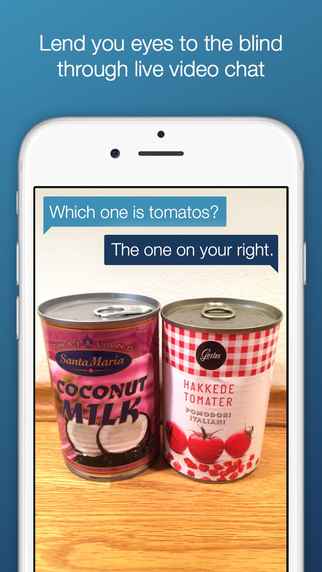
an image showing two cans - coconut milk on the left and tomatoes on the right. Blind person asks which one's the tomatoes. Sighted person's response is the right one.

We very well know that blind people are self sufficient and independent, and can go about their daily lives without much interruption. However, there are rare instances when they need assistance from someone else. 

What's the expiry date on the milk carton in my fridge? Do I have mismatched socks? Does this can have kidney beans or chick peas? Are these tomatoes or extremely ripe avocados?

It helps when someone's around but what if a blind person is by themselves?

To help blind people in such situations, a new iOS app, "Be My Eyes" lets them interact with another sighted person from anywhere in the world and ask questions similar to the ones listed above!

The concept is very simple. Blind people and sighted people register for this app. Blind people to ask questions and sighted people to answer them. Whenever a blind person has a question, they open the app and look for the first sighted person who offers to help. Sighted people, on the other hand, get notified that someone is seeking help. If someone is available to help, they accept the request. If they are not - no worries. There are tons of people out there who would grab that request. (13,000 people helpers signed up in just over a day to help 1,145 blind users). All the blind user has to do is turn on their rear camera and point it at the object they have a question about.The result: the blind user gets their question answered and everybody lives happily ever after!


It doesn't matter where they are - they  can be in one part of the world and still receive help from someone an ocean away!

The app also has a reputation system - the sighted people who are helping build a reputation based on their responses. If someone tries to be clever and gives wrong responses, they are flagged by the system and ousted within no time. So if you are trying to play a prank on a blind person - beware!

The app is free and has already received more than 2,000 requests. If you or someone you know is blind, you may want to definitely take advantage of this unique yet free app.

Download app here.
Website: Be My Eyes

Source: Engadget

Sabtu, 10 Januari 2015

January 17 2015 Is Disability Access Day

disability access day logo
January 17 will be a great day for everyone! 

A group of disabled people and their family and friends have started a great new initiative that will hopefully become a tradition in the future! The message is very simple: Go explore! 

January 17 2015 will be the first Disabled Access Day, a day when disabled people, along with their friends and families, are being encouraged to just go out there - visit a place that they have never been to - be it a movie hall, museum, restaurant, coffee shop, near or far, just about anywhere! The idea is not just to encourage disabled people to go out but also to encourage businesses and establishments to make their premises more accessible for everyone. 

If you are a charity, organization, venue, local authority or an individual, and you want to participate, sign up on Disabled Access Day's website so they could send you resources like posters, stickers, balloons etc. so you could use them on Disabled Access Day. This event is worldwide, and so far, quite many venues in UK, Belgium, Netherlands, Turkey, Portugal  and Cyprus. If your country is not in this list, you can get involved and bring yours on the map too!

For more information, check out Disabled Access Day's website, Facebook page and Twitter.

Sabtu, 03 Januari 2015

Man Controls Both Prosthetic Limbs With Mind

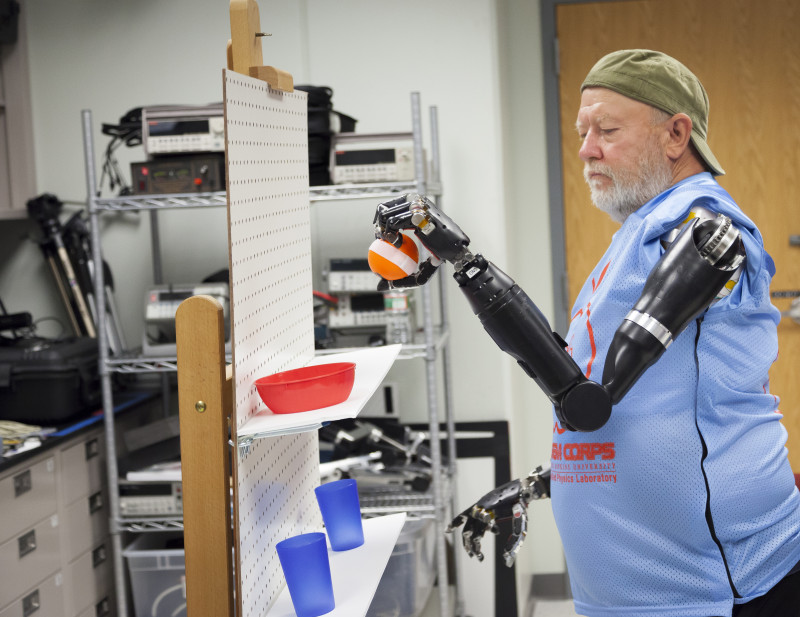
Leslie picking up a ball with his mind controlled left limb.

Recently, Lesie Baugh, who lost both his arms to a freak electrical accident forty years ago, was able to move both his prosthetic limbs to perform daily tasks with just his mind! We have seen in the past one limb being moved, but moving both has never happened before.

Moving both of Leslie's limbs with just thought was a two step process:

1. A surgical procedure known as targeted muscle reinnervation is done first. This surgery reassigns nerves that once controlled the limb. This reassignment is vital for the mind to interact directly with the prosthetic limbs.

2. After the surgery, researchers worked with Leslie to identify which muscles of his contracted, and how well they interacted with each other. This is necessary to find patterns and to calibrate the limbs so they respond to the right signals.

Once the pattern recognition was done, Leslie was fitted with a custom socket that connected his limbs directly to his reinnervated nerves. Using his mind, he could do basic tasks like lifting a glass from one shelf and putting it on another, and grip a ball and move it to a different location. 

The next step is to have Leslie use his limbs in the "outside world" and see how it works for him. He desires to use it for simple things like putting change in a pop machine and getting soda out of it.

The researchers who have been helping Leslie think that this is just the beginning, and that the next 5 - 10 years will bring wonders to the world of prosthetics.

Watch the video below to see Leslie control his limb with his mind, and hit the source link for more details.


Selasa, 30 Desember 2014

Look At Me: Android App For Kids With Autism To Help Improve Eye Contact


There are over 60 million people around the world that have autism. Usually, children with autism struggle with making eye contact with others and displaying social skills. However, recent studies have found that autistic children love technology, especially smart devices. Keeping that in mind, Samsung, with the help of various psychologists, psychiatrists and designers has developed a free Android app that helps children improve their ability to make and sustain eye contact and interpret facial expressions.

The free app "Look At Me" uses the camera app of the phone and consists of seven interactive and engaging missions that make kids remember faces, understand a person's mood, and also lets them take photos of themselves exhibiting various expressions. Through this app, children are expected to learn diverse ranges of emotions like happiness, fear, and surprise. The addition of sound effects, point system and rewards along the way keep kids motivated.

Over a period of 8 weeks, 20 children, used the app daily for 15 minutes, and it was noticed that 60% of the children showed improvement in making eye contact.

If you know a child with Autism that may benefit from this app, head to Google Play to download and use this free app.


The "Look At Me" project is also donating 200 tablets with this app preloaded to families in Canada so they could share results and help the community. To know more or to join this project, follow this link.

Source: Samsung via Engadget

Rabu, 17 Desember 2014

UNI: Device That Converts Sign Language To Text $1,278 Shy Of Meeting Crowdfunding Target

UNI detecting sign language


Motion Savvy, the company that introduced perhaps the most innovative product of 2014 in the assistive technology realm, UNI, has managed to raise almost all of the funds required to mass produce it and deliver it to 370 million deaf people around the world. The crowdfunding campaign ends in 3 days on the 20th, and the company is still $1,300 short of the set target.

If you think this product will be a great asset for deaf people, and want to show your support in any form, head over to their indiegogo page or share this information with someone who might be interested in this device.

Watch the following video to see how a deaf woman plans to use UNI in the future. Read below for more information on UNI as well.


From Motion Savvy:

The pre-sale campaign for UNI, the world�s most innovative communication device for the Deaf and Hard of Hearing, will be ending in three days on December 20th, 2014 and is currently just $2,300 $1,738 shy of hitting the crowdfunding goal.

Time has named MotionSavvy�s first product, UNI, as one of 2014�s best inventions due to the device�s first of its kind technology that utilizes motion gesture recognition to translate sign language to audio and spoken word to text in real time.

Since the launch of UNI�s crowdfunding campaign in October, the product has gained global recognition due to its mission to shed light on the degrading and uncomfortable situations the Deaf community faces when it comes to communicating with the rest of the world. With UNI, the 370 million Deaf people and 3.7 billion others that engage with them every day no longer have to type messages on smartphones, scribble on pieces of paper, or make over-dramatic gestures.

Although the immense positive reaction has proven that there is a high demand for this next level of communication technology, it is apparent from the feedback of the Deaf community that even at the low campaign price of $189, people are unable to afford the product alone. In it�s mission to empower the Deaf community, the MotionSavvy team is inviting the rest of the world to help its cause. With contribution options ranging from $399 to $10,000, people will be able to donate UNIs to individuals, families, schools, or organizations while limited supplies last.

UNI is comprised of three parts: a tablet, a smart case, and a mobile app. The device works without an Internet connection to help the Deaf and Hard of Hearing communicate anywhere at anytime. Here�s what UNI does:
  • Translates sign language into audible speech for hearing individuals using motion gesture recognition technology.
  • Converts spoken word to written text for Deaf and Hard of Hearing individuals using voice recognition technology.
  • Recognizes different ways of signing so that users can train their device to recognize their styles.
  • Gets smarter with every use through SignBuilder to allow people to crowdsource signs so that UNI can provide the most accurate translations.
�An overwhelming amount of people from the Deaf community have reached out to us about how they need UNI, but we�re finding that the same people are having trouble affording one.� said Ryan Hait-Campbell, CEO and co-founder of MotionSavvy. �We�re so thankful for the support we�ve received so far, but it�s clear that this communication barrier is real and we need help from the rest of the world to give UNI to those in need�

MotionSavvy�s crowdfunding campaign on Indiegogo will be ending in three days and is on its way to reach its crowdfunding goal of $40,000 to understand market fit and begin manufacturing. UNI is expected to ship in the Fall of 2015. To learn more or for those who want to help MotionSavvy�s mission, visit: www.motionsavvy.com
Mas Kur. Diberdayakan oleh Blogger.

 
biz.