 |
| Image source: Engadget |
The FDA recently approved a bionic eye that will bring limited vision to people who suffer from a specific type of blindness.
The technology behind this bionic eye, known as artificial retina, will allow people who suffer from retinitis pigmentosa (a condition that causes night blindness, blurring, poor color separation, etc.), to see crosswalks, outlines of trees, cars, people; large numbers/letters among other things. It also helps them identify objects that have a contrast between light and dark - for example, black socks mixed with white ones.
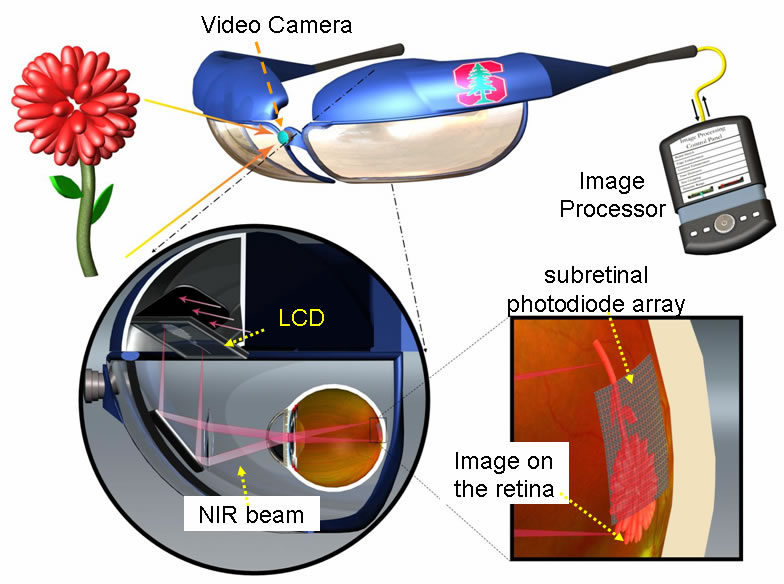
This new device, named Argus II, uses electrodes implanted in the eye, a pair of glasses with a camera attached and a portable video processor that can be worn on the waist. The camera embedded in the glasses captures the scene. This video is processed by the video processor and sent to the implant in the eye, which emits small pulses of electricity that in turn simulate the retina's remaining cells, and conveys visual information to the brain.
As of now, 10,000 to 15,000 Americans will qualify for the Argus II (eligibility: must be over 25; have previously had useful vision. Also, the Argus II should provide a substantial improvement to their current blindness). The device would cost around $150,000 and that does not include the cost of surgery and training. Second Sight, the company that makes this device, is hopeful that soon insurance companies would start covering it.
As mentioned above, this device is currently being made available only to people suffering from retinitis pigmentosa, but it is being looked at as a promising step for treatment for people who have macular degeneration. Eventually, Second Sight plans to use this technology to solve blindness caused by all causes.
Please read the article at the source link to learn more about this technological marvel that has opened many avenues in the assistive technology area. Don't forget to watch the video at the top of that source article too!
What do you think of this invention? A blessing for sure, but does it have limitations? Does it require a lot of work still? What are your thoughts? Please share in the comments section!
Source: NY Times (thank you, Tom Walton!)
Video: Engadget



 Postingan


