Tampilkan postingan dengan label bionic eye. Tampilkan semua postingan

Minggu, 15 September 2013

Telescopic Contact Lenses For Age Related Macular Degeneration

In the recent past, we have seen quite a few solutions for Macular degeneration, a leading cause of legal blindness in adults over the age of 60. These solutions enhance the person's existing vision and give them confidence to go out and about again and help them carry on with their lives more naturally ( see this and this). 

Switchable telescopic contact lens, developed by researchers in the USA and Switzerland, provides the same enhancements but without the need of surgery. It magnifies the scene details by 2.8 times when paired with special spectacles.

The contact lens has a telescopic element that consists of tiny aluminum mirrors. This element sits right outside the central region of the lens that lets light in for normal vision. The mirrors bounce the light around four times within the ring before passing it on to the retina. The accompanying spectacles have polarizing filters that can be turned on so that the only light coming to the retina is through the spectacle+lens combo, thus magnifying the image 2.8x.

Images captured through the contact lens and optomechanical eye. (a) USAF resolution chart @ 1x. (b) USAF resolution chart @ 2.8x. (c) Outdoor image taken with optomechanical eye. (d) Outdoor image taken with contact lens and both apertures (1x + 2.8x). (e) Outdoor image taken with contact lens @ 2.8x.
In the adjoining picture you can look at the results of images captured through the contact lens and optomechanical eye. (a) USAF resolution chart @ 1x. (b) USAF resolution chart @ 2.8x. (c) Outdoor image taken with optomechanical eye. (d) Outdoor image taken with contact lens and both apertures (1x + 2.8x). (e) Outdoor image taken with contact lens @ 2.8x.


This prototype lens is 8mm in diameter, 1mm thick at its center and 1.17 mm thick in the magnifying ring.

Since the lens would be worn by the user for an extended period of time, it was very important to make it "breathable" or make it suitable for use for more than 30 minutes. The researchers achieved the breathability by creating very tiny channels that let the oxygen flow through. The "gas-permeable versions of these lenses are being developed for clinical trials in November.

According to the researchers, the image quality provided by these lenses fell short of design goals but they have identified all the factors that would improve performance in the near future.

Hit the source links to read more about these telescopic contact lenses in greater detail.

Source: Optics InfoBase via BBC

Senin, 18 Februari 2013

FDA Approved Bionic Eye

A man wearing Argus 2
Image source: Engadget

The FDA recently approved a bionic eye that will bring limited vision to people who suffer from a specific type of blindness.

The technology behind this bionic eye, known as artificial retina, will allow people who suffer from retinitis pigmentosa (a condition that causes night blindness, blurring, poor color separation, etc.), to see crosswalks, outlines of trees, cars, people; large numbers/letters among other things. It also helps them identify objects that have a contrast between light and dark - for example, black socks mixed with white ones.

This new device, named Argus II, uses electrodes implanted in the eye, a pair of glasses with a camera attached and a portable video processor that can be worn on the waist. The camera embedded in the glasses captures the scene. This video is processed by the video processor and sent to the implant in the eye, which emits small pulses of electricity that in turn simulate the retina's remaining cells, and conveys visual information to the brain.


As of now, 10,000 to 15,000 Americans will qualify for the Argus II (eligibility: must be over 25; have previously had useful vision. Also, the Argus II should provide a substantial improvement to their current blindness). The device would cost around $150,000 and that does not include the cost of surgery and training. Second Sight, the company that makes this device, is hopeful that soon insurance companies would start covering it.

As mentioned above, this device is currently being made available only to people suffering from retinitis pigmentosa, but it is being looked at as a promising step for treatment for people who have macular degeneration. Eventually, Second Sight plans to use this technology to solve blindness caused by all causes.

Please read the article at the source link to learn more about this technological marvel that has opened many avenues in the assistive technology area. Don't forget to watch the video at the top of that source article too!

What do you think of this invention? A blessing for sure, but does it have limitations? Does it require a lot of work still? What are your thoughts? Please share in the comments section!

Source: NY Times (thank you, Tom Walton!)
Video: Engadget

Sabtu, 06 Oktober 2012

Implant For Age Related Macular Degeneration

close up of implant on finger tip

Scientists at UC Davis Health Systems have successfully started installing implants into eyes of patients who suffer from age-related macular degeneration, thus giving them brand new vision.
close up of virginia bane's eye after the surgery

Macular degeneration, the leading cause of legal blindness in Americans over the age of 60, damages the macula - the part of the retina that provides central vision. This loss of central vision affects a person's ability to perform daily tasks. Unfortunately, macular degeneration has been known to cause depression and diminish quality of life.

The Implantable Miniature Telescope (IMT) is an extremely tiny implant that has been approved for end-stage age-related macular degeneration. With a combination of mirrors, the implant magnifies the image 2-3 times of the normal size and projects on the retina for the eye to see.

Retina Specialists at UC Davis Health Systems started installing the implant in May, and so far 50 patients have received it. One of the recipients, an 89 year old artist named Virginia Bane who stopped   painting four years ago because of age related macular degeneration, is extremely enthralled. "I can see better now", she said after the surgery. "Colors are more vibrant, beautiful and natural, and I can read large prints with my glasses. I haven't been able to read for the past seven years. I look forward to being able to paint again."

Soon Virginia would be able to see even better as she retrains her brain how to see.

Approximately 60% of the patients were able to see three or more lines on the eye chart right after surgery.

The patient needs to met the following requirements to receive this implant:
  • Must be at least 75 years of age.
  • Must have retinal findings of geography atrophy or disciform scar with foveal involvement.
  • Must have BCVA of 20/160 - 20/800.
  • Must have evidence of a cataract in one eye.
  • Must be willing to undergo pre-operative screening and post operative training with a low vision therapist.

Hit the source links to read more.

Source: UC Davis Health Systems (1), UC Davis Health Systems (2), Fox News via Gizmodo
Image sources: UC Davis Health Systems (1)

Rabu, 20 Juni 2012

Bionic Eye: No Battery Required

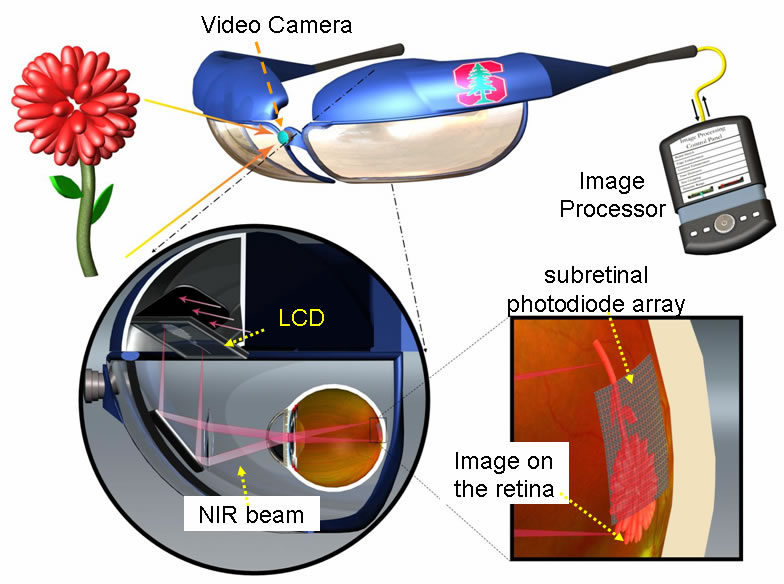
It is common knowledge that bionic eyes receive power from batteries. The existing technology and setup when it comes to bionic eyes dictate the use of wires and battery. However, scientists at Stanford University have invented a new subretinal implant that provides power through infra red beams and electrically stimulates neurons.

Various age related problems such as macular degeneration and retinal pigmentosa cause the death of cells which detect light in the eye. Ultimately, this leads to blindness.

image explaining the pair of glasses with a vieo camera that sends infrared beams to the chipIn modern days, retinal implants have given the ability to some patients to see again. However, the chip that is installed behind the retina requires power from a battery that's installed behind the ear, and wires that connect the two. The implant invented by scientists at Stanford has eliminated the need to have this complex wiring arrangement. The new setup requires the user to wear a pair of glasses that is fitted with a camera. The camera records everything and sends infrared beams to the chip behind the retina. This in turn creates electrical signals which is then passed on to the nerves, ultimately allowing the person to detect motion, perceive light, and identify basic shapes.

Since the chip is very thin, and the setup is totally wireless, the surgery required is very simple. This implant has not been tested on humans yet. However, it has been successfully tested on rats.

Hit the source links to read more about the wireless bionic eye. If you want more technical details, you would want to read the Stanford University source link.

Source: Stanford, BBC via Engadget


Senin, 16 April 2012

Bionic Eye Research at Monash University


microchip for bionic eye
Microchip for the bionic eye (source: Monash)

Researchers at Monash University, who have been working on a project to deliver a direct to eye bionic eye implant by 2014, have started testing the microchip that will power the bionic eye. So far, the results have been very good, which means that the project is on the right track.

The bionic eye would mainly consist of three parts - a camera that would be mounted on a pair of glasses (retina), a pocket processor that takes all the information from the camera and converts it into signals that could be understood by the brain, and cortical implants consisting of several tiles which will stimulate the visual cortex (the part of the brain that processes signals from the eyes). Each of these tiles will have tiny microchips which are currently being tested.

The aim of the researchers is to create something that is the equivalent of a seeing-eye dog or a white cane. Initially, the bionic eye would complement them, but eventually will replace them.

Pre clinical assessments for this bionic eye would start soon.

Watch the following video to understand how a bionic eye works. This video is not related to the research being done at Monash, but gives a good overview of what researchers who work on such projects try to achieve.


Source: Monash
Mas Kur. Diberdayakan oleh Blogger.

 
biz.